The Ancestor Hunt regularly adds and updates new collection links, as well as searches for and fixes broken links.
(This page's most recent update is May 2026)
Practical solutions for real genealogy research problems. Explore the new Field Guides
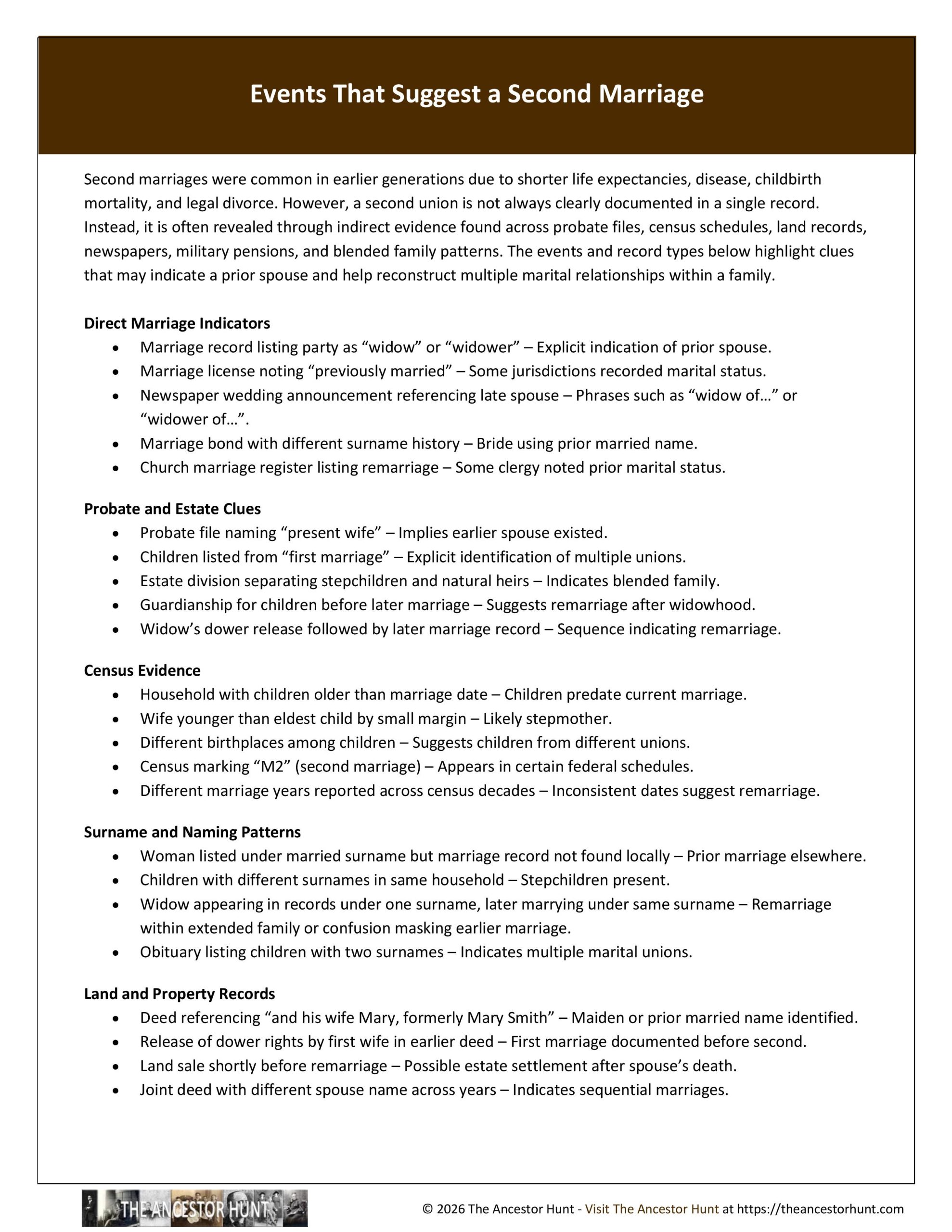
Second marriages were common in earlier generations due to shorter life expectancies, disease, childbirth mortality, and legal divorce. However, a second union is not always clearly documented in a single record. Instead, it is often revealed through indirect evidence found across probate files, census schedules, land records, newspapers, military pensions, and blended family patterns. The events and record types below highlight clues that may indicate a prior spouse and help reconstruct multiple marital relationships within a family.
Direct Marriage Indicators
- Marriage record listing party as “widow” or “widower” – Explicit indication of prior spouse.
- Marriage license noting “previously married” – Some jurisdictions recorded marital status.
- Newspaper wedding announcement referencing late spouse – Phrases such as “widow of…” or “widower of…”.
- Marriage bond with different surname history – Bride using prior married name.
- Church marriage register listing remarriage – Some clergy noted prior marital status.
Probate and Estate Clues
- Probate file naming “present wife” – Implies earlier spouse existed.
- Children listed from “first marriage” – Explicit identification of multiple unions.
- Estate division separating stepchildren and natural heirs – Indicates blended family.
- Guardianship for children before later marriage – Suggests remarriage after widowhood.
- Widow’s dower release followed by later marriage record – Sequence indicating remarriage.
Census Evidence
- Household with children older than marriage date – Children predate current marriage.
- Wife younger than eldest child by small margin – Likely stepmother.
- Different birthplaces among children – Suggests children from different unions.
- Census marking “M2” (second marriage) – Appears in certain federal schedules.
- Different marriage years reported across census decades – Inconsistent dates suggest remarriage.
Surname and Naming Patterns
- Woman listed under married surname but marriage record not found locally – Prior marriage elsewhere.
- Children with different surnames in same household – Stepchildren present.
- Widow appearing in records under one surname, later marrying under same surname – Remarriage within extended family or confusion masking earlier marriage.
- Obituary listing children with two surnames – Indicates multiple marital unions.
Land and Property Records
- Deed referencing “and his wife Mary, formerly Mary Smith” – Maiden or prior married name identified.
- Release of dower rights by first wife in earlier deed – First marriage documented before second.
- Land sale shortly before remarriage – Possible estate settlement after spouse’s death.
- Joint deed with different spouse name across years – Indicates sequential marriages.
Church and Religious Records
- Burial record for first spouse followed by marriage entry – Chronological confirmation.
- Church discipline records referencing adultery or abandonment – May precede remarriage.
- Membership transfer under different married name – Change reflects remarriage.
- Baptism records listing different mothers for siblings – Evidence of multiple marriages.
Military and Pension Files
- Pension file naming “first wife” and “second wife” – Especially common in Civil War pensions.
- Widow’s pension application replaced by new claimant – Indicates remarriage terminated benefits.
- Service record beneficiary change – Suggests new spouse.
- Military headstone application listing remarried widow – Confirms subsequent marriage.
Newspaper Notices
- Obituary for first spouse followed by remarriage announcement – Sequential documentation.
- Legal notice of divorce prior to new marriage – Public record of marital change.
- Social column referencing “Mrs. Brown, formerly Mrs. Jones” – Indicates remarriage.
- Court notice involving alimony termination – May signal remarriage.
- Anniversary notice with different marriage year than earlier records – Suggests second union.
Divorce Indicators
- Court docket showing divorce decree before new marriage date – Legal termination preceding remarriage.
- Newspaper publication of divorce summons – Public notice requirement in many states.
- Restoration of maiden name in divorce decree – Precedes new marriage record.
- Alimony modification following remarriage – Financial record clue.
Blended Family Evidence
- Probate naming half-siblings – Explicit evidence of multiple marriages.
- Stepchild mentioned in will – Confirms remarriage.
- Guardianship involving children of deceased spouse – Precedes new marriage.
- Census showing “stepdaughter” or “stepson” – Direct enumeration clue.
- Different inheritance shares among children – Reflects separate maternal lines.
Community and Social Clues
- Church seating reassigned after spouse’s death – Followed by new listing with second spouse.
- City directory listing man alone, then with new wife – Sequential marital status change.
- Widow taxed independently before later marriage – Property status change.
- Insurance beneficiary update – Suggests new marital relationship.
- Court approval for minor to marry widower – Indicates prior marriage.
Download the Quicksheet PDF
To obtain the Quicksheet PDF of this information, download it by clicking on the Download button below:
For all the previously published Quick Reference Guides, click on QuickSheets.
If you use Quicksheets often, the Quicksheet Vault puts 450+ of them in one organized place — clean, printable, and easy to reuse whenever you need them. Whether you keep digital references handy or build your own genealogy binder, the Vault makes research simpler. Learn more about the Quicksheet Vault HERE