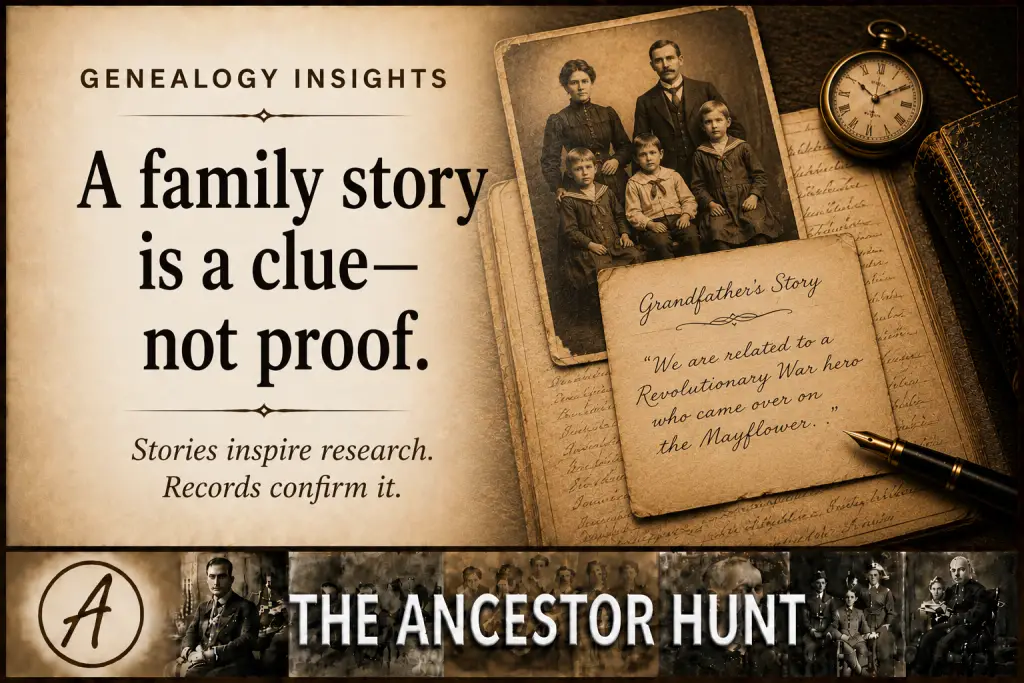
Family stories often point you in the right direction—but records determine whether the story is true.
The Insight
Many genealogy journeys begin with a story passed down through generations. A grandparent mentions a Revolutionary War ancestor. An aunt recalls Native American heritage. A family Bible references an immigrant who arrived under dramatic circumstances. These stories spark curiosity and often inspire the search for more information.
Family stories are valuable because they preserve memories that might otherwise be lost. They provide names, places, relationships, and events that can serve as starting points for research. In many cases, a family story contains a core truth that has survived for decades or even centuries.
The challenge is that stories evolve over time. Details are forgotten. Names become confused. Timelines are compressed. Separate events become combined into a single narrative. With each retelling, small changes can accumulate until the story differs significantly from the original events.
Successful genealogists understand that family stories are not evidence. They are clues. The story itself may be accurate, partially accurate, or entirely mistaken. Only records can determine where the truth begins and where family tradition has filled in the gaps.
Why It Matters
- Family stories often contain valuable research leads.
- A story may preserve information that does not appear in readily available records.
- Long-held family beliefs can sometimes lead research in the wrong direction.
- Assumptions based on family lore can cause researchers to overlook contradictory evidence.
- Verifying stories often leads to discoveries that are more interesting than the original tale.
What To Look For
- Specific names, places, dates, and relationships mentioned in the story.
- Repeated details that appear consistently among different family members.
- Events that can be tested against historical records.
- Timeline inconsistencies that suggest portions of the story may have changed over time.
- Family claims involving famous individuals, military service, royalty, or historic events.
- Stories that have grown more dramatic with each generation.
Research Action
Record family stories exactly as they are told before attempting to verify them. Preserve the wording, identify who shared the information, and note when it was recorded. Then separate the story into individual claims and investigate each one using records, newspapers, vital records, military records, land records, and other available sources.
Treat every family story as a research hypothesis. The goal is not to prove the story correct, but to discover what the evidence reveals.
Key Takeaway
A family story should never be dismissed, but it should never be accepted without verification. Family legends often contain valuable clues, hidden truths, and important leads. The story may begin the journey, but the records tell the final story.
The Genealogy Insights Field Guides
Discover all 30 Genealogy Insights in the Field Guides Collection