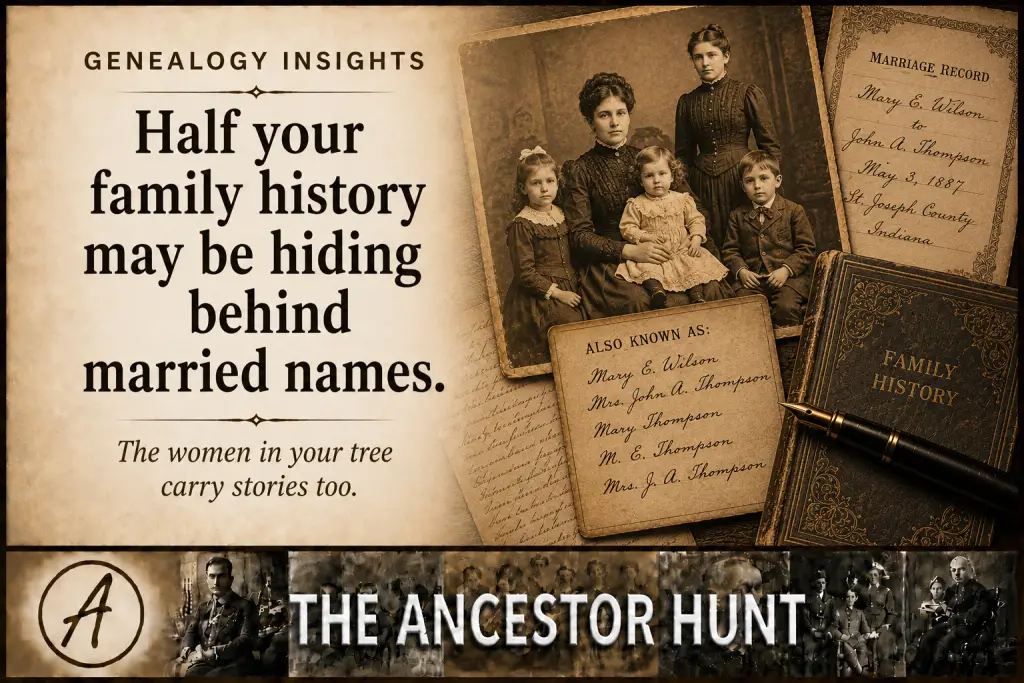
When female ancestors disappear from your research, entire branches of the family tree can disappear with them.
The Insight
Many genealogists unintentionally spend more time researching male ancestors because surnames are easier to follow through historical records. Family trees often grow outward from a familiar surname, making it easy to overlook the women whose names changed through marriage and whose identities were recorded differently throughout their lives.
Yet women often served as the connections that held families, communities, and migration networks together. Their names appear in obituaries, church records, probate files, witness lists, social columns, school records, and newspaper articles that may never appear under the primary surname being researched.
The challenge is that historical records frequently recorded women differently at different stages of life. A woman may appear as a daughter under her father’s surname, a bride under both maiden and married names, a wife under her husband’s name, or a widow under yet another variation. Researchers who focus only on one surname often miss valuable clues that exist elsewhere in the record trail.
Some of the most important discoveries in genealogy occur when researchers deliberately follow female ancestors through every stage of life and across every name by which they may have been known.
Why It Matters
- Female ancestors often provide connections to entire branches of a family.
- Maiden names can unlock previous generations that would otherwise remain hidden.
- Women’s records frequently reveal migration patterns, community ties, and family relationships.
- Important evidence may appear only under a married name or only under a maiden name.
- Ignoring female ancestors can create major gaps in a family history.
What To Look For
- Marriage records that identify maiden names.
- Obituaries listing daughters, sisters, mothers, and other female relatives.
- Witnesses and sponsors in church records.
- Probate records naming married daughters.
- Newspaper social columns that mention women by both maiden and married names.
- Family members appearing in records under unexpected surname variations.
Research Action
Create a timeline for female ancestors just as you would for male ancestors. Track every known name, including maiden names, married names, nicknames, initials, and widow references. Search newspapers, church records, probate files, and local records using each variation.
When researching a family, make a deliberate effort to ask:
“What records might exist under the women’s names?”
The answer often leads to discoveries that would never be found through surname research alone.
Key Takeaway
Female ancestors are often the bridge between generations, families, and communities. When researchers look beyond a single surname and follow women through every stage of life, they frequently uncover some of the richest clues in their family history.
The Genealogy Insights Field Guides
Discover all 30 Genealogy Insights in the Field Guides Collection