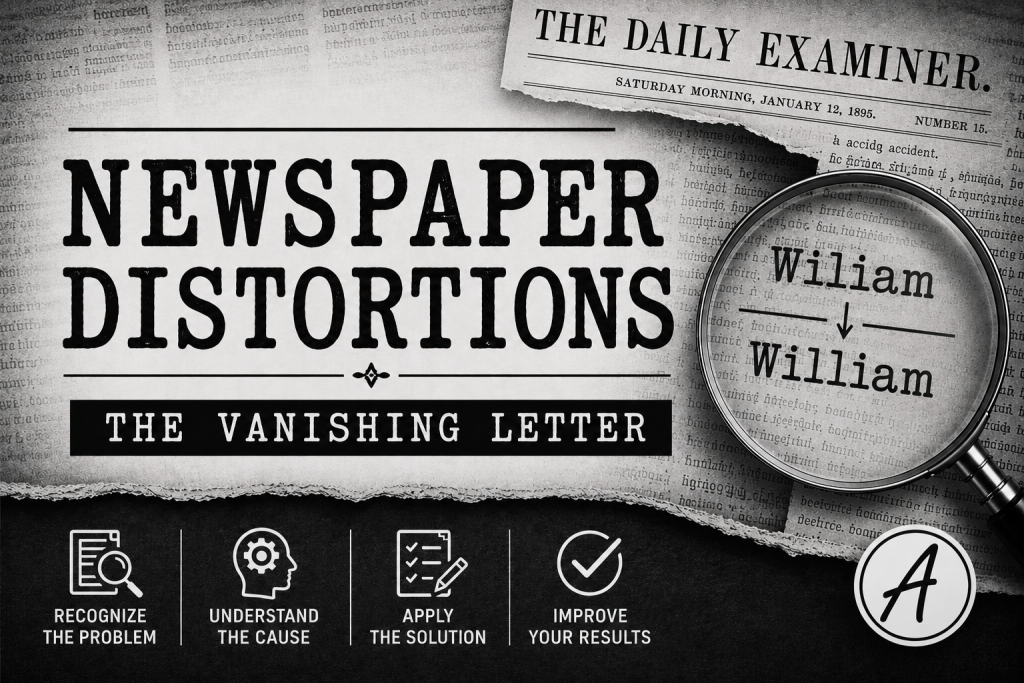
A missing letter may seem insignificant, but in newspaper research it can completely derail a search. Printing defects, worn type, uneven inking, and aging newspaper pages often cause individual letters to disappear or become unreadable. When OCR encounters these damaged names, it frequently indexes them incorrectly, making otherwise valuable articles impossible to find through standard searches.
Distortion Type
Dropped or Blurred Letters
Why it Happens
Broken or worn type, poor inking, or press slippage.
Why it Matters
A single missing letter—“Thompson” vs. “Thomson,” “Braunhart” vs. “Brauhart”—creates a name the database no longer recognizes. To OCR, these are different words.
Search Strategies
- Use wildcards: Thom*on, Braun*.
- Try phonetic searches (Soundex, Daitch–Mokotoff).
- Pair a short name stem with context words (“Braun” + “San Francisco”).
- If OCR fails, browse page images manually around the known date.
Example
An obituary for John Thompson is printed with a weak impression that causes the letter “p” to disappear. The OCR interprets the surname as “Thomson” and indexes it that way. A search for John Thompson produces no results, while a wildcard search for Thom*on quickly uncovers the article and several related family notices.
Key Takeaway
One missing letter can hide an entire family from your search results. When a name suddenly disappears, search for what remains—not just what is missing.
The Newspaper Distortions Field Guides
Discover all 25 Newspaper Distortions, companion Field Notes, videos, and audio lessons in the Field Guides Collection