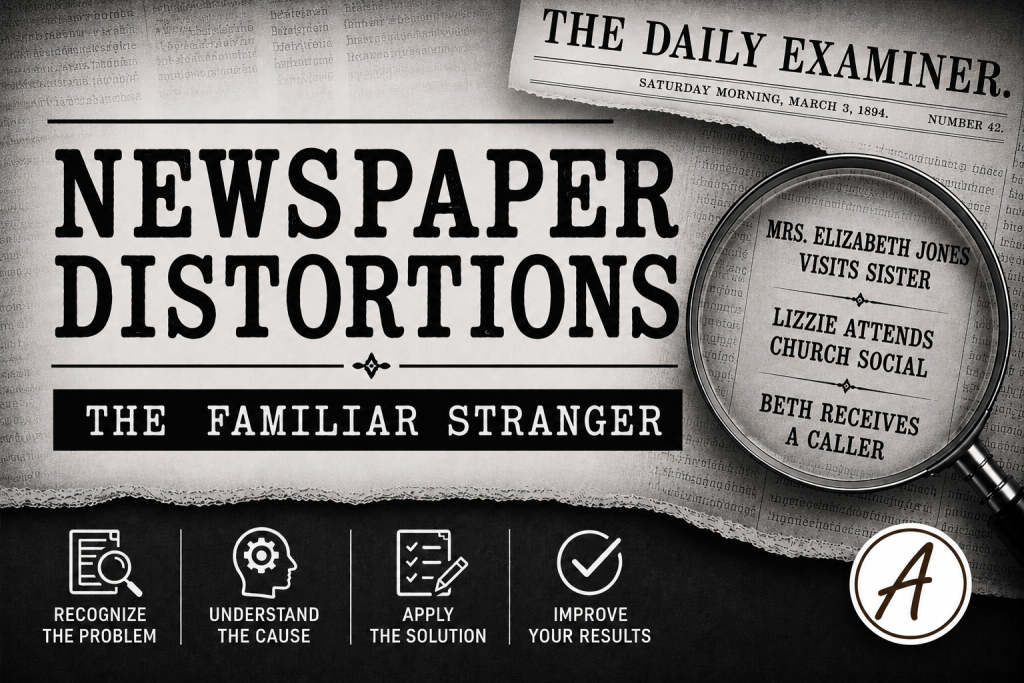
Newspapers often reflected the names people used in everyday life rather than the formal names found in official records. Reporters routinely printed nicknames, pet names, and familiar forms that were widely recognized within a community. As a result, researchers searching only for formal names may completely overlook newspaper references to the very people they seek.
Distortion Type
Nicknames and Pet Names
Why it Happens
Reporters wrote as people spoke; friends and family used informal names.
Why it Matters
“Lizzie” rarely appears as “Elizabeth,” “Bill” for “William,” “Polly” for “Mary.” Entire families can vanish between census and newspaper if nicknames weren’t searched.
Search Strategies
- Combine formal + informal forms: (Elizabeth OR Lizzie).
- Consult nickname lists by region or era.
- Add surname + town to keep focus.
- In society columns, verify relationships by context, not just by name.
Example
A researcher searches for Elizabeth Carter in local newspapers but finds no mention of her wedding or social activities. A broader search reveals that she was consistently referred to as “Lizzie Carter” in society columns and community news. By searching both formal and informal name variations, the researcher uncovers dozens of references that would otherwise have remained hidden.
Key Takeaway
Newspapers often recorded the name people used, not the name that appeared on official documents. If you search only for formal names, you may miss the person entirely.
The Newspaper Distortions Field Guides
Discover all 25 Newspaper Distortions, companion Field Notes, videos, and audio lessons in the Field Guides Collection