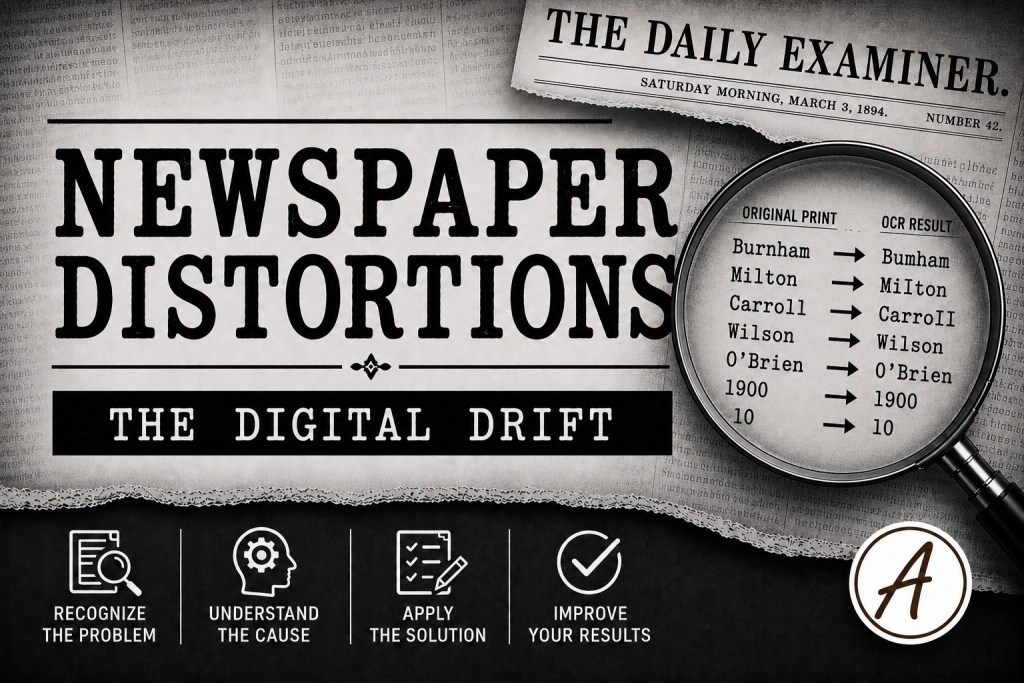
One of the most common distortions in modern newspaper research never appeared in the original newspaper at all. It was created during digitization. Optical Character Recognition (OCR) software attempts to convert scanned newspaper images into searchable text, but historic fonts, faded ink, damaged pages, and unusual typefaces often confuse the software. Characters that look similar to the human eye—such as rn and m, l and I, or O and 0—may be interpreted incorrectly. The result is a digital version of the article that differs from what was actually printed, creating hidden obstacles for researchers who rely solely on keyword searches.
Distortion Type
OCR Confusion and Character Substitution
Why it Happens
OCR misreads similar characters (rn ↔ m, l ↔ I, O ↔ 0).
Why it Matters
A name like “Burnham” might digitize as “Bumham.” Indexes multiply false versions, scattering results.
Search Strategies
- Substitute likely letter swaps manually.
- Use truncated or partial-name wildcards (“Burham,” “Bmham”).
- Re-check in another database—different OCR engines fail differently.
Example
A researcher searches extensively for references to the Burnham family in a digitized newspaper collection but finds only a handful of results. While browsing a newspaper page manually, they discover an article that clearly mentions Burnham, yet the OCR transcription has recorded the surname as Bumham. In another issue, Milton appears as MiIton, with a capital I substituted for a lowercase l. Because the database indexes the OCR text rather than the image itself, searches for the correct spelling fail to locate these articles. By testing likely OCR substitutions and searching for shortened name fragments, the researcher uncovers multiple records that had been hidden by digital character confusion.
Key Takeaway
OCR doesn’t read words—it interprets shapes. When the shapes are wrong, your ancestor may disappear behind a completely different name.
The Newspaper Distortions Field Guides
Discover all 25 Newspaper Distortions, companion Field Notes, videos, and audio lessons in the Field Guides Collection