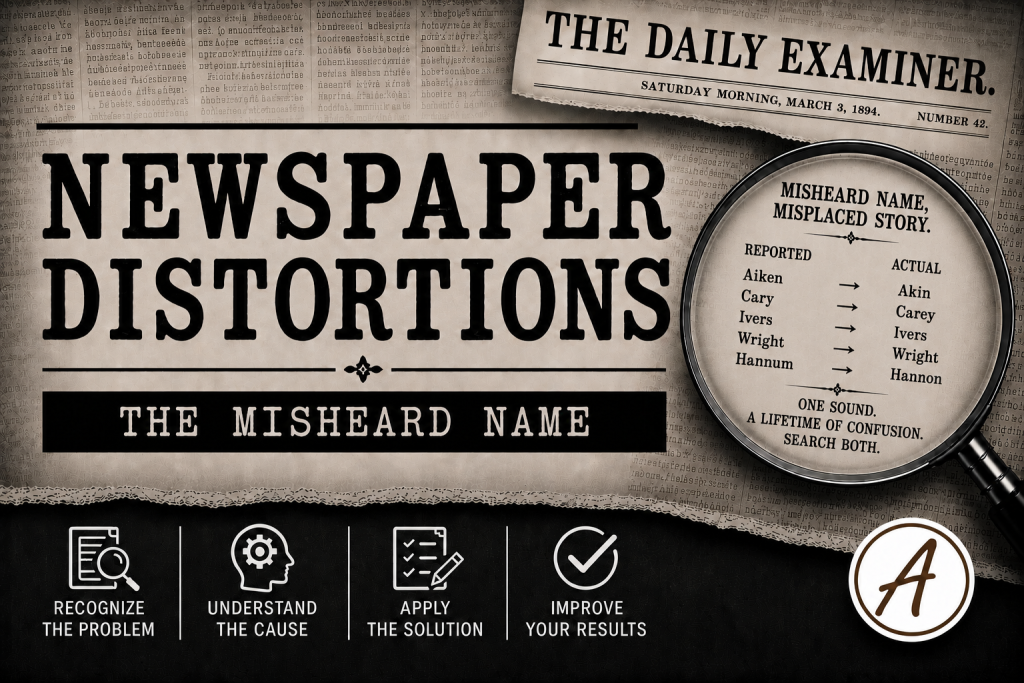
Newspapers were created in a fast-moving environment where information often passed through several hands before reaching print. A reporter might hear a name incorrectly, jot it down hastily in a notebook, and later hand the notes to a typesetter who had never met the person involved. The result was often a perfectly understandable—but incorrect—version of a surname. These small changes may seem insignificant, but they can easily separate newspaper references from the records researchers expect to find.
Distortion Type
Reporter Mishearing or Transcription Error
Why it Happens
Handwritten notes → typesetter guesses.
Why it Matters
“Aiken” becomes “Akin,” “Cary” → “Carey.” Such shifts scatter records.
Search Strategies
- Use wildcard stems (Ai*, Ak*, Car*).
- Search first-name + event rather than surname alone.
- Compare with civil or church record spellings.
Example
A researcher searches for newspaper references to the Aiken family and finds only a handful of results despite extensive documentation placing them in the community. A broader search uncovers numerous articles referring to the family as Akin, including marriage notices, social items, and a probate announcement. Examination of church records confirms that the family’s correct surname was Aiken, but the local newspaper consistently used the simplified spelling. By searching both forms, the researcher discovers records that would otherwise have remained hidden.
Key Takeaway
Newspapers often recorded what reporters thought they heard, not necessarily what was correct. A single misheard syllable can scatter a family’s records across multiple spellings.
The Newspaper Distortions Field Guides
Discover all 25 Newspaper Distortions, companion Field Notes, videos, and audio lessons in the Field Guides Collection