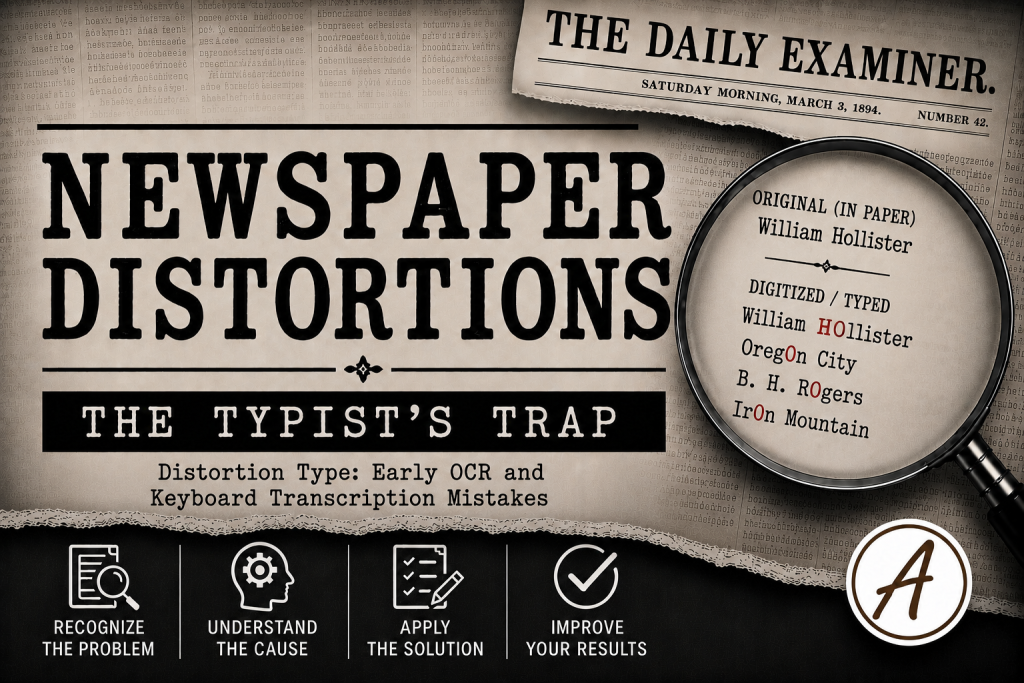
As newspapers moved from paper archives to digital databases, many collections relied on human operators to manually rekey articles, indexes, and metadata. While this process made newspapers searchable, it also introduced a new layer of errors. Characters that looked similar on a screen or in a faded original document were often entered incorrectly, creating mistakes that had never existed in the printed newspaper itself. These transcription errors can still affect searches decades after digitization was completed.
Distortion Type
Early OCR and Keyboard Transcription Mistakes
Why it Happens
Human retyping during digitization introduced new errors.
Why it Matters
Manual rekeying swapped letters (O ↔ 0, I ↔ l). These propagate into every search.
Search Strategies
- Try letter-swap patterns (B↔H, rn↔m).
- Search both capital and lowercase variations.
- When nothing appears, browse images manually.
Example
A researcher searches for William Hollister in a digitized newspaper collection but finds no references despite knowing that his obituary was published there. After experimenting with alternate spellings, the researcher discovers that the name had been manually entered as William H0llister, with the letter O replaced by the numeral 0 during the digitization process. In other cases, a lowercase l may be mistaken for a capital I, or the letter combination rn may be interpreted as m. By testing likely character substitutions and reviewing the original page image, the researcher uncovers records that standard searches failed to find.
Key Takeaway
Digitization made newspapers searchable, but it also introduced new mistakes. Sometimes the error wasn’t made by the newspaper—it was made decades later when someone typed it into a database.
The Newspaper Distortions Field Guides
Discover all 25 Newspaper Distortions, companion Field Notes, videos, and audio lessons in the Field Guides Collection