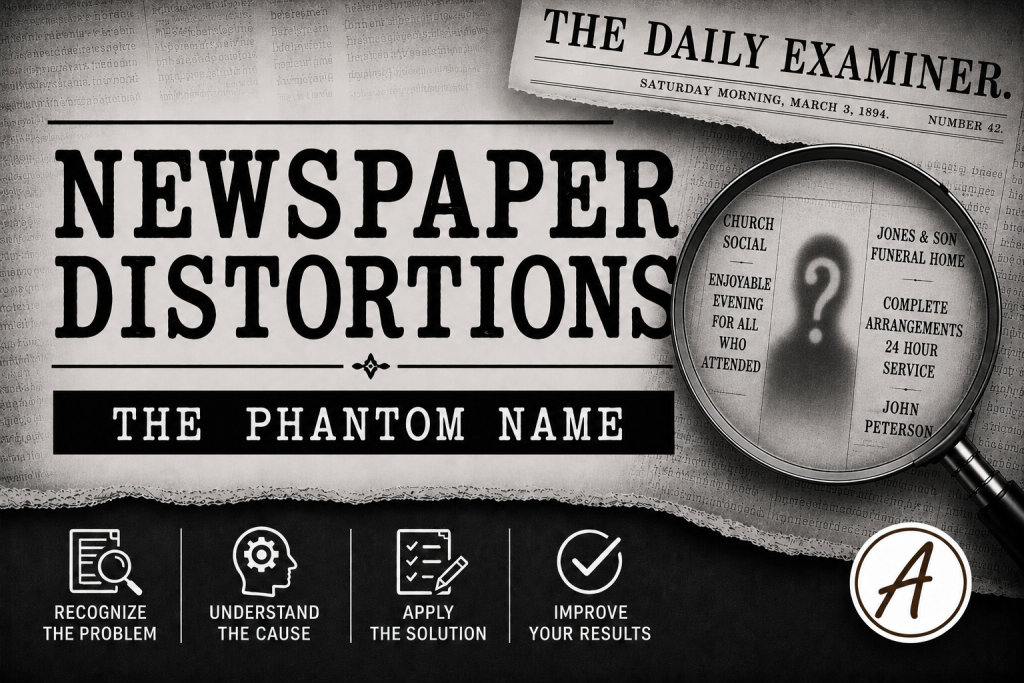
In digitized newspapers, text doesn’t always stay in its proper place. When columns are close together—or when there are borders, rules, or advertisements—OCR software can mistakenly pull words from a neighboring column or ad and attach them to the wrong article. This creates “phantom” names: people who appear in a story but who were never actually mentioned there. The name is real, but the context is false. Researchers who rely only on search results may unknowingly attach an ancestor to an event, organization, or incident in which they never participated.
Distortion Type
Misplaced Text from Adjoining Columns
Why it Happens
OCR merges nearby ads or neighboring stories.
Why it Matters
A “John Peterson” may appear where he doesn’t belong, attached to a funeral home or unrelated event.
Search Strategies
- Verify names by content—does the story context fit the person?
- Cross-reference with date and event type.
- If a result seems improbable, inspect its image to confirm column integrity.
Example
A researcher finds a digitized article reporting a church social and sees the sentence: “John Peterson thanked everyone for attending the event.” Excited by the discovery, the researcher assumes this is their ancestor. However, when viewing the original newspaper image, it becomes clear that John Peterson was actually mentioned in a funeral home advertisement located in the adjoining column. During digitization, the OCR software merged text from the advertisement with the church article, creating a false association. Had the researcher relied solely on the OCR transcription, they might have incorrectly concluded that John Peterson played a prominent role in the event.
Key Takeaway
Not every name belongs to the story where it appears. Sometimes OCR borrows a name from next door. Always verify the context on the original newspaper page.
The Newspaper Distortions Field Guides
Discover all 25 Newspaper Distortions, companion Field Notes, videos, and audio lessons in the Field Guides Collection