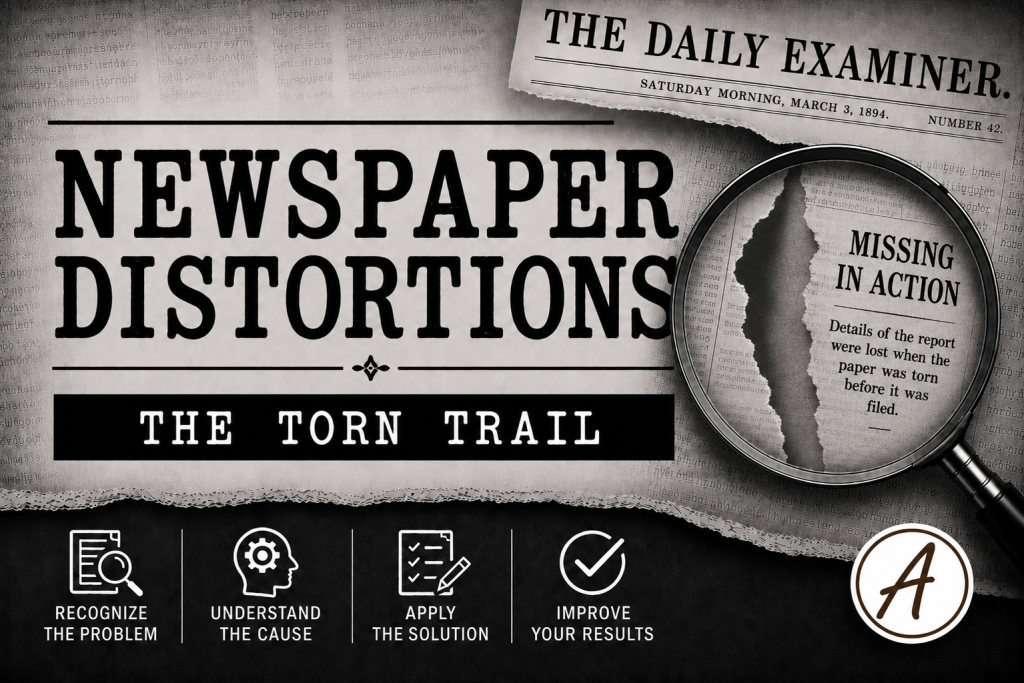
Historical newspapers have survived wars, floods, fires, careless handling, and the simple wear of time. Along the way, many pages suffered tears, missing corners, torn edges, and physical damage that permanently removed portions of the printed text. When these damaged newspapers were later microfilmed and digitized, the missing sections became part of the historical record. Unfortunately, the lost text often includes exactly the information genealogists need most—names, dates, locations, and membership lists. A single missing corner can remove the crucial detail that identifies an ancestor.
Distortion Type
Tears, Chips, and Missing Corners
Why it Happens
Binding wear or damaged microfilm.
Why it Matters
Missing corners remove final letters or parts of lists—especially passenger or membership rosters.
Search Strategies
- Cross-check later issues; lists were often republished.
- Look for reprints in neighboring newspapers.
- If an article ends mid-line, locate continuation on the next page.
Example
A researcher discovers a newspaper article listing passengers departing on a local excursion train. The surname they are seeking appears near the bottom corner of the page, but the newspaper has a torn section that removes the final letters of several names. What remains is only “John Pet…” with the rest of the surname missing. In another issue, a membership roster published by a fraternal organization is missing an entire corner of the page, eliminating dozens of names from the list. By searching neighboring newspapers and reviewing later editions, the researcher eventually finds a reprinted version of the same list with the missing information intact.
Key Takeaway
Sometimes the record exists and the newspaper survives—but the critical piece of information is literally missing. When a page is damaged, finding another copy may be the only way to recover the lost clue.
The Newspaper Distortions Field Guides
Discover all 25 Newspaper Distortions, companion Field Notes, videos, and audio lessons in the Field Guides Collection