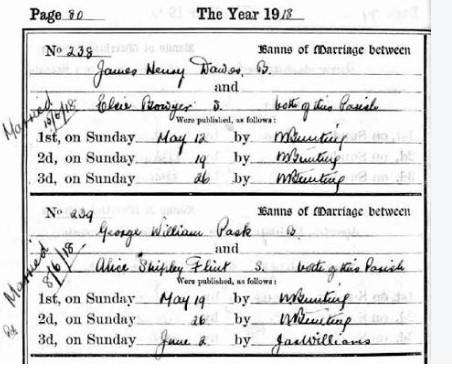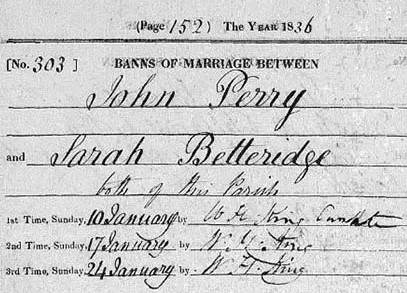
Before there was a marriage certificate, there might have been three public announcements telling an entire congregation that a marriage was about to take place. Those announcements—the marriage banns—may survive even when the marriage record you are searching for does not.
Introduction
Marriage banns were public announcements of an intended marriage, traditionally made in a church before the wedding. Their purpose was straightforward: to give members of the community an opportunity to reveal a legal or religious reason why the couple should not marry.
For genealogists, banns can be much more than a quaint marriage custom. They may identify an intended spouse, establish where one or both parties were living, point to the churches or parishes connected with them, and sometimes provide evidence of a planned marriage that never actually occurred.
Most importantly, a banns record is not the same thing as a marriage record.
Why Were Marriage Banns Published?
The basic purpose of banns was to make the proposed marriage public before it occurred. If someone knew of an impediment—such as an existing marriage, a prohibited degree of relationship, or another legal or ecclesiastical obstacle—there was an opportunity to object before the ceremony.
In the Church of England tradition, banns commonly were announced on three successive Sundays before the wedding. FamilySearch’s description of its Glamorgan parish-register collection similarly notes that banns were posted for three consecutive weeks in the parish church so members of the congregation could raise objections.
Marriage by license provided an alternative in many circumstances, so a researcher should not assume that every church marriage was preceded by banns.
What Might a Banns Record Contain?
The information varies considerably by period, denomination, and location, but a banns entry may include:
- Names of the prospective bride and groom
- Their parishes or places of residence
- Dates on which the banns were announced
- Marital status, such as bachelor, spinster, or widow/widower
- Occasionally occupations or other identifying information
- An indication that one party belonged to another parish
Even a very brief entry can be useful. A reference to another parish, for example, can give the researcher a new location in which to search for baptisms, family members, residences, or other records.
Look in More Than One Parish
This is one of the more useful features of banns for genealogists.
If the prospective bride and groom lived in different parishes, banns could be required in both places. That means two banns records might exist for the same intended marriage.
Finding one should therefore sometimes trigger another search: Where was the other person living, and do banns survive for that parish as well?
The second record could contain information omitted from the first.
Banns Do Not Prove That a Marriage Occurred
This is probably the most important research caution.
Banns document an intention to marry. They do not necessarily document the marriage itself. FamilySearch specifically cautions researchers that the existence of marriage banns does not definitively prove that the couple married.
Plans changed. Weddings could be postponed or cancelled. An impediment might have been discovered. One party might have died.
Therefore, when you find banns, continue looking for the marriage itself—a marriage register entry, certificate, license, newspaper notice, or other evidence that the ceremony actually occurred.
Conversely, finding banns without finding a subsequent marriage can itself become an interesting clue.
Where Might You Find Marriage Banns?
Banns frequently survive among church and parish records rather than in civil vital-record collections. They may appear in a dedicated banns register, in a combined marriage-and-banns register, or among other parish books.
They are easy to overlook because databases and catalogs may place them within broader collections labeled simply Church Records, Parish Registers, or Marriages.
For example, FamilySearch’s catalog separately identifies banns registers for numerous English parishes. Its Lawley, Shropshire holdings include a dedicated Parish Register of Marriage Banns, 1867–1899, while its Dickleburgh, Norfolk holdings identify banns covering several different periods alongside the parish’s marriage registers.
That makes the catalog description worth checking even when a database search produces nothing.
Key Takeaways
- Marriage banns announced a couple’s intention to marry before the ceremony.
- They were intended to expose possible legal or religious impediments to the marriage.
- In the Church of England tradition, banns commonly were announced on three successive Sundays.
- Banns may identify names, residences, parishes, marital status, and other useful details.
- If the couple lived in different parishes, look for banns records in both places.
- Banns can survive separately from the eventual marriage record.
- Finding banns proves an intention to marry—not that the marriage actually occurred.
- Search church and parish collections and examine catalog descriptions rather than relying exclusively on name searches.
Examples