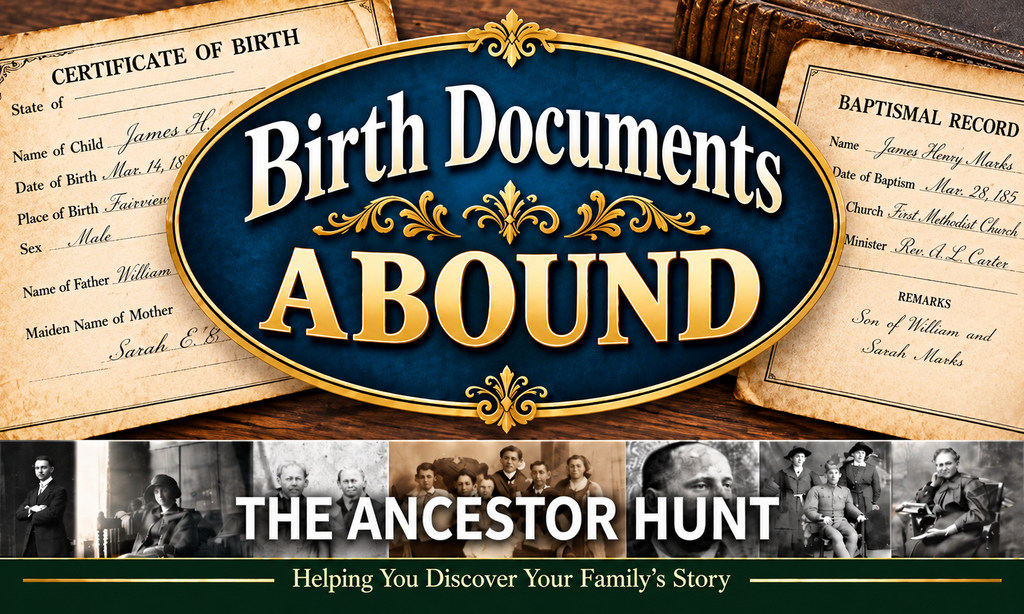
Before governments routinely recorded births, churches often maintained the only surviving records of a child’s early life. A church baptism register may reveal an ancestor’s parents, birthplace, family residence, and even relatives or friends who served as godparents.
Introduction
Church baptism registers are among the most valuable historical sources for genealogists researching ancestors born before civil birth registration became widespread. In many communities, churches recorded baptisms long before local or state governments maintained systematic birth records.
These registers can provide important information about a child’s identity, parents, family relationships, and religious community. Depending on the denomination, location, and historical period, they may also identify godparents, sponsors, witnesses, family residences, and occasionally the child’s actual birth date.
For genealogists researching the 17th, 18th, and 19th centuries, church baptism registers may provide the earliest surviving documentation of an ancestor’s life. They can also help reconstruct families, identify previously unknown siblings, and connect generations when civil records are missing.
Understanding how baptism registers were created, what information they contain, and where to find them can open valuable new avenues for family history research.
What Is a Church Baptism Register?
A church baptism register is a record book or collection of entries maintained by a religious congregation, parish, or other church authority to document baptisms.
Baptism is a religious ceremony practiced by many Christian denominations. Its meaning, timing, and procedures vary according to religious tradition.
In churches that practice infant baptism, the ceremony commonly occurred during infancy, sometimes shortly after birth. Other denominations practice baptism later in childhood or adulthood, often following a personal profession of faith.
Church baptism registers were maintained by religious organizations such as:
- Roman Catholic parishes
- Anglican and Episcopal churches
- Lutheran congregations
- Reformed and Presbyterian churches
- Methodist congregations
- Eastern Orthodox churches
- Other Christian denominations that practiced and recorded baptisms
Some registers were maintained continuously for centuries, while others survive only for limited periods.
A baptism register usually contains entries for many individuals, often arranged chronologically by baptism date.
Unlike a baptism certificate issued for an individual, the register is generally the ongoing record maintained by the church.
An important distinction: A baptism date is not necessarily a birth date. Depending on the religious tradition, a person may have been baptized days, months, or many years after birth.
What Information Can Church Baptism Registers Contain?
The information recorded varies considerably by denomination, location, historical period, and the practices of individual clergy.
Common entries may include:
- Child’s name: Given name, surname, or both.
- Date of baptism: The date the religious ceremony occurred.
- Date of birth: Sometimes recorded separately from the baptism date.
- Place of birth: Town, village, parish, or other location.
- Father’s name: Occasionally including occupation or residence.
- Mother’s name: Sometimes including her maiden surname.
- Parents’ residence: The family’s village, town, or street address.
- Godparents or sponsors: Individuals who participated in or witnessed the baptism.
- Minister or priest: The person who performed the ceremony.
- Church or parish: The congregation where the baptism occurred.
- Legitimacy notation: Some registers recorded whether a child’s parents were married.
- Additional remarks: Occasionally including family circumstances, unusual events, or later annotations.
Some early registers contain only the child’s name, father’s name, and baptism date.
Others provide extensive family information, including both parents’ names, mother’s maiden surname, birth date, residence, and godparents.
Researchers should examine the entire entry and understand the register’s column headings, abbreviations, and terminology.
Genealogical Clues Church Baptism Registers Can Reveal
Identifying Parents and Earlier Generations
One of the most important genealogical uses of baptism registers is identifying a child’s parents.
Some entries include the mother’s maiden surname, which can provide a valuable connection to an earlier family line.
Even when only the father’s name appears, baptism entries may help establish family relationships when compared with other records.
Discovering Godparents and Sponsors
Godparents and baptismal sponsors can provide important clues about extended family relationships and community connections.
In some religious traditions and communities, godparents were frequently relatives, although friends and other members of the congregation also served in these roles.
A sponsor sharing the mother’s maiden surname might suggest a maternal relative worth investigating.
However, a godparent or sponsor should never be assumed to be a relative without supporting evidence.
Reconstructing Families
Church baptism registers often contain multiple entries for children born to the same parents.
Searching across several years may reveal siblings who were previously unknown.
This is particularly valuable for identifying children who died young and never appeared in later census records.
Comparing baptism entries can also help establish family naming patterns and approximate intervals between births.
Establishing Family Residences
Some baptism registers identify the family’s residence at the time of the ceremony.
This information can help locate ancestors in census records, land records, tax lists, and other local sources.
When several children were baptized in different parishes, the records may provide evidence of family migration.
Identifying Religious Affiliations
A baptism entry establishes a connection to a particular religious congregation or tradition at the time of the ceremony.
This information may lead researchers to additional church records, including marriages, burials, confirmations, membership lists, and other religious documents.
However, the baptism of a child does not necessarily establish the lifelong religious affiliation of the child or parents.
Discovering Birth Dates Before Civil Registration
Some baptism registers recorded both the date of birth and the date of baptism.
When civil birth certificates are unavailable, these entries may provide valuable contemporary evidence of an ancestor’s birth.
Even when only the baptism date survives, it may help narrow the likely birth period, particularly in communities where infant baptism was customary.
The interval between birth and baptism should not be assumed without evidence of local practices.
Identifying Family Circumstances
Some registers include notations concerning children born outside marriage, foundlings, or other circumstances.
These entries may provide clues about parentage or explain why a child’s surname differs from that used in later records.
Such information should be interpreted carefully within its historical and religious context.
Historical Development of Church Baptism Registers
Early Parish Registration
Churches maintained baptism records long before modern civil birth registration systems developed.
In England, parish registration was ordered in 1538, although surviving registers and the completeness of their entries vary considerably.
In many European countries, Catholic and Protestant churches maintained baptism registers beginning in the 16th century or earlier in some locations.
These records became essential sources for documenting births and family relationships.
Colonial American Church Records
During the colonial period, religious congregations maintained baptism records in many American communities.
Catholic, Anglican, Lutheran, Reformed, and other churches documented baptisms according to their religious practices.
The survival and completeness of these records vary by colony, region, denomination, and congregation.
In some communities, baptism registers provide information unavailable in surviving civil records.
Nineteenth-Century Church Records
During the 1800s, churches continued to maintain baptism registers even as local governments gradually expanded civil birth registration.
For immigrant families, church records can be particularly useful because they sometimes preserve original-language names, parents’ backgrounds, and connections within ethnic or religious communities.
Modern Baptism Records
Many churches continue to maintain baptism registers today.
More recent records may be subject to privacy policies or denominational restrictions.
Researchers should contact the relevant congregation or church archive to determine whether historical records are available.
Church Baptism Registers Versus Baptism Certificates
Although closely related, baptism registers and baptism certificates serve different purposes.
A church baptism register is the ongoing record maintained by a congregation or religious authority. It generally contains entries for many individuals.
A baptism certificate is an individual document issued to confirm that a baptism occurred.
A certificate may be prepared at the time of baptism or issued years later from information contained in the register.
The original register may contain details omitted from the certificate, including godparents, additional family information, or handwritten annotations.
Conversely, a later certificate may include subsequent information or official annotations not present in an early transcription of the register.
Whenever possible, genealogists should examine the original register entry or a faithful image of it.
Baptism certificates will be explored separately in another Birth Documents Abound Field Note.
Where to Find Church Baptism Registers
Local Churches and Parishes
The church where the baptism occurred is often the first place to investigate.
Some congregations retain their historical registers, while others have transferred older records to denominational archives.
Contacting the church may help identify the location of surviving records.
Diocesan and Denominational Archives
Many religious organizations maintain archives containing historical baptism registers.
Examples include Catholic diocesan archives, Anglican and Episcopal archives, Lutheran archives, and repositories maintained by other denominations.
Access policies vary considerably.
Genealogy Websites
Digitized baptism registers, indexes, and transcriptions may be available through:
Some collections provide images of original church registers, while others contain only indexed information.
Researchers should review collection descriptions to determine which churches, locations, and years are included.
State and Local Archives
Government archives sometimes preserve church records, particularly when historical registers were transferred, copied, or microfilmed.
Local archives may also hold records from congregations that no longer exist.
Historical and Genealogical Societies
Historical societies and genealogical organizations may maintain church register transcriptions, indexes, or microfilm collections.
These sources can be especially useful when the original congregation has closed.
International Church Archives
For ancestors born outside the United States, parish registers may be preserved in local churches, diocesan archives, regional archives, or national repositories.
Researchers should investigate the recordkeeping practices and archival arrangements of the relevant country and religious denomination.
Research Strategies for Church Baptism Registers
1. Identify the Likely Religious Denomination
Begin by determining the family’s possible religious affiliation.
Marriage records, burial records, obituaries, family traditions, and local histories may provide clues.
If the denomination is unknown, investigate churches serving the community during the relevant period.
2. Determine the Correct Parish or Congregation
The nearest church was not necessarily the one the family attended.
Religious affiliation, language, ethnicity, and transportation routes may have influenced where baptisms occurred.
Search neighboring parishes when the expected register contains no matching entry.
3. Search Beyond the Exact Birth Year
A baptism may have occurred shortly after birth or considerably later.
Expand the search period when necessary, particularly when researching denominations that practiced baptism later in life.
4. Examine Original Register Images
Whenever possible, review the original handwritten register rather than relying solely on an index.
Original entries may contain godparents, residences, annotations, or other information omitted from transcriptions.
5. Search for Siblings
Once an ancestor’s baptism entry is located, search the surrounding years for other children born to the same parents.
This can help reconstruct families and identify previously unknown siblings.
6. Investigate Godparents and Sponsors
Record the names of godparents, sponsors, and witnesses.
Search for these individuals in marriage records, census records, and other church documents.
They may provide clues about relatives, neighbors, and community relationships.
7. Consider Language and Name Variations
Church registers may use Latin, German, French, Spanish, or other languages.
Names may appear in religious or Latinized forms rather than the versions used in later civil records.
For example, Johannes may appear in records for someone later known as John.
Search using alternative spellings and language variations.
8. Compare Birth and Baptism Dates
If both dates are recorded, note them separately.
Do not substitute the baptism date for the birth date.
When only the baptism date is known, identify it accurately in your genealogical records.
9. Examine Other Church Records
A baptism entry may lead to additional records maintained by the same congregation.
Marriage registers, burial registers, confirmation records, and membership records may help establish family relationships and trace an ancestor’s life.
10. Investigate Missing Registers
If a church register cannot be located, determine whether the congregation closed, merged, changed names, or transferred its records.
Diocesan archives, historical societies, and regional repositories may hold surviving copies.
Important Research Considerations
Church baptism registers are valuable historical sources, but they require careful interpretation.
Baptism and birth are different events. A baptism date should not automatically be treated as the child’s birth date.
Not all Christian denominations practiced infant baptism. Some baptized individuals later in childhood or adulthood, making the baptism date less useful for estimating birth.
Registers may be incomplete. Pages may be missing, records may have been damaged, or entries may never have been made.
Names may appear in unfamiliar forms. Latinized names, foreign-language spellings, abbreviations, and clerical variations can complicate searches.
Godparents are not necessarily relatives. Their names provide research clues, not automatic evidence of family relationships.
Some registers contain sensitive historical terminology. Entries concerning legitimacy, parentage, or family circumstances should be interpreted within their historical context.
Later transcriptions may contain errors. Handwritten registers can be difficult to read, and published indexes may omit important details.
Church jurisdictions may have changed. Parish boundaries, congregation names, and denominational affiliations sometimes changed over time.
Researchers should also distinguish between original entries created near the baptism and later copies or compilations.
Whenever possible, information from baptism registers should be compared with civil birth records, census records, marriage records, and other independent sources.
Key Takeaways
- Church baptism registers may provide some of the earliest surviving documentation of an ancestor’s life.
- They are especially valuable for births that occurred before reliable civil registration systems existed.
- Entries may identify parents, residences, godparents, sponsors, and sometimes the actual birth date.
- Searching multiple baptism entries can help reconstruct families and identify previously unknown siblings.
- Godparents and sponsors may provide clues about extended family and community relationships.
- Baptism dates should never automatically be treated as birth dates.
- Original register images may contain valuable information omitted from indexes and transcriptions.
- Church records can lead researchers to additional sources documenting marriages, burials, and family relationships.
Examples
Example 1 – Discovering a Mother’s Maiden Name
A researcher locates an 1820s Catholic baptism entry identifying a child’s parents, including the mother’s maiden surname. The information provides a connection to an earlier family line that was missing from later census and marriage records.
Example 2 – Identifying a Possible Family Connection Through Godparents
An 1848 baptism register lists two godparents, one of whom shares the mother’s maiden surname. Further research reveals that the sponsor was the mother’s brother, helping establish a connection between two family branches.
Example 3 – Reconstructing a Family Before Civil Birth Registration
A researcher examining an early 19th-century Lutheran baptism register discovers entries for six children born to the same parents. Two children do not appear in later census records, prompting a search of church burial registers and cemetery records.
These are illustrative research scenarios, not documented historical cases.