When researching our ancestors, we often begin with the familiar documents: birth certificates, marriage licenses, death certificates, and obituaries.
These records can provide valuable information about important events in an ancestor’s life. But they represent only a small portion of the documents that may have been created.
What about the other records?
A birth might have been documented by a midwife, a church, or a hospital. A marriage could have generated banns, bonds, applications, or consent affidavits. A death might have resulted in cemetery records, funeral home documents, burial permits, or a coroner’s investigation.
Each of these records offers another opportunity to discover information about our ancestors and their families.
And some of the most valuable clues may be hiding in documents we’ve never considered searching for.
Birth Records Go Far Beyond Birth Certificates
A birth certificate may establish when and where an ancestor was born, but other birth-related documents can provide additional information.
Delayed birth registrations, birth affidavits, baptism registers, midwife records, and adoption birth records may help establish parentage, family relationships, residences, religious affiliations, and circumstances surrounding a child’s birth.
Some of these documents are particularly valuable when an original birth certificate was never created or cannot be located.
Knowing which alternative records exist — and where to search for them — can open new avenues of research.
Marriage Records Tell More Than When Two People Married
Marriage certificates and licenses are familiar sources, but a marriage could generate numerous other documents.
Marriage banns, marriage bonds, applications, returns, underage consent affidavits, and religious marriage records may reveal details that never appeared on the final certificate.
These records can identify parents, witnesses, relatives, previous marriages, residences, and religious connections.
In some cases, they may help explain family relationships or circumstances that were previously unclear.
Death Records Can Reveal an Ancestor’s Life
Death certificates and obituaries are important sources, but they are far from the only records associated with an ancestor’s death.
Funeral home records, burial permits, cemetery interment cards, death registers, institutional records, and coroner’s files may provide additional information.
Some records identify relatives or informants. Others document occupations, residences, burial arrangements, or circumstances surrounding a death.
Researching several different death-related records can help develop a more complete understanding of an ancestor’s final years and family connections.
Obituaries Offer More Than Names and Dates
Obituaries can be among the richest sources of family history information.
Beyond reporting a death, they may identify spouses, children, siblings, parents, occupations, organizations, residences, and important events in a person’s life.
But obituaries also require careful interpretation.
Information may be incomplete, names may be misspelled, relationships may be described ambiguously, and some details may have been supplied by people with limited firsthand knowledge.
Understanding how to find, interpret, and evaluate obituaries can help researchers uncover valuable clues while avoiding incorrect conclusions.
Introducing the Vital Records Abound Bundle
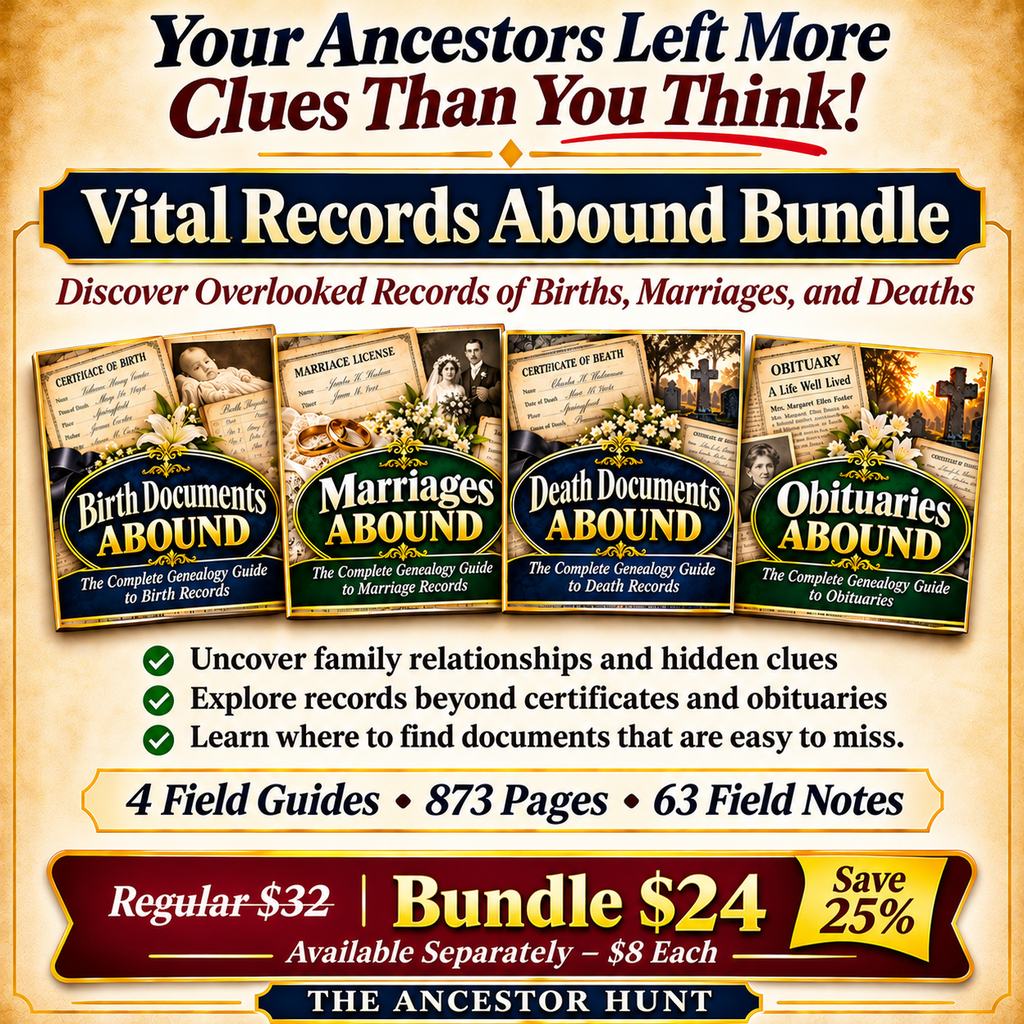
To help genealogists explore these often-overlooked sources, The Ancestor Hunt has brought together four comprehensive Field Guides into one collection.
The Vital Records Abound Bundle includes:
- Birth Documents Abound – 196 pages exploring 14 types of birth-related documents.
- Marriage Documents Abound – 277 pages exploring 23 types of marriage-related documents.
- Death Documents Abound – 296 pages exploring 26 types of death-related documents.
- Obituaries Abound – 104 pages devoted to researching and understanding obituaries.
Together, these four Field Guides provide 873 pages of practical genealogy research guidance, including 63 individual Companion Field Notes covering birth, marriage, and death documents.
The guides explain what different records are, the genealogical information they may contain, the historical circumstances surrounding their use, and where researchers can look for them.
Whether you’re beginning a new family history search or trying to break through a longstanding research obstacle, these resources can help you identify additional records worth investigating.
Explore More Records. Discover More Clues.
The next important discovery about your ancestor may not be in the certificate you’ve already found.
It may be in a marriage bond, a delayed birth registration, a funeral home record, a baptism register, or an obituary published in an unexpected newspaper.
The more types of documents you know about, the more opportunities you have to uncover the stories of your ancestors.
Get the Vital Records Abound Bundle
Four Complete Field Guides – 873 Pages of Genealogy Research Guidance
Regular combined price: $32.00
Vital Records Abound Bundle: $24.00
Save $8 – 25%
Purchase the Vital Records Abound Bundle: https://buy.stripe.com/9B66oH2W83D3aWK43scwg0R
All four Field Guides are also available individually for $8 each.
Explore Individual Field Guides
One-Time Payment • Lifetime Access • No Subscriptions