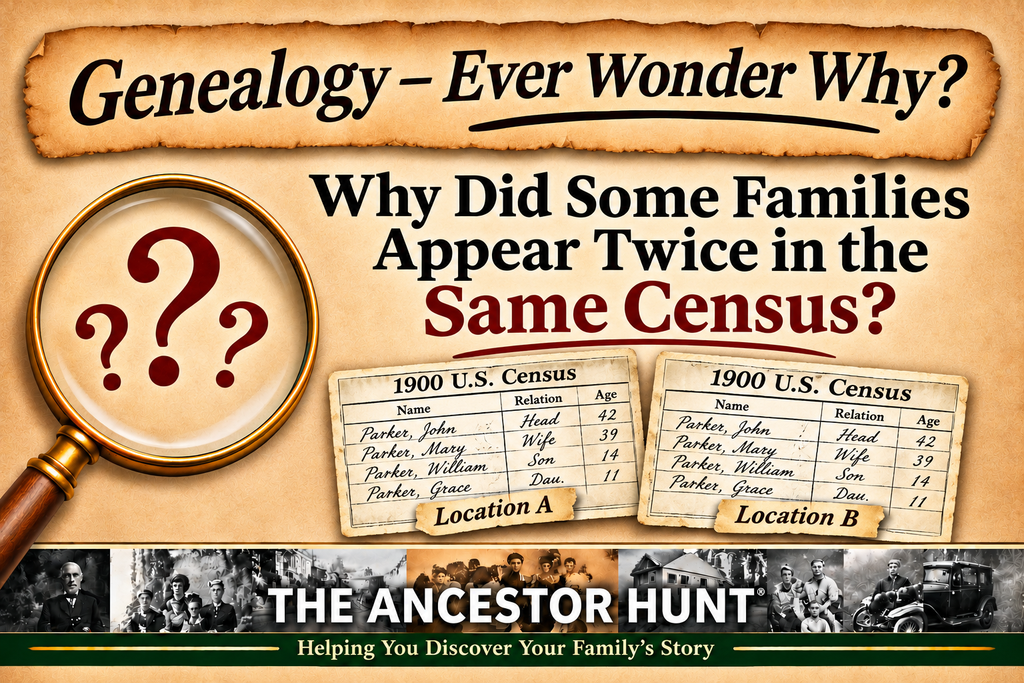
Imagine discovering your ancestor and their entire family in the 1900 census. You record their ages, occupations, and residence, and add the information to your family tree.
Then, while researching another town, you discover something unexpected.
The same family appears again in the very same census year!
The names match. The children’s ages are similar. Even the parents’ birthplaces are identical. But the family is living at a different address, perhaps even in a different state.
How could the same family be counted twice?
Surprisingly, there are several explanations, and some have nothing to do with a family moving.
The Family Moved During the Census
One possibility is that the family relocated while census enumerators were making their rounds.
Although each census had an official reference date, enumerators often spent weeks visiting households. Someone who moved between visits might have been reported at both addresses.
For example, a family might have been recorded at its former residence by someone who still considered it their home, then counted again after settling into a new community.
Technically, census information was supposed to reflect where people lived on the official census date. But that didn’t always happen in practice.
A Family Had More Than One Residence
Some families maintained residences in two locations.
A merchant might operate a business in one town while maintaining a family home elsewhere. A farmer might have a residence near agricultural land and another in a nearby community.
Seasonal employment, business arrangements, and extended family obligations could also lead to multiple living arrangements.
If different people supplied information to enumerators in those locations, the same family might be reported twice.
The important distinction is that having two residences did not necessarily mean a family was supposed to be counted twice.
Relatives Reported Family Members Who Weren’t Actually Living There
Sometimes the duplication began with a relative trying to be helpful.
Imagine a married daughter and her children temporarily staying with her parents. They might be enumerated in the grandparents’ household.
Meanwhile, her husband or another relative might report the entire family at their usual home.
The same thing could happen with children staying with grandparents, relatives visiting for extended periods, or family members temporarily living elsewhere.
In these situations, one census entry might accurately describe where the family was staying, while the other reflected where someone believed they belonged.
Workers and Students Could Be Counted in Two Places
Employment and education created additional opportunities for duplicate enumeration.
A young man working away from home might be counted at his boardinghouse and again by his parents.
A daughter employed as a domestic servant might appear in her employer’s household and in her family’s household.
Students attending schools away from home could also be reported in both locations.
These examples usually involve individual family members rather than entire families. However, they help explain why a household might appear to contain the same people in more than one census entry.
They also remind us that the meaning of home wasn’t always straightforward.
Enumerators Could Make Mistakes
Not every duplicate resulted from unusual living arrangements.
Census enumerators were responsible for covering assigned geographic districts, sometimes under difficult conditions.
An enumerator might accidentally revisit a household. Neighboring enumeration districts could overlap, or an address near a district boundary might be recorded twice.
Information might also be collected from different people who provided slightly different answers.
As a result, duplicate entries could contain differences in ages, occupations, names, and even birthplaces.
Those differences don’t necessarily mean you’re looking at two different families.
What Can Two Census Entries Tell You?
Finding a family twice might initially seem like a research problem, but it can actually be an opportunity.
Instead of choosing one entry and ignoring the other, compare them carefully.
Look for differences in:
- Addresses and locations: Were the households in neighboring communities or hundreds of miles apart?
- Household members: Did both entries include everyone, or were some people missing?
- Occupations: Could employment explain the family’s connection to both locations?
- Relationships: Were relatives or other familiar people living nearby?
- Enumeration dates: How much time passed between the two visits?
- Ages and birthplaces: Did different informants provide conflicting details?
Then examine city directories, property records, newspapers, school records, and other available sources.
Two census entries might reveal a move, a temporary residence, an employment arrangement, or a family connection you hadn’t previously discovered.
And if the entries contain contradictory information, the differences themselves might provide clues about who supplied the answers.
A Clue Worth Remembering
Finding the same family twice in a census doesn’t necessarily mean someone made a mistake.
It might reflect a move, multiple residences, temporary living arrangements, or conflicting information supplied by different people.
And sometimes, of course, it really was an enumeration error.
The important question isn’t simply why the family was counted twice. It’s what those two entries might reveal about the family’s life.
A duplicate census entry might be more than an inconvenience. It could be an overlooked piece of your family’s story.
Sources and Further Reading
- U.S. Census Bureau – History of the Census: https://www.census.gov/history/
- National Archives – Census Records: https://www.archives.gov/research/census
- National Archives – 1900 Census Records: https://www.archives.gov/research/census/1900
- IPUMS USA – Historical Census Documentation: https://usa.ipums.org/usa/voliii/