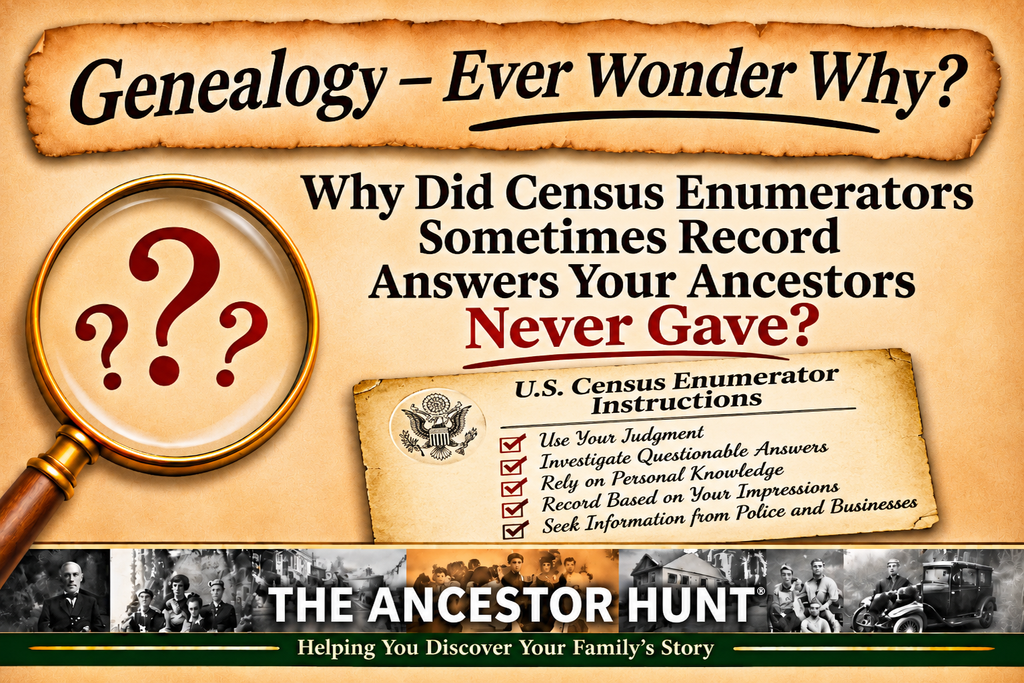
When we examine a census record, we generally assume that the information recorded came from our ancestors or someone in their household.
We know that census enumerators sometimes obtained information from neighbors when family members weren’t home. We also know that misunderstandings, language barriers, and transcription errors could result in inaccurate information.
But what if the census enumerator deliberately recorded something different from what your ancestor told them?
Or supplied an answer to a question that your ancestor never answered?
Or recorded information based entirely on their own observations?
Surprisingly, these practices weren’t necessarily violations of census procedures. In certain circumstances, enumerators were specifically instructed to do these things.
The original census enumerator instructions reveal some fascinating details about how information concerning our ancestors was collected and recorded.
Enumerators Were Instructed to Supply Answers They Believed Were True
One of the most surprising discoveries can be found in Paragraph 92 of the 1900 census enumerator instructions.
Enumerators who were unable to obtain an answer from members of the household or people in the neighborhood were instructed, whenever possible, to enter:
“the answer you believe to be true.”
They were further instructed not to record an answer as unknown until they had exhausted their efforts to obtain the information.
Similar instructions were issued in 1890, encouraging enumerators to supply an answer themselves when they had sufficient reason to believe they knew it.
Think about what this means for genealogists.
An answer that appears perfectly complete and convincing on a census record may actually represent the enumerator’s best judgment rather than information supplied by a family member.
There might be nothing on the census record to indicate that this had occurred. An answer based on the enumerator’s judgment could look exactly like one provided directly by your ancestor.
Sources:
Enumerators Could Override Answers Given by Your Ancestors
We might assume that census enumerators were simply responsible for asking questions and recording the answers they received.
That wasn’t always the case.
The 1880 and 1890 census instructions authorized enumerators to override information they knew or reasonably suspected was false.When respondents persisted in giving obviously incorrect answers, enumerators were expected to investigate and record what they considered to be the actual facts.
They could do this through their own observations or by consulting other people they considered reliable.
Imagine your ancestor providing an answer only to have the enumerator reject it and record a different answer based on information obtained elsewhere.
The enumerator was expected to exercise judgment rather than simply act as a recorder of information.
Of course, what the enumerator believed to be true wasn’t necessarily true. Their judgment could have been influenced by misunderstandings, inaccurate information, or personal biases.
For genealogists, this introduces another possible explanation for discrepancies between census records and other family documents.
Sources:
- 1880 Census Enumerator Instructions – The Obligation to Give Information
- 1890 Census Enumerator Instructions – False Statements, Page 5
Enumerators Could Record Information Based on Personal Knowledge
The 1880 census instructions provide a particularly revealing example involving family members with disabilities.
The instructions expressed concern that some parents might be reluctant to disclose their children’s disabilities or might deny that those conditions existed.
Enumerators were directed to report such conditions if they knew about them personally or could establish their existence through inquiries with neighbors.
This becomes even more interesting when we consider who the census enumerators were.
The 1880 instructions generally required enumerators to reside within their assigned enumeration districts, with limited exceptions permitting appointments from elsewhere in the county.
Consequently, an enumerator might already have been familiar with the families being counted. They may have known the children, attended the same church, conducted business with the parents, or participated in the same community activities.
Their personal knowledge could become part of the official census record without the family’s confirmation.
If you discover a disability recorded for an ancestor that was never mentioned in family accounts, remember that the information may not have originated with the family itself. It also deserves independent verification.
Source: 1880 Census Enumerator Instructions – General Instructions and The Obligation to Give Information
Some Information Was Based on the Enumerator’s Impressions
Have you ever discovered an ancestor whose racial classification changed from one census to another?
One possible explanation is the way that information was collected.
The 1920 census instructions established racial categories and definitions that enumerators were expected to apply when completing the population schedule.
The National Archives explains that racial classification in the 1920 census was based on the enumerator’s impressions.
This means that a recorded classification did not necessarily represent how an individual or family identified themselves.
Two enumerators encountering the same person ten years apart could have reached different conclusions. Changing census categories, historical classification rules, and individual perceptions could all contribute to conflicting entries.
For genealogists researching families with inconsistent racial classifications across census years, this is an important consideration.
A change in classification does not necessarily indicate a change in the family’s ancestry or identity. It may reflect a change in how someone else classified them.
Sources:
- 1920 Census Enumerator Instructions – Paragraphs 120 and 121
- National Archives – 1920 Federal Population Census, Microfilm Catalog
Enumerators Sometimes Relied on Police and Business Owners to Locate People
Neighbors weren’t the only people outside a household whom census enumerators were instructed to consult.
The 1880 census instructions recognized that some individuals lived in places that might easily be overlooked during a conventional house-to-house canvass.
These included people occupying rooms above stores, warehouses, factories, and stables, as well as other unconventional living quarters.
To help locate these individuals, enumerators were directed to make inquiries of business occupants and local police.
The Census Office even indicated that it would seek the cooperation of police departments through the mayors of large cities to prevent these individuals from being missed.
Similar instructions appeared in 1890.
Imagine an ancestor who worked in a store and slept in a room above it, or someone living alone in a warehouse loft.
The enumerator might first have learned about that person’s existence and living arrangements from a business owner or police officer rather than from the individual concerned.
Although these instructions primarily concerned locating people who might otherwise be overlooked, they demonstrate that census information gathering extended well beyond conversations at the family doorstep.
Sources:
What Does This Mean for Your Genealogy Research?
When information in a census record conflicts with information you have obtained elsewhere, it is tempting to assume that your ancestor was mistaken, forgetful, or deliberately dishonest.
But perhaps your ancestor never provided that information at all.
When evaluating census information, consider the following possibilities:
- The enumerator supplied an answer based on what they believed was true.
- The enumerator rejected an answer provided by a family member.
- The information came from the enumerator’s personal knowledge of the family.
- The entry reflected the enumerator’s observations or impressions.
- Someone outside the household provided the information.
Unfortunately, we generally cannot determine which of these circumstances occurred simply by examining a completed census entry.
Even when a census identifies the person who supplied household information, as the 1940 census did, that does not necessarily establish the origin of every individual answer.
Compare census entries with birth, marriage, and death records, church records, immigration documents, newspapers, and other available sources before drawing conclusions about conflicting information.
It is also worth reading the original enumerator instructions for the census year you are researching. They can reveal a great deal about how the information was supposed to be collected, interpreted, and recorded.
A Clue Worth Remembering
Census records are among the most valuable resources available to genealogists. But they are not necessarily a verbatim account of what our ancestors said about themselves.
In certain circumstances, census enumerators were authorized to interpret information, reject answers, supply missing details, and rely on their own knowledge and observations.
The original instructions document these practices, although they cannot tell us how frequently they occurred or whether they affected a particular ancestor’s census entry.
So the next time you encounter an unexpected or seemingly incorrect answer in a census record, consider one additional possibility.
Perhaps the answer didn’t come from your ancestor. Perhaps it came from the person holding the pencil.
Sources and Further Reading
- 1880 Census Instructions to Enumerators – U.S. Census Bureau
- 1890 Census Instructions to Enumerators – U.S. Census Bureau
- 1900 Census Instructions to Enumerators – IPUMS USA
- 1920 Census Instructions to Enumerators – IPUMS USA
- 1920 Federal Population Census – National Archives
- 20 Tips for Census Research Success – National Archives