The Ancestor Hunt regularly adds and updates new collection links, as well as searches for and fixes broken links.
(This page's most recent update is February 2026)
Want to improve your newspaper research skills? Become an AcademyPro member of the Newspaper Research Academy at Academy
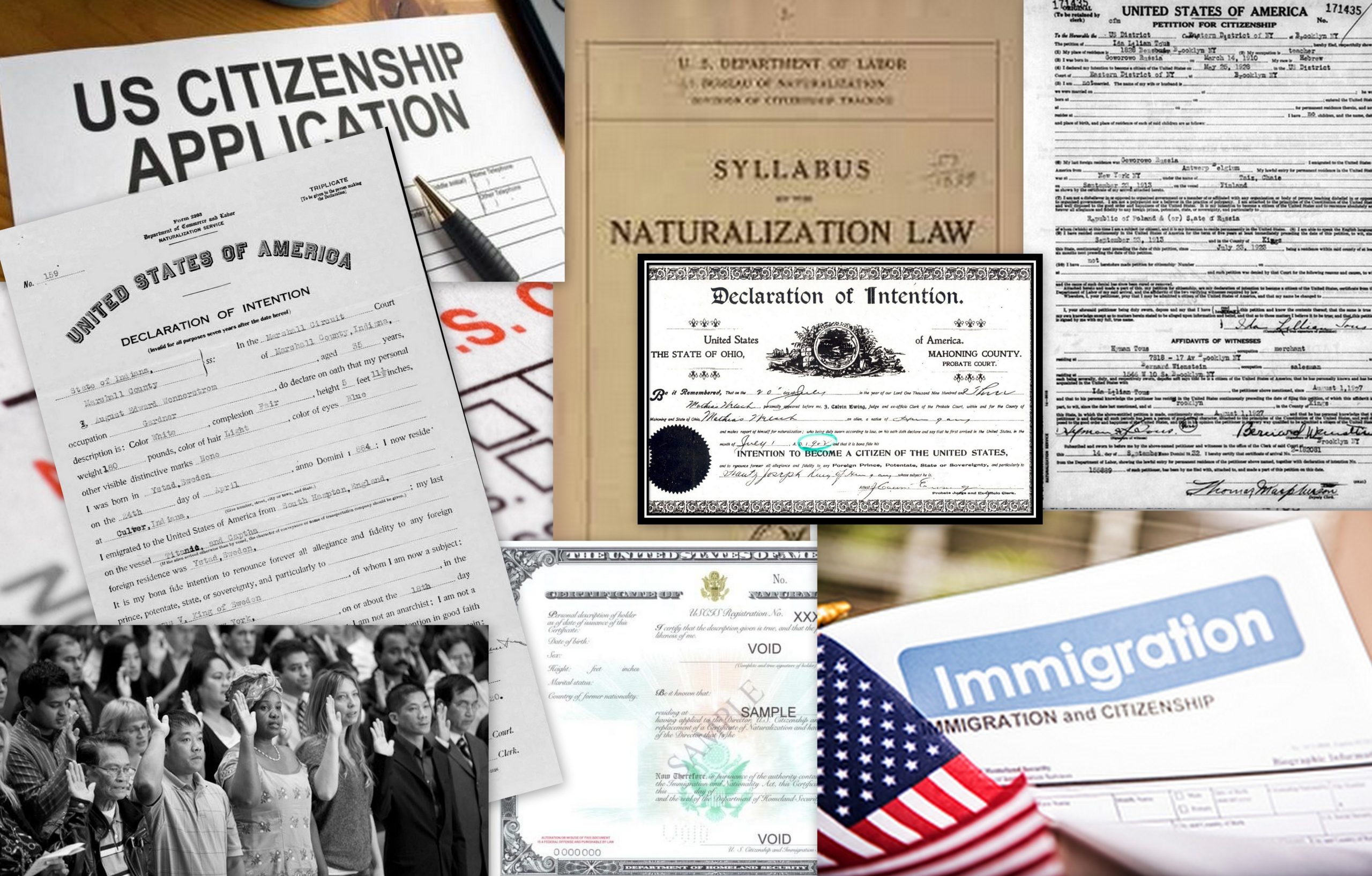
Naturalization in the United States was typically a multi-step legal process rather than a single document. Researchers often search for “naturalization papers” without realizing that several distinct records may have been created over time — and that some immigrants completed only part of the process. Understanding how these documents relate to one another is essential for accurate research.
Declarations of Intent
A Declaration of Intent was the formal statement that an immigrant intended to become a U.S. citizen. In many periods, it had to be filed several years before final citizenship could be granted. Early declarations (especially before 1906) may contain only minimal information such as name and country of allegiance. After federal standardization in 1906, declarations typically include birth date, birthplace, date and port of arrival, and current residence. After 1952, filing a declaration was no longer required.
Petitions for Naturalization
The Petition for Naturalization was the formal application requesting citizenship. This document is often the most detailed in the naturalization file. Especially after 1906, petitions commonly include:
- Full name and residence
- Date and place of birth
- Date and port of arrival
- Occupation
- Spouse’s name
- Names and birthdates of minor children
- Names of witnesses
While many immigrants filed a declaration first and later submitted a petition, some petitions exist without a prior declaration depending on the time period and law in effect.
Final Order of Naturalization
Once the court approved the petition, it entered a final order admitting the applicant to citizenship. Depending on the court and era, this may appear in minute books, order books, or as a separate document attached to the petition. In some cases, researchers find the final order recorded in court minutes even when the petition paperwork no longer survives.
Oath of Allegiance
The Oath of Allegiance was the formal act that completed the naturalization process. In many files, the oath appears within the petition itself. In other cases, it may be recorded separately in court minutes. The date of the oath is often considered the legal date of citizenship.
Certificate of Arrival
After 1906, many petitioners were required to obtain a Certificate of Arrival from federal authorities verifying lawful entry into the United States. This certificate was frequently attached to the petition and may confirm the port and date of arrival. Earlier naturalizations did not require this verification, which explains inconsistencies in arrival information in pre-1906 files.
Certificates of Naturalization
After citizenship was granted, the new citizen received a Certificate of Naturalization as personal proof. Courts typically did not retain these certificates; they were issued directly to the individual. If lost, replacement could be difficult. For that reason, original certificates are rarely found in court files.
Derivative Citizenship
In certain time periods, wives and minor children automatically derived citizenship when a husband or father naturalized. As a result, some family members may not have separate naturalization records of their own. Law changes affecting derivative citizenship are summarized in QC069 (Historical Naturalization and Immigration Laws, 1790–1952) and should be reviewed when researching women and children.
Pre-1906 Variations
Before the federal standardization of naturalization procedures in 1906, local, county, state, and even municipal courts could grant citizenship. Requirements varied widely, and documentation was often minimal. The absence of one document type does not necessarily mean naturalization did not occur.
Post-1952 Changes
The Immigration and Nationality Act of 1952 eliminated the requirement for a Declaration of Intent. After this date, some immigrants completed naturalization through a single petition process.
Incomplete Naturalization Trails
It is common to find only part of the naturalization process. Some immigrants filed a Declaration of Intent but never petitioned. Others petitioned but were denied. Some began the process and moved to another jurisdiction. Others derived citizenship automatically and filed no documents at all. Recognizing the multi-step nature of naturalization helps explain these gaps.
What a Complete Naturalization File May Contain
A more complete naturalization file — particularly after 1906 — may include (not all files contain every document):
- Declaration of Intent
- Petition for Naturalization
- Oath of Allegiance
- Certificate of Arrival
- Court order admitting the applicant
- Supporting affidavits or witness statements
If you’d like this information in a clean, printable, and well-organized reference format, this topic is also included in the Quicksheet Vault. The Vault is designed for researchers who prefer working tools they can save, print, and reuse — whether that means building a personal binder of key resources or keeping reliable references close at hand. You can learn more about the Quicksheet Vault HERE