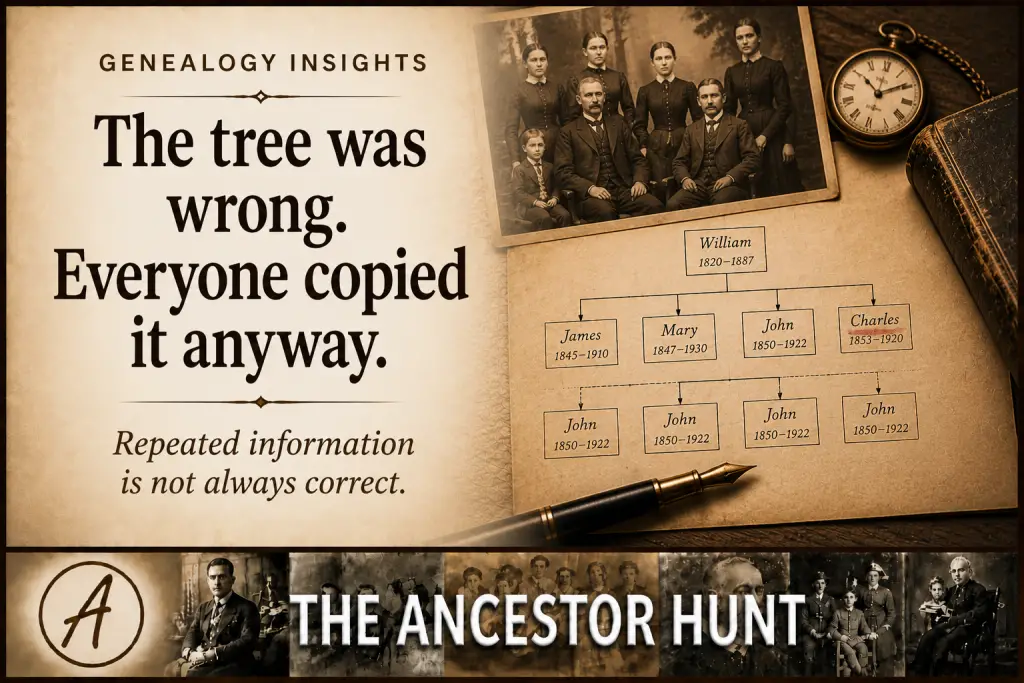
Just because everyone copied it doesn’t mean anyone proved it.
The Insight
One of the fastest ways for bad genealogy information to spread is through online family trees. A single incorrect relationship, date, or location can be copied repeatedly until it starts to look believable simply because it appears everywhere.
The problem is that many online trees are treated like evidence when they are really starting points. Some are carefully researched. Others were built quickly, merged automatically, or copied from other trees without verification. Once an error spreads, it becomes surprisingly difficult to separate fact from repetition.
Researchers sometimes encounter the same conclusion in dozens of trees and assume the information must be correct. In reality, many of those trees may trace back to the same original mistake.
Online trees can be valuable clues, but clues are not proof. The real value comes from discovering where the information originated and whether the supporting records actually exist.
Why it Matters
- Repeated information is not the same as verified information.
- A widely copied error can mislead research for years.
- Online trees can point you toward records, but they cannot replace them.
- Verifying information at the source prevents inherited mistakes.
- Strong genealogy is built on evidence, not popularity.
What to Look For
Pay attention to:
- Trees that provide no sources.
- Exact dates without supporting records.
- Identical errors appearing in multiple trees.
- Relationships that lack documentation.
- Conclusions based entirely on other online trees.
- Claims that cannot be traced to an original source.
Ask yourself: Where did this information come from, and can I verify it independently?
Research Action
Choose one fact from an online tree that you currently accept as true.
Then:
- Identify where you first found it.
- Look for the original supporting record.
- Confirm the information using independent sources.
- Compare the evidence against other available records.
- Note any assumptions that were made along the way.
If you cannot find evidence supporting the claim, treat it as a clue rather than a conclusion.
Key Takeaway
Online trees are useful guides, but they are not evidence by themselves. The more often information is copied, the more important it becomes to verify where it started and whether the records actually support it.
The Genealogy Insights Field Guides
Discover all 30 Genealogy Insights in the Field Guides Collection
One reply on “Genealogy Insight – The Tree Was Wrong. Everyone Copied It Anyway”
And when you try to correct them, they ignore you.