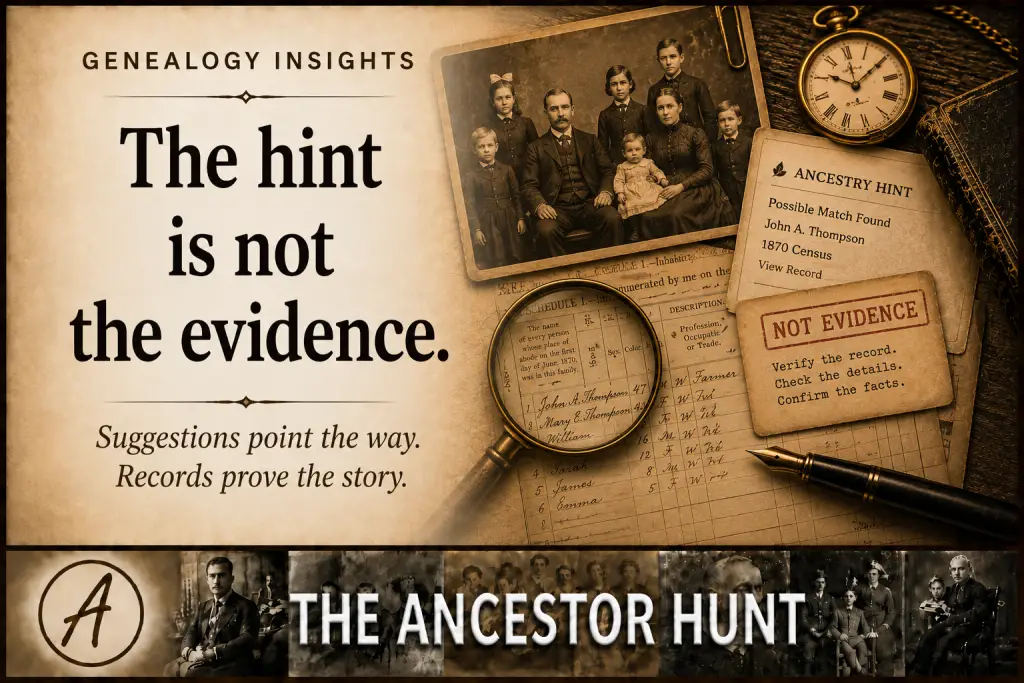
A hint may point you toward the answer, but only the record can help prove it.
The Insight
Modern genealogy websites have transformed family history research by making billions of records searchable from home. Along with those records come hints, suggested matches, user-submitted trees, and automated recommendations designed to help researchers discover possible connections.
These tools are valuable, but they are often misunderstood. A hint is not evidence. It is simply a suggestion that a record may be relevant to your research.
The real work begins after the hint appears. Researchers must examine the actual record and determine whether the names, dates, locations, relationships, and other details truly match the individual being investigated. Sometimes the hint leads to an important discovery. Other times it leads to the wrong person entirely.
Experienced genealogists treat hints as research leads rather than conclusions. The hint points the way. The record provides the evidence.
Why It Matters
- Hints are generated by algorithms, not by proof.
- Similar names can easily lead to incorrect conclusions.
- User-submitted trees may contain errors that spread widely.
- Repeated hints can create a false sense of certainty.
- Careful evaluation helps prevent mistakes from entering your family tree.
What To Look For
- Names that match more than one individual.
- Dates that conflict with known facts.
- Locations that do not fit the family’s documented history.
- Relationships that lack supporting records.
- Original documents that verify the information suggested by a hint.
- Multiple records that independently support the same conclusion.
Research Action
When a new hint appears, resist the temptation to accept it immediately.
Instead, ask:
- What record is the hint pointing to?
- Have I examined the original document?
- Do the dates, places, and relationships fit?
- Is there additional evidence supporting the conclusion?
- Could this record belong to someone else with a similar name?
Treat every hint as a possible lead that requires investigation rather than a fact that requires acceptance.
Key Takeaway
Hints can save time and uncover valuable records, but they are not evidence by themselves. Strong genealogy is built by evaluating records, verifying details, and drawing conclusions from documented facts rather than automated suggestions.
The Genealogy Insights Field Guides
Discover all 30 Genealogy Insights in the Field Guides Collection