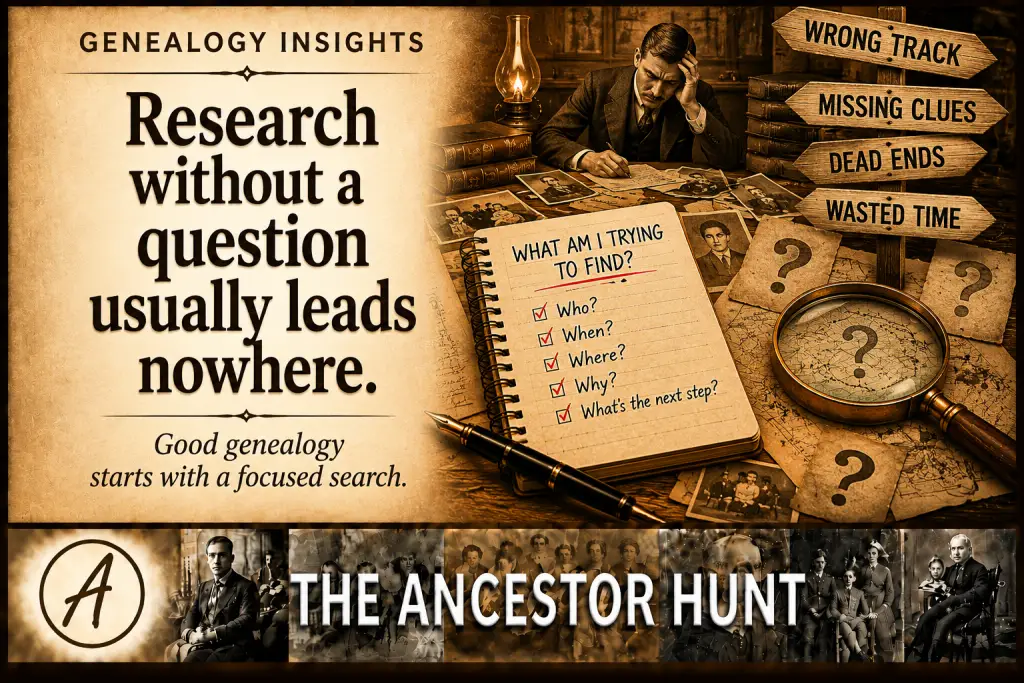
The quality of your research often depends on the quality of the question you ask before you begin.
The Insight
Many genealogy searches fail before they even begin—not because records are missing, but because the researcher never clearly defined what they were trying to learn.
It is easy to open a database, enter a surname, and begin searching. The result is often a flood of records, hints, and possible connections. Without a specific objective, however, it becomes difficult to determine which records matter and which are merely distractions.
Experienced genealogists rarely begin with a broad search. Instead, they start with a focused question. A well-defined question provides direction, helps identify the most useful records, and creates a framework for evaluating the evidence that is found.
Research questions do not need to be complicated. In fact, the best questions are often simple and specific. The goal is to identify exactly what information is missing and then search for records that may provide the answer.
A clear question transforms genealogy from random searching into purposeful investigation.
Why It Matters
- Focused questions create focused research.
- Clear objectives help prevent wasted time.
- Specific questions make it easier to evaluate evidence.
- Research plans become more efficient when the goal is defined.
- Smaller questions are often easier to answer than broad ones.
What To Look For
- Gaps in your timeline.
- Missing relationships that need verification.
- Unknown locations, dates, or family connections.
- Contradictory information that requires clarification.
- Records that could potentially answer a specific question.
- Research notes that identify what is known and what remains unknown.
Research Action
Before beginning a research session, write down the specific question you want to answer.
Instead of asking:
“What can I find about this family?”
Ask:
“Where was this person living in 1880?”
or
“Who were the parents named on this marriage record?”
or
“When did this family move from one county to another?”
Once the question is defined, identify the records most likely to contain the answer and focus your search accordingly.
Key Takeaway
Successful genealogy research begins with a purpose. A clearly defined question creates direction, reduces distractions, and helps transform a collection of records into meaningful evidence. The better the question, the more productive the search.
The Genealogy Insights Field Guides
Discover all 30 Genealogy Insights in the Field Guides Collection