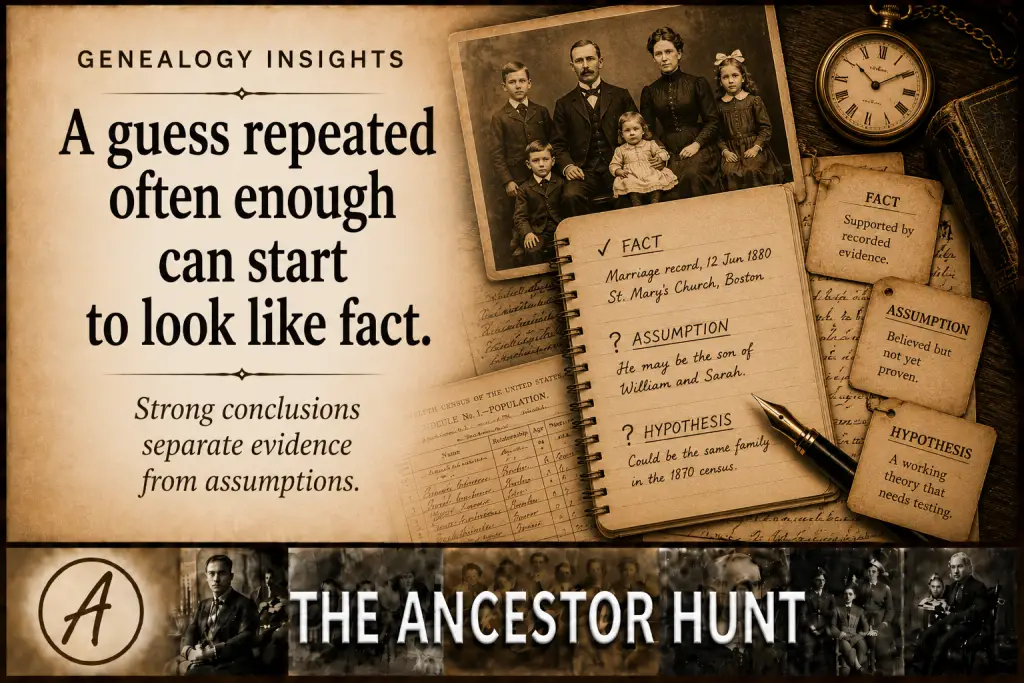
The longer an assumption circulates, the easier it becomes to mistake it for evidence.
The Insight
Many genealogy errors begin with a reasonable possibility.
A researcher notices two individuals with the same surname living in the same county. A family appears near another family in a census record. A marriage record seems to connect two people who fit the expected timeline. The theory may be plausible and even worthy of investigation.
The problem begins when the possibility quietly transforms into a conclusion.
As information is copied from one family tree to another, repeated in notes, or shared among relatives, the distinction between evidence and assumption can disappear. Over time, the original source of the claim may be forgotten entirely. What started as an educated guess eventually becomes accepted as fact simply because it has been repeated often enough.
Strong genealogy research depends on recognizing the difference between what is known, what is suspected, and what remains unproven. The goal is not to avoid theories. The goal is to label them accurately until sufficient evidence either confirms or disproves them.
Why It Matters
- Unproven assumptions can send research in the wrong direction.
- Errors copied into multiple family trees often gain an undeserved appearance of credibility.
- Repeated claims may discourage researchers from seeking original evidence.
- Incorrect conclusions can become difficult to reverse once widely accepted.
- Separating evidence from theory leads to stronger and more reliable research.
What To Look For
- Relationships that appear in multiple trees but lack supporting records.
- Statements that cite no source beyond another family tree.
- Claims that use words such as “probably,” “possibly,” or “may have” but are presented elsewhere as facts.
- Conclusions based solely on surname, location, or proximity.
- Family traditions that have never been tested against records.
- Information that is widely repeated but poorly documented.
Research Action
Review your research notes and family tree for conclusions that may have originated as assumptions. Ask a simple question:
“What evidence actually supports this claim?”
If the answer cannot be clearly documented, treat the conclusion as a hypothesis rather than a fact. Then identify what records might confirm or refute it.
Good researchers are comfortable living with uncertainty until the evidence becomes clear.
Key Takeaway
A theory is not a fact simply because it has been repeated for years. Sound genealogy separates evidence from assumptions and assumptions from hypotheses. Family history is strongest when conclusions are built on records rather than repetition.
The Genealogy Insights Field Guides
Discover all 30 Genealogy Insights in the Field Guides Collection