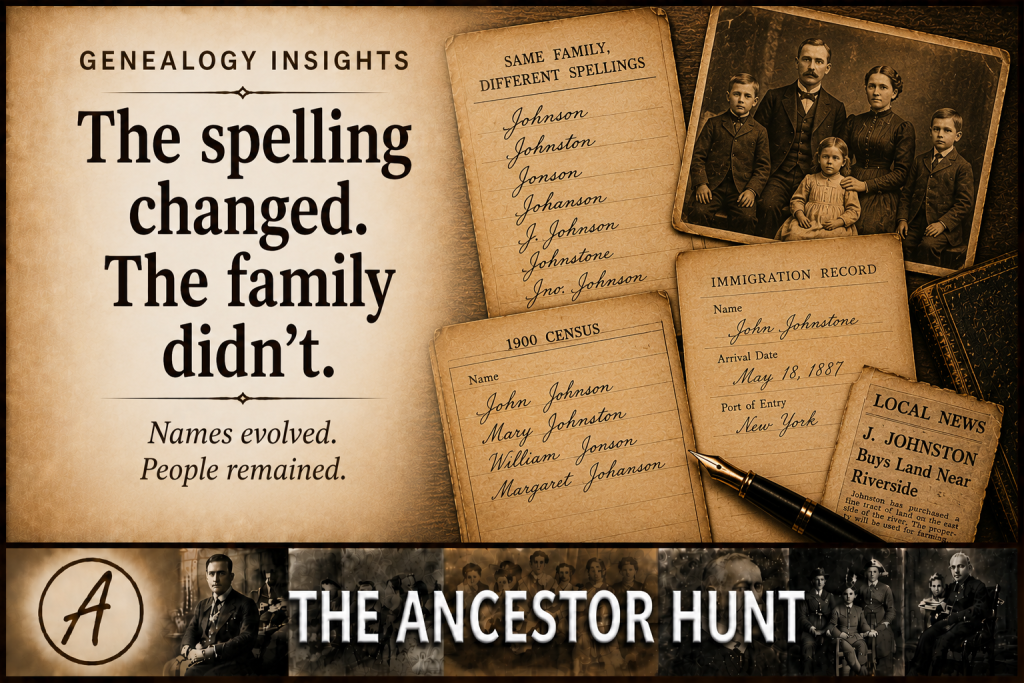
If you search for only one spelling of a name, you may be searching for only part of the family story.
The Insight
One of the quickest ways to miss an ancestor is to search for only one spelling of a name.
Today, we tend to think of names as fixed and permanent. In the past, that was often not the case. Clerks, census takers, ministers, newspaper editors, and even family members frequently spelled names according to how they sounded. Many people could not read or write well enough to correct mistakes, and standardized spelling was far less important than it is today.
As a result, the same person may appear under several different spellings across a lifetime. A surname like Johnson might also appear as Johnston. Schmidt could become Smith. McDonald might be recorded as MacDonald, Mc Donnell, or several other variations. Given names were just as flexible, with nicknames, abbreviations, and alternate forms appearing in different records.
Immigrant families faced an additional challenge. Names were often translated, shortened, Anglicized, or altered by local officials and record keepers. What appears to be a completely different surname may actually belong to the same family.
Why it Matters
- Records may be indexed under unexpected spellings.
- Different record sets may use different versions of the same name.
- Immigration, language, and literacy often influenced name changes.
- A missing ancestor may simply be hiding behind a spelling variation.
- Searching only one spelling can create unnecessary brick walls.
What to Look For
Watch for:
- Phonetic spellings.
- Alternate surname forms.
- Nicknames and abbreviations.
- Anglicized versions of foreign names.
- Variations created by census takers, clerks, and newspaper editors.
- Different spellings used by members of the same family.
Research Action
When a search produces no results, try saying the name aloud.
Search for:
- Common spelling variations.
- Alternate pronunciations.
- Abbreviated forms.
- Wildcard searches.
- Neighboring families and known relatives.
- Multiple versions of both given names and surnames.
Search broadly before narrowing your results.
Key Takeaway
Names changed far more often than most researchers realize. A record that appears to belong to someone else may actually belong to your ancestor under a different spelling. Sometimes the record is not missing at all.
The Genealogy Insights Field Guides
Discover all 30 Genealogy Insights in the Field Guides Collection