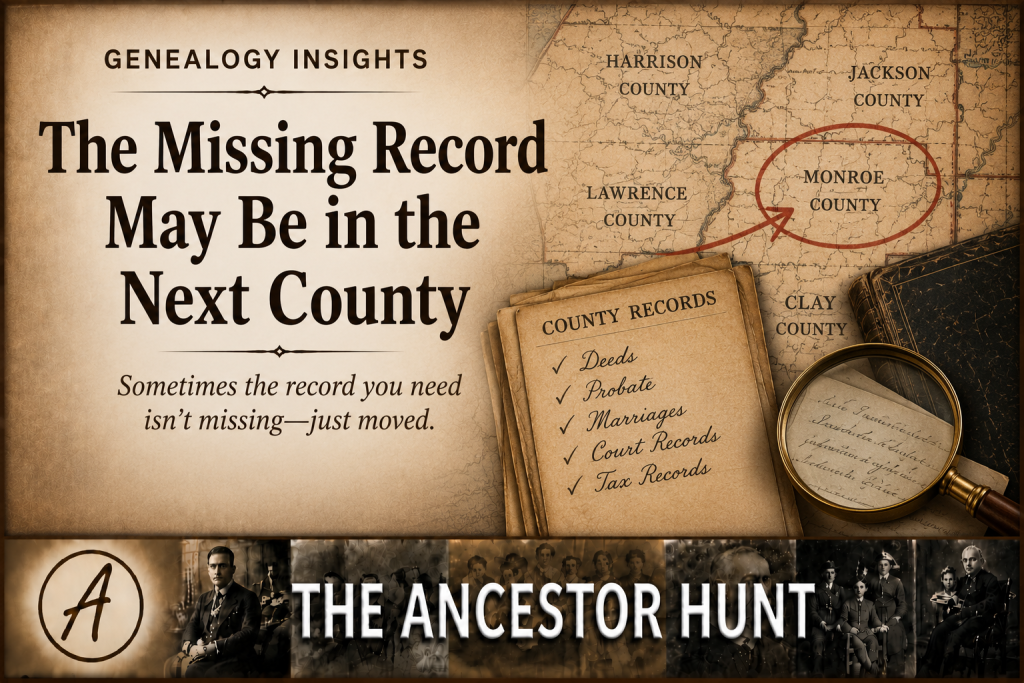
When records seem to disappear, the problem is often geography—not genealogy.
The Insight
Many genealogists spend hours searching for a record in the place where they believe it should be. When the record does not appear, they often conclude that it was lost, destroyed, or never created.
In reality, records frequently move.
Counties were divided. New jurisdictions were created. State boundaries shifted. Courthouses burned. Records were transferred to neighboring counties, state archives, historical societies, and other repositories. What originated in one location may eventually be stored somewhere entirely different.
Researchers naturally assume that if an ancestor lived in a particular county, every record connected to that ancestor will still be found there. Unfortunately, historical recordkeeping was rarely that simple. A marriage record, land deed, probate file, tax record, or court proceeding may have been relocated decades ago as jurisdictions changed and government boundaries evolved.
The record may not be missing at all. It may simply be somewhere else.
Why It Matters
- County boundaries changed frequently throughout American history.
- New counties were often formed from older jurisdictions.
- Records were sometimes transferred when counties were reorganized.
- Courthouse fires and disasters occasionally resulted in records being relocated.
- Important records may exist in archives, libraries, or neighboring counties rather than the county where an ancestor lived.
What To Look For
- County formation maps and boundary-change histories.
- Parent counties that existed before a new county was created.
- Neighboring counties that may have inherited records.
- State archives and historical societies holding transferred collections.
- Alternate jurisdictions responsible for probate, land, tax, or court records.
- Research guides that identify where older records are currently stored.
Research Action
When a record cannot be found where you expect it, resist the urge to conclude that it does not exist.
Instead:
- Review county formation histories.
- Identify parent and neighboring counties.
- Study historical maps for boundary changes.
- Search state archives and historical societies.
- Investigate whether records were transferred after a courthouse fire or reorganization.
Expanding your geographic search area often reveals records that appear to have vanished.
Key Takeaway
A missing record is not always a lost record. Historical boundary changes, jurisdictional shifts, and record transfers have moved countless documents away from their original locations. When the expected search fails, looking beyond the county line may be the key to finding the answer.
The Genealogy Insights Field Guides
Discover all 30 Genealogy Insights in the Field Guides Collection