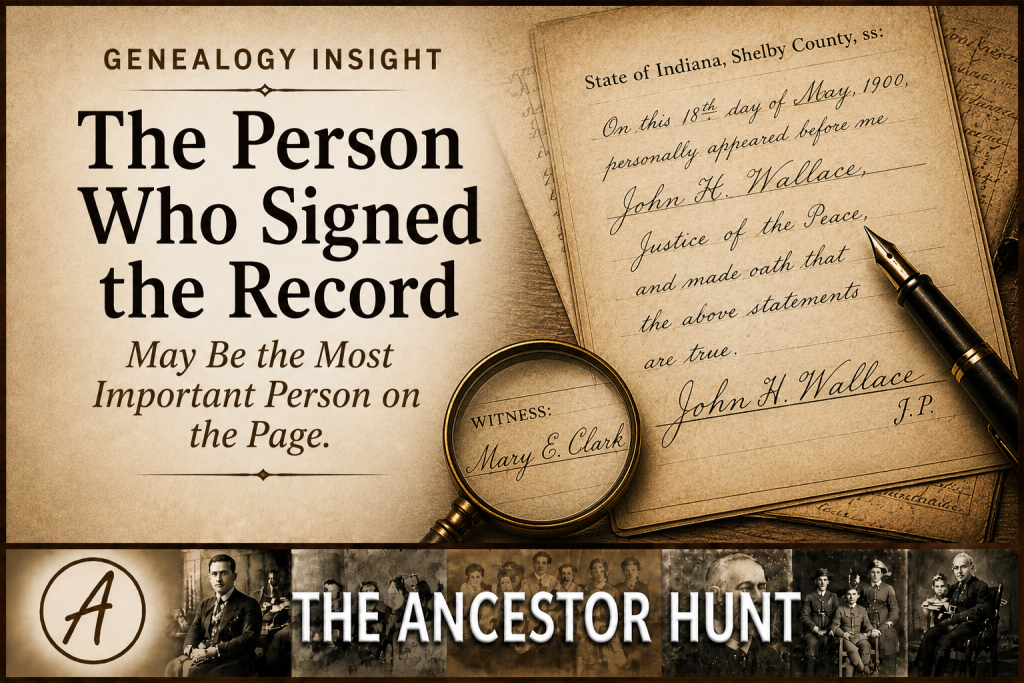
The name that solves a genealogy problem is often not the one you were searching for.
The Insight
Many researchers focus only on the primary names appearing in a record. A marriage record, deed, probate file, court record, birth certificate, or death certificate, however, often contains additional names whose significance may not be immediately obvious.
Witnesses, bondsmen, neighbors, executors, administrators, informants, sponsors, and signers were rarely random individuals. They were frequently relatives, close friends, business partners, trusted associates, or longtime neighbors. In many cases, they belonged to the same social and family network as the ancestor being researched.
When direct evidence is scarce, these individuals can become some of the most valuable clues available. A witness on a marriage record may turn out to be a sibling. An executor named in a probate file may be a son-in-law. An informant on a death certificate may reveal an otherwise unknown family connection.
Experienced genealogists learn to study every name on a document, not just the names they expected to find.
Why It Matters
- Witnesses and signers often provide clues to family relationships.
- Associates can help identify relatives when direct evidence is lacking.
- Informants may possess first-hand knowledge about an ancestor.
- Community networks often reveal migration and family patterns.
- Researching associated individuals frequently leads to new discoveries.
What To Look For
- Witnesses on marriage, deed, and court records.
- Bondsmen, sureties, or sponsors.
- Executors, administrators, and heirs in probate records.
- Informants on birth and death certificates.
- Neighbors appearing repeatedly across records.
- Individuals who sign legal documents on behalf of family members.
- Names that appear repeatedly throughout an ancestor’s records.
Research Action
The next time you examine a record, make a list of every person named on the page.
Ask yourself:
- Who are they?
- Why were they involved?
- Do they appear in other records connected to the family?
- Could they be relatives, neighbors, or business associates?
- What additional records might connect them to the people being researched?
Following these connections often reveals relationships that are never stated directly.
Key Takeaway
The most important clue on a record is not always the person you were searching for. Witnesses, signers, informants, and associates can provide critical evidence that helps identify relationships, solve research problems, and uncover new branches of a family story.
The Genealogy Insights Field Guides
Discover all 30 Genealogy Insights in the Field Guides Collection