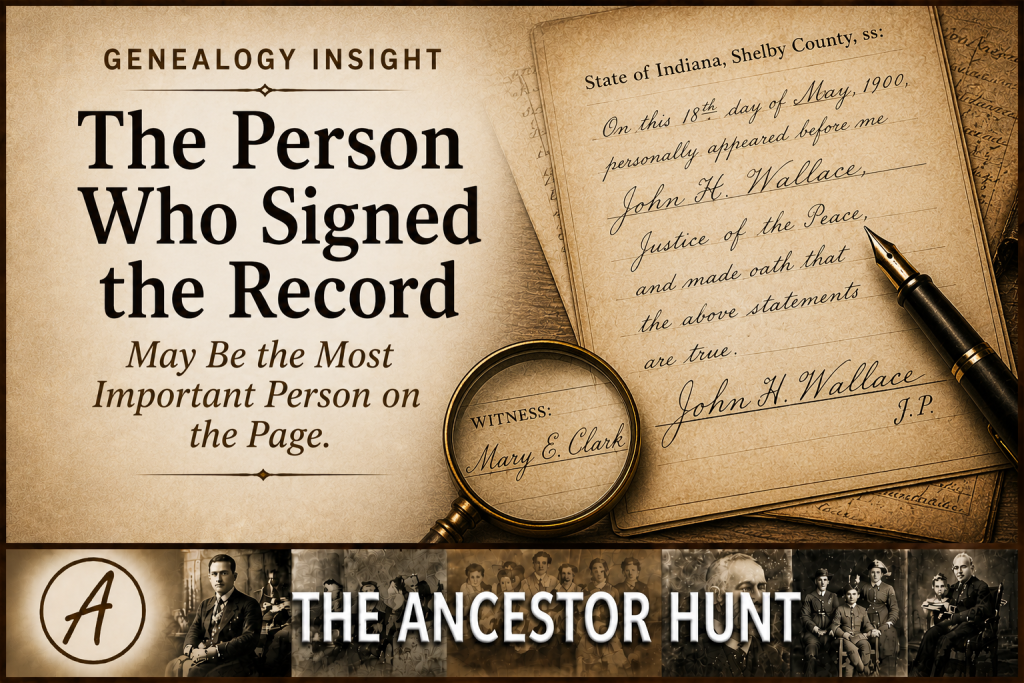
The name that solves a genealogy problem is often not the one you were searching for.
The Insight
Many researchers focus only on the primary names appearing in a record. A marriage record, deed, probate file, court record, birth certificate, or death certificate, however, often contains additional names whose significance may not be immediately obvious.
Witnesses, bondsmen, neighbors, executors, administrators, informants, sponsors, and signers were rarely random individuals. They were frequently relatives, close friends, business partners, trusted associates, or longtime neighbors. In many cases, they belonged to the same social and family network as the ancestor being researched.
When direct evidence is scarce, these individuals can become some of the most valuable clues available. A witness on a marriage record may turn out to be a sibling. An executor named in a probate file may be a son-in-law. An informant on a death certificate may reveal an otherwise unknown family connection.
Experienced genealogists learn to study every name on a document, not just the names they expected to find.
Why It Matters
- Witnesses and signers often provide clues to family relationships.
- Associates can help identify relatives when direct evidence is lacking.
- Informants may possess first-hand knowledge about an ancestor.
- Community networks often reveal migration and family patterns.
- Researching associated individuals frequently leads to new discoveries.
What To Look For
- Witnesses on marriage, deed, and court records.
- Bondsmen, sureties, or sponsors.
- Executors, administrators, and heirs in probate records.
- Informants on birth and death certificates.
- Neighbors appearing repeatedly across records.
- Individuals who sign legal documents on behalf of family members.
- Names that appear repeatedly throughout an ancestor’s records.
Research Action
The next time you examine a record, make a list of every person named on the page.
Ask yourself:
- Who are they?
- Why were they involved?
- Do they appear in other records connected to the family?
- Could they be relatives, neighbors, or business associates?
- What additional records might connect them to the people being researched?
Following these connections often reveals relationships that are never stated directly.
Key Takeaway
The most important clue on a record is not always the person you were searching for. Witnesses, signers, informants, and associates can provide critical evidence that helps identify relationships, solve research problems, and uncover new branches of a family story.
The Genealogy Insights Field Guides
Discover all 30 Genealogy Insights in the Field Guides Collection
4 replies on “Genealogy Insight – The Person Who Signed the Record May Be the Most Important Person on the Page”
Your observation that the signer can be the hidden key in a marriage or probate record resonates with anyone stuck on a dead‑end lead. The same logic works with Arrests Public Records, where the officer or informant listed points to family ties or community links missed otherwise. Just as a probate witness may be a sibling, an arrest entry can reveal a relative’s involvement, opening a line of inquiry. Keeping an eye on peripheral names enriches a family tree and shows how thorough record searches can surface unexpected connections.
Your insight that the signer of a record can be the most revealing clue is a core principle of genealogy. Similarly, in modern investigations an ARRESTS MO Lookup often uncovers the officer or agency behind a booking, exposing hidden links to related cases. Just as a marriage witness may be a sibling, the arresting official can point to a broader network of contacts. Treating every name as a lead turns peripheral entries into essential connections for both family trees and case files.
The article’s reminder that a seemingly peripheral signer on a marriage or probate record can unlock hidden family ties resonates strongly with any researcher who treats every line of a document as a potential lead; using the ARRESTS MN Database as a modern analogue, investigators can trace the arresting officer or booking clerk to uncover broader social networks and recurring patterns. By cross‑referencing those ancillary names with historical sources, one can confirm relationships that would otherwise remain invisible, and the same disciplined eye turns a contemporary police report into a genealogical goldmine. For those interested in exploring this intersection further, the resources available through mn‑arrests.org provide valuable tools for both historical and current investigations.
Your point that every name on a marriage or probate record can be a hidden link is a vital reminder for genealogists. An Arrest Records Search often reveals the same pattern, where the officer or informant listed can point to familial or community ties that enrich a subject’s profile. Treating those ancillary names as leads lets us cross reference them with booking data to reveal otherwise unseen networks. Your insight shows how a broader lens turns ordinary paperwork into a family history treasure map.