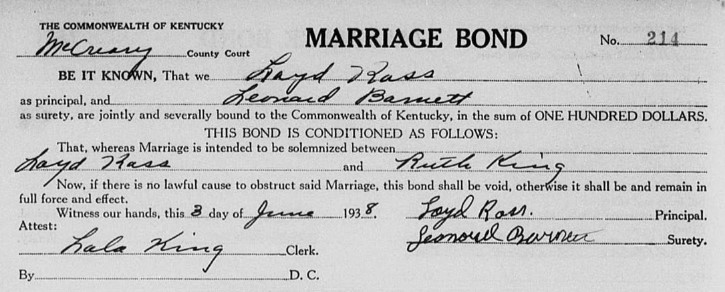
Before some couples could marry, someone had to put money on the line. A marriage bond was a financial guarantee that there was no legal reason the marriage should not take place—and the person signing that bond may provide an unexpected clue about the bride, groom, or their families.
Introduction
A marriage bond was a document associated with obtaining permission or a license to marry. It was used in various places and periods, particularly before modern marriage-licensing procedures became standardized.
The groom—usually joined by another man known as the bondsman or surety—pledged a specified sum of money as assurance that no lawful impediment prevented the proposed marriage.
The bond was not normally money actually paid to the government. Instead, it represented a financial penalty that could be imposed if the statements supporting the marriage proved false or a legal obstacle to the marriage was discovered.
For genealogists, the bond can be valuable not only because it identifies the prospective couple, but because of the additional person who signed it.
What Was the Marriage Bond For?
Marriage laws sought to prevent marriages that violated legal requirements. Possible impediments included an existing marriage, prohibited degrees of relationship, lack of required consent, or other circumstances that made the proposed marriage unlawful.
The marriage bond provided financial assurance that the marriage could legally proceed.
The amount written on a bond can look surprisingly large. Researchers should not assume the groom and bondsman handed over that amount. It generally represented the amount for which they could become liable if the conditions of the bond were violated.
What Might a Marriage Bond Contain?
The amount and type of information vary by jurisdiction and period, but a marriage bond may contain:
- Name of the prospective groom
- Name of the prospective bride
- Date of the bond
- Name of the bondsman or surety
- Amount of the bond
- County, town, or jurisdiction
- Signatures or marks of the groom and bondsman
- Names of officials involved in issuing or witnessing the bond
- Occasionally additional information concerning consent or the parties to the marriage
As with many marriage documents, the bond may provide information that does not appear on the later marriage record.
Don’t Ignore the Bondsman
For genealogists, the bondsman may be the most interesting person on the document after the bride and groom.
A bondsman was often someone the groom knew and trusted. He might have been a relative, friend, neighbor, associate—or someone connected to the bride’s family.
That does not mean a bondsman should automatically be treated as the bride’s father, brother, or other relative. His presence establishes an association, not the exact nature of the relationship.
But that association is worth investigating.
If you are trying to identify a bride’s parents or distinguish between two people with the same name, research the bondsman. Look for him in census records, deeds, probate files, tax lists, church records, and other records involving either family.
A name that initially looks incidental may become part of the evidence connecting two families.
A Marriage Bond Is Not Proof of Marriage
Like marriage banns, a marriage bond generally documents a step leading toward a marriage.
It does not by itself establish that the wedding ceremony actually occurred.
Plans could change. A legal impediment could emerge. One of the parties could withdraw or die before the ceremony.
When you find a marriage bond, continue searching for evidence that the marriage was completed, such as a marriage return, register entry, certificate, church record, or newspaper announcement.
The distinction can be especially important when a marriage bond is the only record that appears in an index or database.
Watch the Dates
The date on a marriage bond is usually connected with the marriage process, not necessarily the wedding itself.
A bond might have been executed shortly before the ceremony. Therefore, don’t automatically enter the bond date into your family tree as the marriage date.
Instead, record exactly what the document represents and continue searching for the actual date of the ceremony.
At the same time, the bond date can help narrow your search. If you have a bond dated June 10, for example, concentrate first on marriage records created shortly afterward.
Where Might You Find Marriage Bonds?
Marriage bonds may survive in county courthouse records, state or provincial archives, libraries, historical societies, microfilmed collections, and digitized genealogy databases.
They may be cataloged under Marriage Bonds, but they can also be buried within broader collections such as:
- Marriage Records
- Marriage Licenses
- Marriage Bonds and Licenses
- Marriage Bonds and Allegations
- County Court Records
- Marriage Papers
Don’t stop with a searchable marriage index. An index may give you only the names and date while the underlying bond contains the bondsman’s name, signatures, and other details.
Whenever possible, view the original document or an image of it.
Key Takeaways
- A marriage bond was a financial guarantee connected with permission for a proposed marriage.
- The amount stated on the bond generally was a potential penalty, not necessarily money actually paid.
- Marriage bonds can identify the bride, groom, bondsman, date, jurisdiction, and sometimes additional participants.
- Pay special attention to the bondsman or surety. That person may provide an important clue to relatives or associates of the couple.
- Do not assume the bondsman was related to either party; investigate the relationship.
- A marriage bond documents part of the marriage process but does not necessarily prove that the marriage occurred.
- Do not automatically treat the bond date as the wedding date.
- Whenever possible, examine the original bond rather than relying solely on an index or transcription.
Examples