Finding your ancestor’s marriage license is exciting, but it doesn’t necessarily mean you’ve found proof that the wedding actually happened. A marriage license was permission to marry, and the original document may contain valuable information about the couple that never made it into the marriage certificate or register.
Introduction
A marriage license was an official document issued by a civil or other authorized official permitting two individuals to marry.
Marriage licenses have been used in various forms for centuries, although the requirements, procedures, and information recorded varied considerably by jurisdiction and period.
For genealogists, a marriage license can provide valuable information about the prospective bride and groom, including their names, ages, residences, marital status, and sometimes their parents or other family members.
However, one important distinction should always be kept in mind: A marriage license authorizes a marriage. It does not, by itself, establish that the marriage ceremony actually occurred.
Why Was a Marriage License Required?
Marriage licenses provided a formal means of authorizing a proposed marriage under the laws and procedures of the jurisdiction.
Before issuing a license, officials might need to establish that the prospective couple satisfied applicable legal requirements. These could include minimum age requirements, the absence of an existing marriage, and any necessary parental or guardian consent.
Depending on the time and location, obtaining a marriage license might involve additional documents, including a marriage application, marriage bond, consent affidavit, or sworn statement.
In some jurisdictions and periods, couples could marry through alternative procedures, such as the publication of marriage banns.
Consequently, not finding a marriage license does not necessarily mean that a marriage was invalid or never occurred.
What Might a Marriage License Contain?
The information recorded on marriage licenses varies considerably, but a license may include:
- Names of the prospective bride and groom
- Ages or dates of birth
- Places of residence
- Marital status, such as single, widowed, or divorced
- Occupations
- Names of parents or guardians
- Date the license was issued
- County or other jurisdiction issuing the license
- Name or signature of the issuing official
- License number or other identifying information
Some licenses contain little more than the couple’s names, the date, and authorization to marry. Others provide considerably more identifying information.
The amount of detail may depend on the jurisdiction, the period, and whether the license was issued as a separate document or combined with an application or other marriage paperwork.
Don’t Confuse the License with the Marriage Application
A marriage license and a marriage application are related, but they are not necessarily the same document.
The marriage application generally contains information supplied by the prospective couple when requesting permission to marry.
The marriage license is the authorization issued after the applicable requirements have been satisfied.
In some jurisdictions, the application and license were recorded on the same form. In others, they were maintained as separate documents.
This distinction can be important because the application may contain information that does not appear on the license.
For example, a license might identify only the couple and the date of issuance, while the application could provide their birthplaces, parents’ names, previous marital status, or other personal information.
When you locate a marriage license, investigate whether the original application or supporting paperwork also survives.
A Marriage License Is Not Proof That the Marriage Occurred
This is one of the most important distinctions for genealogists.
A marriage license provided permission for a couple to marry, but obtaining that permission did not guarantee that the ceremony actually took place.
A couple might have postponed the wedding, changed their plans, or decided not to marry.
Therefore, the date a marriage license was issued should not automatically be recorded as the date of the marriage.
The license date may be several days or weeks before the ceremony, depending on local laws and circumstances.
When you find a license, continue searching for a marriage return, marriage certificate, church register, or other record documenting that the ceremony occurred.
Look for the Marriage Return
In many jurisdictions, the marriage license was part of a process that generated another important document: the marriage return.
After performing the ceremony, the officiant might have been required to complete and return a certificate or portion of the license to the issuing authority.
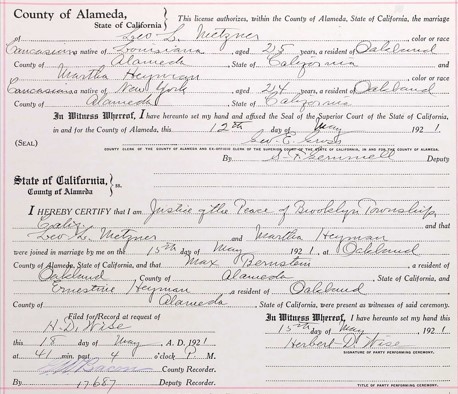
The returned document could identify the actual date and location of the ceremony, the officiant, and sometimes the witnesses.
In some cases, the license and return appear on the same sheet of paper. The license authorizes the marriage, while the completed return documents that the ceremony occurred.
If you find a marriage license with a completed return attached, examine both portions carefully.
The two dates may be different, and they represent different events.
Look Beyond the Marriage License Index
Many online genealogy databases provide searchable indexes of marriage licenses.
These indexes can be useful for identifying a couple and locating a marriage record, but they may contain only a small portion of the information available in the original document.
An index might provide the names of the bride and groom, a date, and a county. The original license could contain additional information, signatures, or references to supporting documents.
It is also important to determine exactly what the indexed date represents. Depending on the collection, it could be the license date, the marriage date, or the date the record was entered into a register.
Whenever possible, examine an image of the original license rather than relying exclusively on an index or transcription.
Where Might You Find Marriage Licenses?
Marriage licenses may survive in county clerk’s offices, courthouses, state or provincial archives, historical societies, libraries, and digitized genealogy collections.
Depending on the jurisdiction, they may be preserved as individual documents, bound registers, microfilmed records, or digital images.
Look for collections described as:
- Marriage Licenses
- Marriage License Applications
- Marriage Records
- Marriage Licenses and Returns
- Marriage Bonds and Licenses
- Marriage Papers
- County Clerk Records
If a searchable database does not produce a result, investigate the relevant county or jurisdiction’s record collections directly.
Also consider whether the couple obtained their license in a neighboring county or another jurisdiction rather than where they resided.
Don’t Overlook Newspaper Marriage License Notices
In some communities, newspapers regularly published lists of marriage licenses issued by local authorities.
These notices might identify the prospective bride and groom and provide additional details such as their ages, residences, or occupations.
A newspaper notice may be particularly useful when the original license is difficult to locate or when you are trying to narrow the date of a proposed marriage.
However, like the license itself, a newspaper notice reporting that a license was issued does not establish that the marriage ceremony occurred.
Newspaper marriage license notices are a separate document type and will be examined in their own Marriage Documents Abound Field Note.
Key Takeaways
- A marriage license was an official authorization permitting a couple to marry.
- The information recorded varies by jurisdiction and period, but licenses may identify ages, residences, marital status, parents, and other useful details.
- A marriage license and a marriage application are not necessarily the same document. Search for both when possible.
- A marriage license does not, by itself, prove that the marriage ceremony occurred.
- Do not automatically treat the license issuance date as the wedding date.
- Look for a completed marriage return, certificate, or register entry documenting the actual ceremony.
- Examine the original license whenever possible rather than relying exclusively on an index.
- Search for supporting documents that may have been created during the licensing process.
- Newspaper marriage license notices may provide additional clues, particularly when the original license is difficult to locate.
Examples