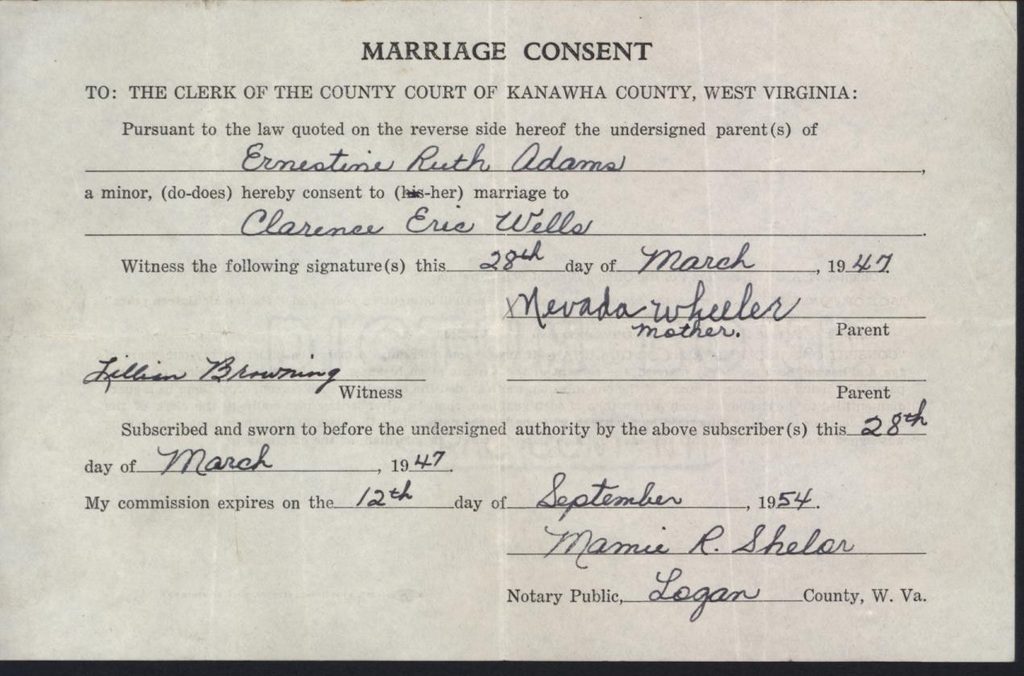
Too young to marry without permission? That requirement may have created another record. An underage consent affidavit can do more than document approval of a marriage—it may identify a parent or guardian and provide evidence of a family relationship that is difficult to find elsewhere.
Introduction
When a prospective bride or groom was below the legal age for marrying without consent, a parent, guardian, or other legally authorized person might have been required to give permission before a marriage license could be issued.
That permission could generate an underage consent affidavit—a sworn statement documenting the consent.
For genealogists, this can be an especially valuable companion to the marriage record. The marriage license or register may identify only the couple, while the consent document may introduce another person directly connected to the underage bride or groom.
Why Was Consent Required?
Marriage laws varied considerably by jurisdiction and period, including the ages at which a person could marry and the age at which parental or guardian consent was required.
When consent was necessary, officials needed some form of evidence that permission had been given. Depending upon local practice, consent might be given in person, through a written statement or letter, or in a sworn affidavit.
The important lesson for researchers is that the marriage itself may not be the only document created by the process.
If either party appears to have been young at the time of marriage, look for supporting consent papers.
What Might an Underage Consent Affidavit Contain?
The contents vary by place and time, but an affidavit may include:
- Name of the prospective bride or groom
- Name of the person providing consent
- Stated relationship to the underage person
- Age or an indication that the person was under legal age
- Name of the intended spouse
- Date consent was given
- Residence or jurisdiction
- Signature or mark of the person giving consent
- Signature of the official taking the affidavit
- Names of witnesses or other participants
Even when the document is brief, a stated relationship such as father, mother, or guardian can make it genealogically significant.
The Parent’s Name May Be the Real Prize
Suppose you already know that 17-year-old Mary Smith married John Brown. Finding another record stating that William Smith, father of Mary Smith, gives his consent changes the value of the marriage evidence considerably.
You now have a document connecting Mary with a named parent.
That can be especially useful when researching women, whose identities before marriage can sometimes be difficult to establish, or when several families with the same surname lived in the same area.
But read the wording carefully. If the person giving consent is identified as a guardian, don’t automatically assume that person was a parent or even a relative.
The relationship stated in the document matters.
A Guardian Can Open Another Door
Finding a guardian rather than a parent may create an entirely new research path.
Why did the prospective bride or groom have a guardian? Were the parents deceased? Was there a formal guardianship proceeding? Was the guardian another relative?
A consent affidavit naming a guardian may point toward probate, estate, guardianship, or court records that contain considerably more information about the family.
In that situation, the marriage document isn’t merely providing another name. It is telling you where to search next.
Don’t Assume Who Gave Consent
It can be tempting to expect the father to appear on an underage consent document, but family circumstances and legal requirements varied.
Consent might come from a father, mother, guardian, or another person legally empowered to provide it.
The absence of a parent from the document should not, by itself, be interpreted as evidence that the parent was dead, estranged, or otherwise unavailable. It is a clue that deserves further investigation—not a conclusion.
Look Beyond the Marriage Register
Consent affidavits and related papers may not have been copied into the permanent marriage register.
Instead, they might survive as loose marriage papers, attachments to a marriage-license application, county court records, or separate consent files.
That creates a familiar genealogy problem: the searchable database may show the marriage, while the more interesting supporting document remains somewhere else.
When a young bride or groom is involved, check the catalog description for collections containing terms such as consents, affidavits, marriage papers, marriage applications, marriage licenses, or loose records.
Whenever possible, look beyond the index and examine the associated images or original files.
Key Takeaways
- Underage marriage could require permission from a parent, guardian, or other legally authorized person.
- That requirement sometimes produced a separate consent affidavit or supporting document.
- The affidavit may identify a parent or guardian who does not appear in the basic marriage record.
- Pay close attention to the relationship actually stated in the document.
- A named guardian may point toward probate, guardianship, estate, or court records.
- Do not assume that an absent parent was deceased simply because someone else provided consent.
- Consent papers may survive separately from the marriage register or license.
- If either spouse married young, search specifically for the supporting marriage papers.
Examples