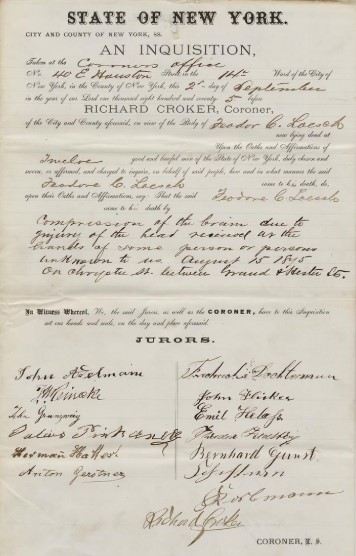
When an ancestor died suddenly, unexpectedly, or under unusual circumstances, their death may have triggered an investigation that created an entirely different set of records. A coroner’s inquest can reveal witnesses, family relationships, and details about an ancestor’s final days that may never appear on a death certificate or in an obituary.
Introduction
A coroner’s inquest was a formal investigation into the circumstances surrounding a person’s death, generally conducted when the death was sudden, unexplained, violent, accidental, or otherwise required official examination.
Depending on the jurisdiction and time period, the investigation might involve a coroner, jury, medical professionals, and witnesses. Its purpose was to establish how, when, and where the person died and, when possible, determine the cause and circumstances of death.
For genealogists, a coroner’s inquest can be one of the most revealing records associated with an ancestor’s death. Unlike a standard death certificate, it may contain testimony from relatives, neighbors, employers, or other individuals who knew the deceased, providing valuable information about the person’s life and relationships.
Why Was a Coroner’s Inquest Conducted?
Not every death required an inquest. The circumstances that triggered an investigation varied by jurisdiction and period, but commonly included:
- Accidents at home, work, or elsewhere
- Sudden or unexpected deaths
- Suspected homicide or suicide
- Deaths where the cause was unknown
- Deaths occurring under suspicious circumstances
- Deaths involving individuals in custody
- Deaths where no physician could establish the cause
An inquest did not necessarily mean that a crime had occurred. A person who died after falling from a ladder, drowning, or suffering an unexpected medical emergency might have been the subject of an investigation simply because the circumstances required official examination.
What Might a Coroner’s Inquest Contain?
The contents vary considerably, but surviving records may include:
- Name of the deceased
- Date and place of death
- Age, residence, and occupation
- Description of the circumstances surrounding the death
- Names of family members or other individuals connected with the deceased
- Names of witnesses and their testimony
- Statements from physicians or other medical professionals
- Findings concerning the cause or manner of death
- Names and signatures of the coroner and jurors
- Verdict or formal conclusion of the investigation
Some records consist of little more than a brief finding or verdict. Others include extensive testimony and supporting documents.
The amount of genealogical information available may depend as much on which portions of the investigation survive as on the circumstances of the death itself.
Witness Testimony May Reveal Unexpected Family Connections
One of the most valuable aspects of a coroner’s inquest is the possibility of finding statements from people who knew the deceased.
A spouse might describe the person’s final hours. A neighbor might explain where the deceased lived or worked. An employer might provide information about an accident. A relative might identify other family members.
Witnesses sometimes explained how they knew the deceased, how long they had known the person, or when they had last seen them.
For example, if an ancestor died in an industrial accident, the inquest might identify coworkers who witnessed the event, describe the workplace, and establish the deceased person’s occupation and employer.
Those details could lead to employment records, city directories, newspaper articles, or other sources documenting the ancestor’s life.
Don’t limit your attention to the verdict. The witness statements may contain the most useful genealogical information in the entire file.
An Inquest May Help Explain a Mysterious Death
Sometimes a death certificate or obituary provides only a brief explanation of how an ancestor died.
A death certificate might record drowning, for example, without explaining the circumstances.
An inquest could reveal where the drowning occurred, who discovered the body, whether the person had been traveling or working, and what witnesses reported about the events leading up to the death.
Such details may help resolve questions about an ancestor’s whereabouts, occupation, or circumstances during their final days.
However, witness statements should be evaluated carefully. Witnesses could be mistaken, provide conflicting accounts, or report information they had heard from someone else.
An inquest documents the investigation and its findings, but not every statement contained in the record should automatically be accepted as established fact.
Look for More Than the Final Verdict
A coroner’s inquest may have generated several separate documents, including witness depositions, medical reports, jurors’ findings, correspondence, and the final verdict.
In some jurisdictions, only a brief summary or verdict was entered into an official register. Elsewhere, the supporting papers were preserved as separate case files.
Finding an indexed inquest entry or brief verdict does not necessarily mean you have found everything associated with the investigation.
When possible, determine whether the original case file or supporting documents survive.
Where Might You Find Coroner’s Inquest Records?
Coroner’s inquest records may be preserved in county courthouses, local government archives, state or provincial archives, historical societies, and other repositories holding judicial or administrative records.
Depending on the jurisdiction and period, they may be cataloged under:
- Coroner’s Inquests
- Coroner’s Records
- Coroner’s Case Files
- Inquest Registers
- County Court Records
- Medical Examiner Records
- Death Investigation Records
Some records have been digitized or indexed, while others remain available only through local archives or government offices. Access may also be restricted for certain records, particularly more recent investigations.
When searching online catalogs, try the terms coroner, inquest, and death investigation, along with the relevant county or jurisdiction.
If you find an inquest register or index, investigate whether the original case papers are available separately.
Don’t Overlook Newspaper Reports of Coroner’s Inquests
Newspapers frequently reported on coroner’s inquests, particularly when a death involved an accident, suspicious circumstances, or an event of public interest.
An article might summarize witness testimony, identify relatives, describe the circumstances of the death, or report the jury’s verdict.
Newspaper coverage may provide details missing from surviving official records and help identify the approximate date and jurisdiction of an inquest.
If an ancestor died under unusual circumstances, search newspapers for several days or weeks following the death.
An initial death report may have been followed by a separate article describing the subsequent inquest.
Newspaper accounts should be treated as separate sources rather than substitutes for original investigation records. Reporters could summarize testimony selectively, misunderstand details, or publish information before the investigation was completed.
Key Takeaways
- A coroner’s inquest was a formal investigation into a death requiring official examination.
- Inquests were commonly associated with sudden, unexpected, accidental, violent, suspicious, or unexplained deaths.
- An inquest does not necessarily indicate that a crime occurred.
- Records may contain details about the deceased’s residence, occupation, family relationships, and final activities.
- Witness testimony may identify relatives, neighbors, coworkers, and other associates who do not appear in conventional death records.
- Look beyond the final verdict for depositions, medical reports, and other supporting documents.
- Evaluate witness statements carefully, particularly when accounts conflict or contain secondhand information.
- Search county and local government records, court collections, and archival catalogs for surviving inquest files.
- Newspaper reports may provide additional details or help locate the original investigation.
- Not every inquest record has survived, and access to some records may be restricted.
Examples