You found your ancestors’ names in a marriage index. Have you found the record behind the entry? Marriage indexes may provide only a bride’s name, a groom’s name, and a date, but they can be the first step toward locating a marriage certificate, license, or register entry containing additional information about the couple and their families. The trick is understanding what was indexed—and where the original record might be found.
Introduction
A marriage index is a finding aid that helps researchers locate records of marriages. It typically identifies the bride and groom and provides enough information to help locate the corresponding marriage record.
For many genealogists, a marriage index is the first record they encounter when searching for an ancestor’s marriage.
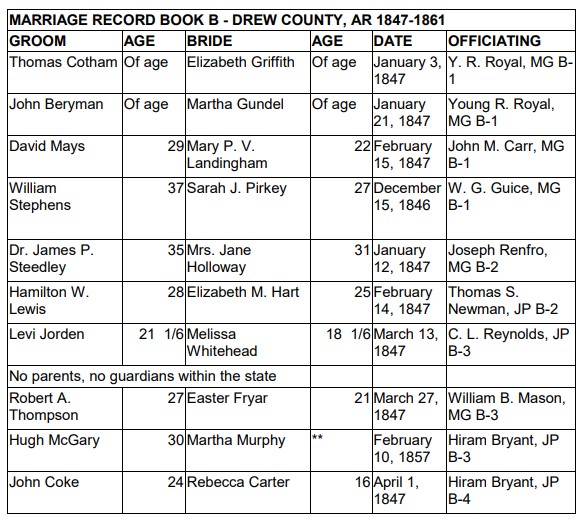
Marriage indexes take many forms. Some were created by county clerks to help locate entries in official marriage books. Others were compiled by libraries, historical societies, genealogy organizations, or volunteers who extracted names and dates from existing records.
Some indexes are searchable online databases. Others are handwritten books, printed volumes, card catalogs, or transcriptions of older marriage registers.
Although the information in an index may be limited, it can provide the essential clue needed to locate a more detailed record.
What Might a Marriage Index Contain?
The information varies according to the original records and the purpose of the index.
An entry may include:
- Name of the bride
- Name of the groom
- Date of marriage
- Date the marriage license was issued
- County or other jurisdiction
- Names of parents
- Ages or residences of the couple
- Name of the officiant
- Marriage certificate or license number
- Marriage book, volume, and page number
Some indexes provide only the names of the bride and groom and a reference number.
Others contain substantial information extracted from marriage applications, certificates, registers, or other records.
A volume and page number, certificate number, or license number may be the most valuable information in the entry because it can lead directly to the underlying marriage record.
County Marriage Books and Indexes
Many counties maintained marriage books containing records of marriages performed or registered within their jurisdiction.
To make those records easier to locate, county clerks sometimes created separate indexes organized by the surname of the bride, groom, or both.
An index entry might identify the couple and provide a volume and page number directing the researcher to the corresponding marriage record.
In some counties, marriage information was copied from original records into bound volumes. These transcribed marriage books may contain only selected details, even when the original documents included additional information.
The terminology can be confusing. A volume labeled Marriage Book might contain detailed marriage records, a chronological register, or an alphabetical index directing researchers to another volume.
Do not assume that a county marriage book contains the original marriage record simply because it lists the couple’s names and marriage date.
Examine the volume’s title, introduction, column headings, and references to determine its purpose.
If an entry includes a book and page number, investigate whether it refers to another record that can be examined.
Marriage Registers Can Function as Indexes
Marriage registers are generally maintained to record marriages, rather than simply to index them. However, some registers contain only brief entries identifying the bride, groom, marriage date, and certificate or license number.
For genealogists, these registers can function much like indexes.
For example, a county marriage register might list a couple’s names and provide a certificate number that directs the researcher to a separate marriage certificate or return.
The register may establish that a marriage was recorded, but the associated document could contain additional information about the couple, their parents, witnesses, or officiant.
When a marriage register provides a certificate or license number, use that reference to investigate whether a separate document survives.
A brief register entry may be only one part of the county’s marriage record collection.
Library and Historical Society Marriage Indexes
Libraries, historical societies, and genealogical societies have created marriage indexes from a wide variety of sources.
These may include:
- County marriage registers
- Marriage certificates and licenses
- Church marriage records
- Published marriage books
- Newspaper marriage announcements
- Family Bibles
- Local histories and genealogical publications
Some indexes combine information from several sources into a single collection.
For example, a library’s marriage index might contain entries extracted from county marriage records alongside marriage announcements published in local newspapers.
The resulting index may be especially useful when original records are scattered among different repositories or when the researcher does not know which source contains the marriage information.
However, the source of each entry matters.
A marriage date extracted from a county marriage register is not necessarily the same kind of evidence as a date reported in a newspaper announcement or family history.
Look for a source citation, collection description, or reference identifying where the indexed information originated.
Volunteer-Created Marriage Indexes
Volunteer genealogy projects have made an enormous amount of marriage information available online.
Sites such as USGenWeb and Genealogy Trails may provide marriage indexes and transcriptions contributed by volunteers working with county records, newspapers, church registers, and other historical sources.
These collections can be particularly useful when the original records have not been digitized or are difficult to locate through large genealogy databases.
A volunteer-created index might identify a marriage that would otherwise require searching through handwritten county books or historical newspaper issues.
However, the amount of information provided varies.
Some entries include a detailed source reference, while others provide only names and dates.
When you find a promising entry, look for information identifying the original source and the location of the underlying record.
If no source is provided, use the names, date, and location as clues for further investigation rather than treating the indexed entry as the final documentation of the marriage.
An Index Entry Is Not Necessarily Proof That a Marriage Occurred
This is an important distinction.
Not every collection labeled Marriage Index was created from records of completed marriages.
Some indexes were compiled from marriage licenses, marriage applications, marriage bonds, or other documents associated with an intended marriage.
A couple could obtain a marriage license without subsequently marrying.
Similarly, a newspaper engagement announcement or notice of an issued marriage license does not establish that the ceremony occurred.
Before recording an indexed date as the actual marriage date, determine what type of document was indexed.
If the source was a marriage license, the date may refer to when permission to marry was granted rather than when the wedding took place.
Look for a marriage return, certificate, register entry, or another record documenting the completed ceremony.
Understand What the Index Covers
A marriage index does not necessarily include every marriage that occurred in a particular location.
Coverage may be limited by:
- Dates: The index may cover only certain years.
- Geography: It may include one county, city, parish, or other jurisdiction.
- Record type: It may index marriage licenses, certificates, registers, or another specific collection.
- Record survival: Some original records may have been lost or damaged.
- Indexing progress: Only part of a larger collection may have been transcribed or made available online.
A library or volunteer project may also have indexed only the records available to its contributors.
Before concluding that an ancestor’s marriage is missing, examine the collection description to determine which records were included.
An unsuccessful search of one marriage index does not establish that no marriage record exists.
Search for Both the Bride and the Groom
Marriage indexes may be organized by the groom’s surname, the bride’s surname, or both.
Some older county indexes provide separate sections for brides and grooms. Others may list only one party alphabetically.
When searching online, try both names independently.
If the bride does not appear under her expected surname, consider whether she had been married previously and may have used a different surname at the time of the marriage.
Also search for:
- Alternative surname spellings
- Given-name variations and nicknames
- Initials instead of full given names
- A broader range of dates
- Neighboring counties or jurisdictions
Indexing errors can occur when handwritten names are misread or when information is transcribed incorrectly.
If the collection allows you to browse the original index pages, examine nearby entries rather than relying entirely on the searchable database.
One Marriage May Appear in Several Indexes
Finding the same couple in multiple marriage indexes does not necessarily mean that several independent records of their marriage exist.
A county clerk may have created an index to a marriage register. A library may later have transcribed that index, and a volunteer genealogy website may have published the library’s transcription.
The couple could then appear in three separate online collections, even though all three entries originated from the same county record.
Comparing the entries can still be useful. One transcription may include a certificate number or other detail omitted from another.
However, determine whether the indexes refer to the same underlying record before treating them as independent evidence.
Several index entries copied from one marriage record do not independently confirm the information in that record.
Use the Index to Find the Underlying Record
Once you identify a promising marriage index entry, determine what record it references.
Look for a certificate number, license number, volume and page reference, newspaper citation, or other source information.
Depending on the collection, the underlying record may be held by:
- A county clerk or other local government office
- A state or provincial archive
- A church or denominational archive
- A library or historical society
- A genealogy organization
- A newspaper archive
If the index links to a digitized image, examine the original record whenever possible.
If no image is available, investigate whether the record can be accessed through the repository that maintains it.
A brief index entry may lead to a marriage application, license, certificate, return, or church register containing information that was never included in the index.
The goal is not simply to find your ancestors’ names in a marriage index. It is to discover what record the index can help you locate.
Key Takeaways
- Marriage indexes are often the first resources genealogists encounter when searching for an ancestor’s marriage.
- County marriage books may contain original entries, transcribed records, or indexes directing researchers to other volumes.
- Some marriage registers function as indexes by providing brief entries and certificate or license numbers.
- Libraries, historical societies, and volunteer projects create marriage indexes from many different sources.
- Read the collection description to determine exactly what was indexed.
- An entry derived from a marriage license or application does not necessarily establish that the marriage occurred.
- Search for both the bride and groom, using alternative names and spellings when necessary.
- Multiple index entries may originate from the same underlying marriage record.
- Use certificate numbers, volume and page references, and source citations to locate the associated document.
- Whenever possible, examine the underlying marriage record for information not included in the index.
Examples