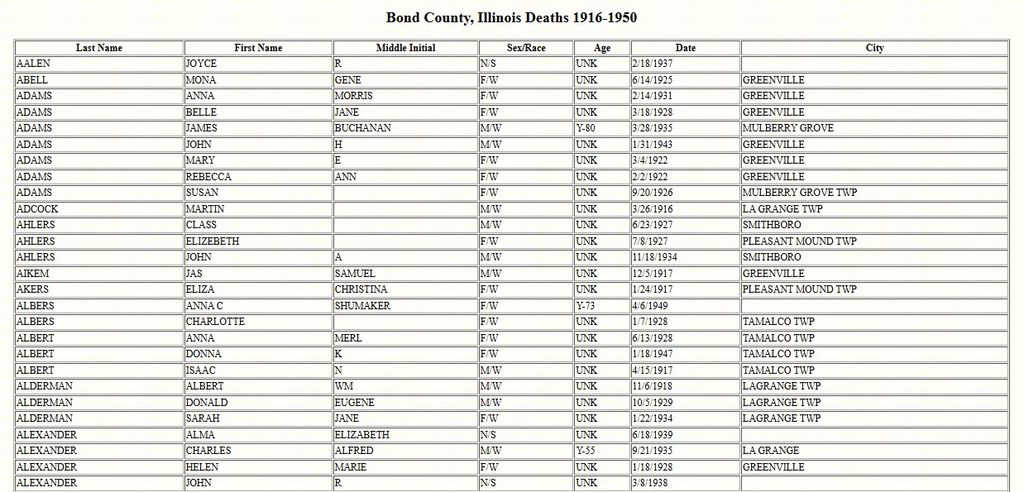
You found your ancestor in a death index. Have you found the record behind the entry? A death index may provide only a name, date, and location, but those few details can lead you to a death certificate, registration, or another record containing information about your ancestor and their family. The index is often the beginning of the search, not the end.
Introduction
A death index is a finding aid that helps researchers locate records of deaths. It typically lists individuals whose deaths were recorded by a government agency, church, or other recordkeeping organization.
Death indexes are among the most widely available online genealogy resources. Many of the free death-record collections available through libraries, archives, government agencies, and genealogy websites are indexes rather than images of the original records.
For genealogists, a death index can establish a promising lead when searching for an ancestor’s death and provide the information needed to locate the underlying record.
The important distinction is that a death index and a death record are not necessarily the same thing.
An index may contain only selected information extracted from a death certificate, death register, or other original record. The underlying document may contain considerably more genealogical information.
What Might a Death Index Contain?
The information included in a death index depends on the original records, the indexing process, and the organization that created it.
An entry may include:
- Name of the deceased
- Date of death
- Place of death
- Age at death or date of birth
- Sex
- Place of residence
- Names of parents or spouse
- Certificate or registration number
- Volume and page number
- Name of the government office or jurisdiction where the death was recorded
Some indexes provide only a name and death date. Others contain enough information to help distinguish between individuals with similar names.
A certificate number, registration number, or volume and page reference may be particularly valuable because it can help you locate or request the original record.
A Death Index Is Not a Death Certificate
One of the most common mistakes when using online death collections is assuming that an indexed entry contains everything recorded about the death.
For example, an online index might identify an ancestor by name, death date, county, and certificate number.
The corresponding death certificate could also identify the person’s parents, spouse, birthplace, occupation, usual residence, cause of death, and place of burial.
Those additional details may be essential when researching an ancestor whose identity or family relationships are uncertain.
Whenever possible, use the index entry to locate the original death record.
Look for a link to a digitized image, a certificate number, or instructions for obtaining a copy from the appropriate government office or archival repository.
If the index does not identify its underlying records, investigate the collection description to determine what was indexed.
A Death Index Is Not Necessarily an Obituary Index
The terms death index and obituary index are sometimes used interchangeably, particularly by libraries, historical societies, and other organizations that have created their own local collections. However, they do not necessarily describe the same thing.
A traditional death index generally points to an official death record, such as a death certificate, death registration, or death register entry.
An obituary index generally points to an obituary or death notice published in a newspaper. Instead of a death certificate number, it may provide information such as:
- Name of the deceased
- Date of death
- Name of the newspaper
- Date the obituary or death notice was published
- Page or column number
To make matters more interesting, some indexes combine both types of information. An entry might provide the individual’s date of death along with the newspaper title and publication date of an obituary.
And terminology is not always consistent. A library may call its collection a Death Index even though its primary purpose is to direct researchers to newspaper obituaries. Another repository may call essentially the same type of collection an Obituary Index.
Don’t rely on the title of the index alone. Read the collection description and examine the information provided in the entries to determine exactly what has been indexed and where the index can lead you.
If an entry includes a newspaper title and publication date, you may have been handed another research lead: go find the newspaper article itself.
Understand What the Index Actually Covers
A collection labeled Death Index does not necessarily include every death that occurred in a particular location.
Coverage may be limited by:
- Dates: The index may cover only certain years.
- Geography: It may include one county, city, state, or other jurisdiction rather than an entire country.
- Record type: It may index death certificates, death registrations, church death registers, or another specific collection.
- Record survival: Some original records may have been lost or never transferred to the repository.
- Indexing progress: Only part of a larger collection may have been indexed or made available online.
Death registration requirements also changed over time and varied by jurisdiction. A death may have occurred before systematic registration began or during a period when compliance was incomplete.
Before concluding that an ancestor does not appear in a death index, read the collection’s description and determine which records, dates, and locations it actually includes.
An unsuccessful search of one index does not establish that no death record exists.
Search for Name Variations and Indexing Errors
Death indexes are useful, but they are not free from errors.
A name may have been misspelled in the original record, misread during indexing, or entered incorrectly into a searchable database.
Older handwritten records can be especially difficult to interpret. Similar-looking letters, unfamiliar surnames, abbreviations, and damaged pages may result in inaccurate index entries.
When an expected ancestor does not appear, try:
- Alternative spellings of the surname
- Given-name variations and nicknames
- Initials instead of full given names
- A married or maiden surname, when applicable
- A broader range of death dates
- Nearby counties or other jurisdictions
- Searching by a spouse’s or parent’s name, if the database permits it
If the collection allows browsing by date, location, or register volume, examine the relevant records directly rather than relying entirely on the name search.
A person may be present in the underlying collection even when the searchable index does not return their name.
Pay Attention to the Location
The place associated with a death index entry may refer to the location where the death occurred, where it was registered, or the jurisdiction responsible for maintaining the record.
It may not be the deceased person’s usual residence.
For example, an ancestor who lived in one county might have died in a hospital in a neighboring county. Their death could appear in an index associated with the county where the hospital was located.
Similarly, a person who died while traveling might appear in records maintained far from their home.
When searching for a missing death record, consider where the person may have died rather than searching exclusively in the place where they last lived.
If the index identifies both a place of death and a place of residence, record those details separately.
Watch for Differences Between Dates
A death index may contain a death date, a registration date, or both.
The date a death was recorded is not necessarily the date the person died.
Some indexes also contain only a month or year, while others use a registration quarter or another reporting period.
Read the collection description and column headings carefully to determine what each date represents.
If an index entry provides a registration date rather than an exact death date, do not enter it into your family tree as the date of death without additional evidence.
The original death certificate or registration may clarify the distinction.
One Death May Appear in Several Indexes
Finding the same ancestor in multiple death indexes does not necessarily mean that several independent death records exist.
Different genealogy websites, archives, or organizations may have indexed the same underlying government collection.
One database might provide only the deceased person’s name and death year, while another includes a certificate number, age, or county.
Comparing the entries can be useful, particularly when one index provides information missing from another.
However, determine whether the indexes were created from the same original record before treating them as independent evidence.
Three online index entries derived from one death certificate are not the same as three separate records confirming the death.
Use the Index to Find the Original Record
Once you identify a promising index entry, examine the collection information to determine where the original record is held.
Depending on the jurisdiction and period, the underlying document may be available through:
- A government vital records office
- A state or provincial archive
- A county or municipal records office
- A library or historical society
- A digitized collection maintained by a genealogy organization
Look for a certificate number, registration number, volume and page reference, or other identifier.
If the index provides a direct link to an image, examine the original document and record any additional information it contains.
If no image is available, investigate whether a copy can be requested from the responsible office or repository.
Access rules, fees, and availability vary by jurisdiction and the age of the record.
Don’t Stop at the First Matching Name
An index entry that matches your ancestor’s name and approximate death date is a useful lead, but it may not identify the correct person.
This is particularly important when researching individuals with common names.
Compare the index information with what you already know about the ancestor, including age, residence, spouse, occupation, and family relationships.
If several possible matches appear, investigate each one before selecting a record.
The underlying death certificate or registration may contain the additional information needed to distinguish your ancestor from someone else with the same name.
Treat an index match as a lead to investigate, not automatic proof that you have found the correct person.
Key Takeaways
- A death index is a finding aid that helps researchers locate records of deaths.
- Many online death collections contain indexed entries rather than images of the original documents.
- Indexes may provide names, dates, locations, ages, and certificate or registration numbers.
- The underlying death record may contain substantially more genealogical information than the index entry.
- Read the collection description to understand its geographic coverage, date range, and the type of records indexed.
- An unsuccessful search does not establish that no death record exists.
- Search name variations, broader date ranges, and neighboring jurisdictions when necessary.
- Distinguish the place of death from the person’s residence and the death date from the registration date.
- Multiple indexes may have been created from the same original record.
- Whenever possible, use the index to locate the original death certificate, registration, or other underlying document.
Examples