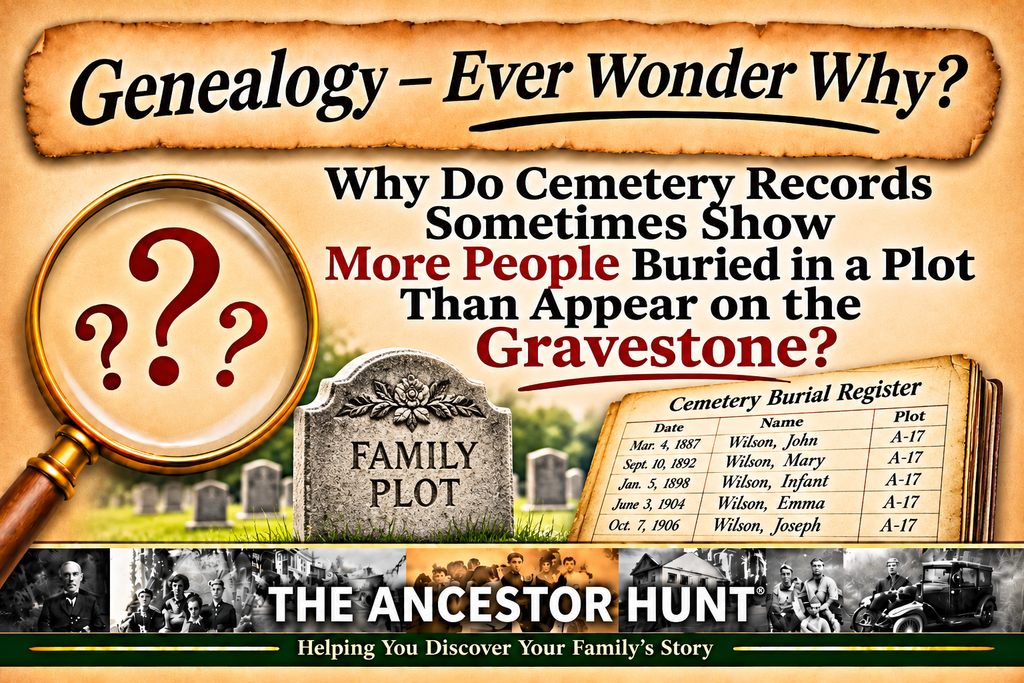
Imagine visiting your ancestors’ cemetery and finding a beautiful family monument bearing the names of three family members. You photograph the monument, record the names and dates, and consider your cemetery research complete.
But what if the cemetery’s burial register reveals that seven people were actually buried in that family plot?
Who were the other four people? And why weren’t their names included on the monument?
There are several fascinating explanations. Some may lead to genealogical discoveries you never expected to make.
Infants and Stillborn Children Were Sometimes Buried Without Inscriptions
One of the most significant possibilities for genealogists involves infants and stillborn children.
Children who died shortly after birth were sometimes buried in existing family plots without receiving individual gravestones or having their names added to the family monument.
In some cases, an infant was buried in the same grave as another family member.
The cemetery’s burial register might identify these children by name or simply record them as “Infant of,” followed by a parent’s name.
For genealogists, these entries can be particularly valuable when a child was born and died between census years or before civil registration of births and deaths became widespread.
The cemetery register may contain evidence of a child whose existence you never suspected.
Family Monuments Were Not Always Updated
A large family monument might have been purchased when the first member of a family died, with additional names intended to be added as subsequent family members were buried.
But those additions did not always occur.
There were several possible reasons:
- Surviving family members could not afford additional inscriptions.
- The person responsible for maintaining the family plot had died or moved away.
- Later generations had lost contact with other branches of the family.
- There was insufficient space on the original monument.
- Arrangements to add inscriptions were simply never completed.
The cemetery continued recording burials, but the monument remained unchanged.
What appears to be a complete family monument may actually represent only the first few decades of a family plot’s use.
Individual Gravestones May Have Disappeared
Not everyone buried in a family plot was necessarily intended to be identified on the central monument.
Some family plots contained a large central monument surrounded by smaller individual markers identifying the people buried there.
Over the decades, those smaller markers may have:
- Deteriorated or broken.
- Sunk beneath the surface of the ground.
- Been damaged by cemetery maintenance equipment.
- Been removed because they presented a safety hazard.
- Disappeared through vandalism or neglect.
Wooden markers were particularly vulnerable to deterioration.
The large family monument may have survived for more than a century while the smaller markers identifying other occupants of the plot disappeared entirely.
What you see today may be considerably different from what a cemetery visitor would have seen 100 years ago.
People Other Than Immediate Family Members Were Buried in Family Plots
The surname on a family monument does not necessarily identify the surnames of everyone buried in the plot.
Family burial plots sometimes accommodated people such as:
- Married daughters and their spouses.
- Relatives of a spouse.
- Nieces, nephews, and cousins.
- Stepchildren and other members of blended families.
- Close friends or other individuals permitted to be buried there.
Depending on cemetery regulations and the burial rights associated with the plot, individuals outside the immediate family could be interred there with the appropriate authorization.
Their names may never have been added to the principal family monument.
This is an excellent reason to obtain a complete list of everyone buried in a family plot, rather than limiting your research to people with your ancestor’s surname.
An unfamiliar surname in a cemetery register could reveal a previously unknown marriage or family connection.
More Than One Person Could Be Buried in a Single Grave
We tend to think of a grave as the final resting place of one person. However, that is not always the case.
Depending on cemetery practices, regulations, and burial arrangements, a single grave could contain more than one burial.
Examples include:
- Double-depth burials, in which two caskets are buried at different depths.
- Cremated remains interred in an existing family grave.
- Infants buried with another family member.
- Remains transferred from another burial location into an existing grave, where permitted.
Additional burials did not necessarily result in additional inscriptions.
Consequently, even counting the number of individual gravestones in a family plot may not tell you how many people are actually buried there.
Remains Were Sometimes Transferred Into Existing Family Plots
Over the years, remains were sometimes removed from one cemetery and reinterred in another.
This could occur because of cemetery closures, construction projects, flooding, family decisions, or the relocation of older burial grounds.
A family might arrange to have the remains of several relatives transferred into an established family plot.
The cemetery receiving those remains might record the reinterments in its records, but the existing family monument might never be modified to reflect the additional burials.
Another interesting consequence is that the date of interment in a cemetery register could be many years later than the person’s actual date of death.
That discrepancy may be a clue to investigate an earlier burial location.
What Does This Mean for Your Genealogy Research?
A gravestone photograph is an excellent genealogical resource, but it should not be considered a complete record of a family burial plot.
Whenever possible, investigate additional cemetery records, including:
- Burial and interment registers.
- Lot and plot records.
- Cemetery plot maps.
- Burial permits.
- Burial rights and lot ownership records.
- Disinterment and reinterment records.
- Older cemetery surveys and gravestone transcriptions.
When contacting a cemetery, consider asking a different question.
Instead of simply asking for information about a particular ancestor, ask for a list of everyone interred in that ancestor’s burial plot, including individuals with different surnames.
Also, distinguish between people actually interred in the plot and people listed only as lot owners or holders of burial rights. They are not necessarily the same.
The results may surprise you.
A Clue Worth Remembering
A family monument tells us whom someone chose to commemorate. A cemetery burial register may tell us who was actually buried there.
Those are two very different things.
The names missing from a family gravestone may be just as important to your genealogy research as the names carved into it.