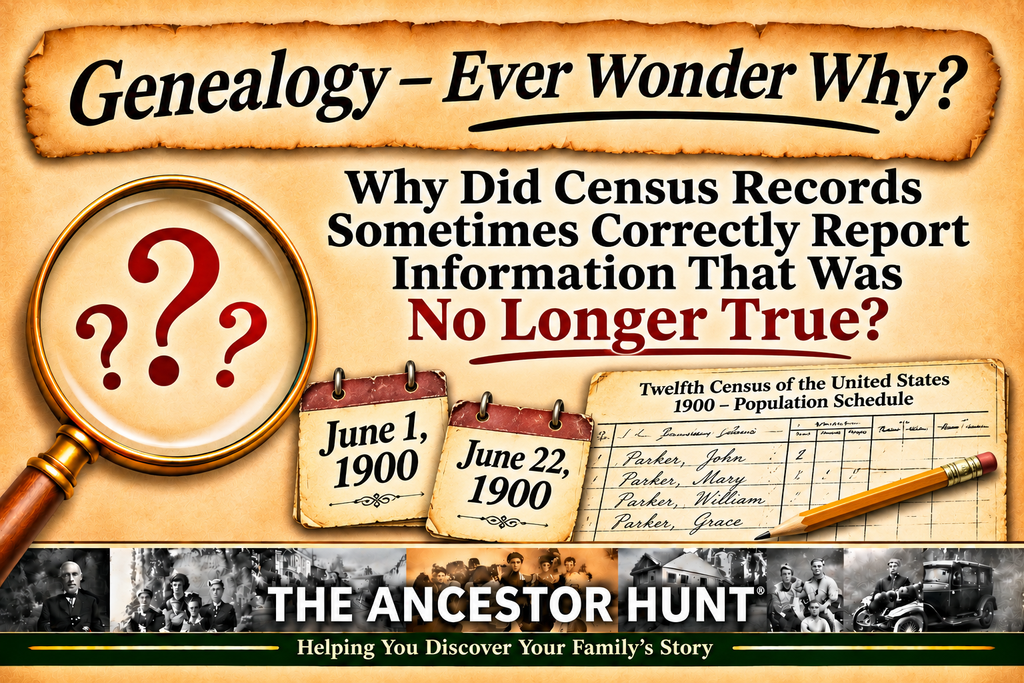
Imagine discovering your ancestor in a census record dated three weeks after their documented death.
Or finding a marriage certificate that proves your ancestor was married before the enumerator visited, yet the census lists them as single.
Perhaps a child you know was already born when the enumerator visited the family is completely missing from the census.
Were these mistakes? Did the family provide incorrect information? Was the enumerator careless?
Surprisingly, the enumerator may have been following government instructions.
The Census Was Designed to Capture a Single Moment in Time
Taking a nationwide census was an enormous undertaking. It was impossible for enumerators to visit every household in the country on the same day.
Yet the government wanted a statistical picture of the population as it existed on a particular date.
To accomplish this, each census had an official reference date, commonly referred to as Census Day.
Regardless of when an enumerator visited a household, the population count was supposed to reflect who lived there on that official date. Many personal characteristics were also supposed to reflect circumstances as of that date.
There were essentially two dates of importance:
- The Official Census Date – The date the government wanted the information to represent.
- The Enumeration Date – The date the enumerator actually collected or recorded the information.
Depending on the circumstances, there could be a considerable difference between those two dates.
And during that interval, many things could change in your ancestors’ lives.
People Who Had Already Died Were Supposed to Be Included
Perhaps the most surprising consequence of the official census date is that enumerators were sometimes required to include people who were already dead.
Consider this hypothetical example from the 1900 census:
- June 1 – Official Census Day.
- June 8 – Your ancestor dies.
- June 22 – The enumerator visits the household.
Your ancestor should still have been included in the census because they were alive on June 1.
The enumerator’s inclusion of your deceased ancestor was not an error. The enumeration was intended to represent an earlier point in time.
Imagine the confusion this could cause a genealogist who discovers a death certificate dated two weeks before the enumeration date.
Both documents could be entirely accurate.
This is particularly important when attempting to establish the latest date on which an ancestor was known to be alive.
The date at the top of the census page does not necessarily establish that your ancestor was alive on that date.
Babies Already Born Were Supposed to Be Excluded
The opposite situation could occur with newborn children.
Consider another hypothetical example using the 1900 census:
- June 1 – Official Census Day.
- June 5 – A child is born.
- June 20 – The enumerator visits the household.
Although the baby was alive and possibly being held by the mother during the interview, the child was not supposed to be included in the census.
The baby had not yet been born on the official census date.
A genealogist who compares the child’s birth certificate with the date of the enumeration might reasonably conclude that the child had been overlooked.
But the omission may have been entirely appropriate.
This is another reason why the absence of a child from a census household does not necessarily establish that the child was living somewhere else, had died, or had been accidentally omitted.
Married Ancestors Could Correctly Be Recorded as Single
Marital status could also change between Census Day and the enumerator’s visit.
Imagine that an unmarried woman was living with her parents on the official census date. Two weeks later, she married and moved into her husband’s home.
By the time the enumerator arrived, she was a married woman living in a different household.
Under the census reference-date principle, her unmarried status and usual residence on Census Day were the relevant circumstances.
A similar situation could occur when someone became widowed or divorced after Census Day.
A woman whose husband had recently died could still correctly be recorded as married, rather than widowed.
These possibilities are particularly worth investigating when marriage, divorce, and death records contain dates close to the official census date.
An apparent contradiction between two records might not be a contradiction at all.
Your Ancestor’s Recorded Age Could Already Be Outdated
Genealogists frequently encounter discrepancies between ages recorded in census records and ages calculated from known birth dates.
Sometimes the official census date provides an explanation.
Suppose your ancestor was born on June 10, 1860.
On June 1, 1900, your ancestor was 39 years old.
When the enumerator visited on June 20, your ancestor was 40 years old.
The age appropriate for the 1900 census was 39, even though the individual was already 40 when the information was collected.
This distinction becomes particularly important when using census ages to estimate birth years or narrow down possible birth dates.
Before concluding that an ancestor gave an incorrect age, consider whether a birthday occurred between Census Day and the date of enumeration.
The enumerator may have recorded exactly the age required by the census instructions.
Your Ancestors Could Be Recorded Where They No Longer Lived
Families did not necessarily remain in the same residence throughout the census-taking period.
They moved between houses, neighborhoods, towns, counties, and sometimes states.
The census was generally intended to count people at their usual place of residence on Census Day.
Consequently, a family that moved after that date could legitimately be associated with its former residence.
An apparent conflict between a census address and an address found in a city directory, property transaction, or newspaper might simply reflect a move during the enumeration period.
Of course, tracking people who moved presented practical difficulties for enumerators.
If the family had already departed, obtaining accurate information about them might be difficult. At their new residence, the family might be incorrectly counted again.
Such circumstances could contribute to duplicate census entries or missing families.
The timing of a move is therefore worth investigating when an ancestor appears in an unexpected location.
Not Every Census Question Referred to Census Day
There is another important distinction.
Although the census used an official reference date, certain questions concerned events or circumstances during entirely different periods.
For example:
- The 1910 census asked whether an individual had been out of work on April 15 and also requested information about weeks of unemployment during 1909.
- The 1940 census included questions about residence on April 1, 1935, as well as employment during a specified week in March 1940 and income during 1939.
In other words, a single census entry can contain information relating to several different points in an ancestor’s life.
The date associated with a particular answer depended on what the census question actually asked.
Reading the original instructions can help identify the time period that a particular census column represents.
The Official Census Date Changed Over the Years
Genealogists should not assume that every federal census used the same official date.
Here are the official dates for the U.S. federal population censuses from 1790 through 1950:
| Census Year(s) | Official Census Date |
|---|---|
| 1790, 1800, 1810, 1820 | First Monday in August |
| 1830–1900 | June 1 |
| 1910 | April 15 |
| 1920 | January 1 |
| 1930, 1940, 1950 | April 1 |
These are the standard federal census reference dates. Special enumeration procedures could apply in certain locations.
Knowing the correct date for the particular census you are researching can help resolve apparent discrepancies involving ages, births, deaths, marital status, and residences.
The Census Bureau’s current FAQ identifies June 2 as Census Day in 1890, while its older published historical tables identify June 1.
The change from April 15 in 1910 to January 1 in 1920 also means that those two censuses were not exactly ten years apart.
This is another factor to consider when comparing an ancestor’s recorded ages across consecutive censuses.
What Does This Mean for Your Genealogy Research?
Whenever you examine a census record, consider both the official census date and the actual enumeration date.
Pay particular attention to births, deaths, marriages, divorces, birthdays, and changes of residence that occurred between those dates.
Consult the original census enumerator instructions when the information appears inconsistent with evidence from another historical record.
Remember, however, that enumerators and informants did not always follow the instructions correctly. The official census date provides a possible explanation for a discrepancy, not automatic proof that the census entry was accurate.
Dates that you may previously have considered unimportant could provide the explanation for a genealogical mystery.
A Clue Worth Remembering
A census record does not necessarily describe your ancestors’ lives on the day someone knocked on their door.
It was generally intended to describe their lives on a predetermined date, even when their circumstances had subsequently changed.
Before deciding that a census record is wrong, make sure you know the date for which it was supposed to be right.
Sources and Further Reading
The original enumerator instructions are particularly valuable for this article. They explicitly support several of our most interesting discoveries.
- 1900 Census – Instructions to Enumerators – Paragraphs 65 and 109–111 cover usual residence, newborn children, deceased individuals, and difficulties avoiding duplicate enumerations. Paragraph 110 specifically instructed enumerators to record qualifying deceased individuals “precisely as if still living.” 1900 Enumerator Instructions+1
- 1910 Census – Instructions to Enumerators – Paragraphs 100, 110, 112, 114 and 115 cover residence, age, children’s ages, changes in marital status, and marriage duration. Paragraph 178 covers employment status. 1910 Enumerator Instructions
- 1920 Census – Instructions to Enumerators – Includes instructions about recording actual enumeration dates, including when a census page was completed over multiple days. 1920 Enumerators Instructions
- 1940 Census – Instructions to Enumerators – Includes questions relating to earlier periods of residence, employment, and income. 1940 Enumerators Instructions
- U.S. Census Bureau – History of Demographic Surveys – Official census dates throughout U.S. history.