The Ancestor Hunt regularly adds and updates new collection links, as well as searches for and fixes broken links.
(This page's most recent update is May 2026)
Practical solutions for real genealogy research problems. Explore the new Field Guides
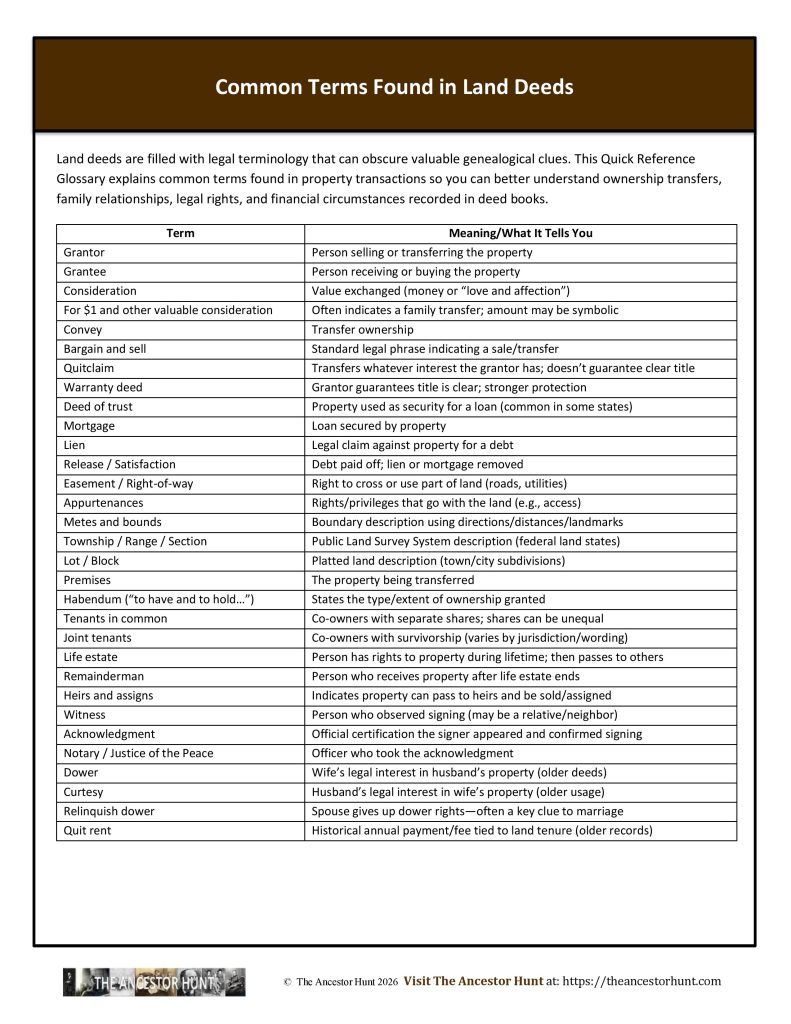
Land deeds are filled with legal terminology that can obscure valuable genealogical clues. This Quick Reference Glossary explains common terms found in property transactions so you can better understand ownership transfers, family relationships, legal rights, and financial circumstances recorded in deed books.
| Term | Meaning |
|---|---|
| Grantor | Person selling or transferring the property |
| Grantee | Person receiving or buying the property |
| Consideration | Value exchanged (money or “love and affection”) |
| For $1 and other valuable consideration | Often indicates a family transfer; amount may be symbolic |
| Convey | Transfer ownership |
| Bargain and sell | Standard legal phrase indicating a sale/transfer |
| Quitclaim | Transfers whatever interest the grantor has; doesn’t guarantee clear title |
| Warranty deed | Grantor guarantees title is clear; stronger protection |
| Deed of trust | Property used as security for a loan (common in some states) |
| Mortgage | Loan secured by property |
| Lien | Legal claim against property for a debt |
| Release / Satisfaction | Debt paid off; lien or mortgage removed |
| Easement / Right-of-way | Right to cross or use part of land (roads, utilities) |
| Appurtenances | Rights/privileges that go with the land (e.g., access) |
| Metes and bounds | Boundary description using directions/distances/landmarks |
| Township / Range / Section | Public Land Survey System description (federal land states) |
| Lot / Block | Platted land description (town/city subdivisions) |
| Premises | The property being transferred |
| Habendum (“to have and to hold…”) | States the type/extent of ownership granted |
| Tenants in common | Co-owners with separate shares; shares can be unequal |
| Joint tenants | Co-owners with survivorship (varies by jurisdiction/wording) |
| Life estate | Person has rights to property during lifetime; then passes to others |
| Remainderman | Person who receives property after life estate ends |
| Heirs and assigns | Indicates property can pass to heirs and be sold/assigned |
| Witness | Person who observed signing (may be a relative/neighbor) |
| Acknowledgment | Official certification the signer appeared and confirmed signing |
| Notary / Justice of the Peace | Officer who took the acknowledgment |
| Dower | Wife’s legal interest in husband’s property (older deeds) |
| Curtesy | Husband’s legal interest in wife’s property (older usage) |
| Relinquish dower | Spouse gives up dower rights—often a key clue to marriage |
| Quit rent | Historical annual payment/fee tied to land tenure (older records) |
Download the Quicksheet PDF
To obtain the Quicksheet PDF of this information, download it by clicking on the Download button below:
For all the previously published Quick Reference Guides, click on QuickSheets.
If you use Quicksheets often, the Quicksheet Vault puts 450+ of them in one organized place — clean, printable, and easy to reuse whenever you need them. Whether you keep digital references handy or build your own genealogy binder, the Vault makes research simpler. Learn more about the Quicksheet Vault HERE