The Ancestor Hunt regularly adds and updates new collection links, as well as searches for and fixes broken links.
(This page's most recent update is May 2026)
Practical solutions for real genealogy research problems. Explore the new Field Guides
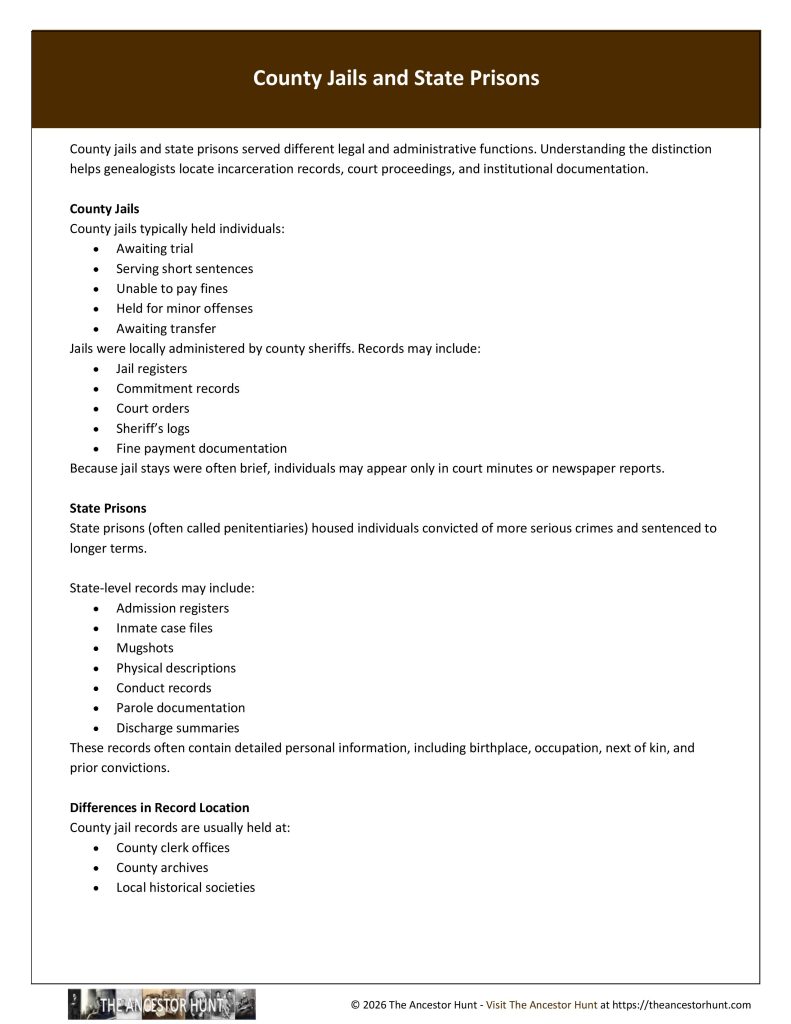
County jails and state prisons served different legal and administrative functions. Understanding the distinction helps genealogists locate incarceration records, court proceedings, and institutional documentation.
County Jails
County jails typically held individuals:
- Awaiting trial
- Serving short sentences
- Unable to pay fines
- Held for minor offenses
- Awaiting transfer
Jails were locally administered by county sheriffs. Records may include:
- Jail registers
- Commitment records
- Court orders
- Sheriff’s logs
- Fine payment documentation
Because jail stays were often brief, individuals may appear only in court minutes or newspaper reports.
State Prisons
State prisons (often called penitentiaries) housed individuals convicted of more serious crimes and sentenced to longer terms.
State-level records may include:
- Admission registers
- Inmate case files
- Mugshots
- Physical descriptions
- Conduct records
- Parole documentation
- Discharge summaries
These records often contain detailed personal information, including birthplace, occupation, next of kin, and prior convictions.
Differences in Record Location
County jail records are usually held at:
- County clerk offices
- County archives
- Local historical societies
State prison records are commonly located at:
- State archives
- Department of Corrections archives
- State libraries
Census Clues
Individuals incarcerated at the time of enumeration may appear:
- Listed under the institution name
- Identified as “Inmate”
- Recorded with occupation listed as “Prisoner”
- Enumerated without family members
Institutional entries often group inmates together in census schedules.
Newspaper Coverage
Local newspapers frequently reported:
- Arrests
- Trials
- Sentencing
- Jail escapes
- Prison transfers
- Pardons
Even short jail stays may be documented in legal notices or crime columns.
Additional Record Sources
Related records may include:
- Court trial transcripts
- Indictments
- Grand jury records
- Pardons and clemency petitions
- Governor’s correspondence
- Parole board records
Research Considerations
Incarceration records can provide:
- Physical descriptions
- Alias names
- Family contacts
- Immigration details
- Prior residence
- Criminal history
However, access restrictions may apply for more recent records.
Understanding whether an ancestor was held in a county jail or a state prison helps determine where records are most likely to be found.
Download the Quicksheet PDF
To obtain the Quicksheet PDF of this information, download it by clicking on the Download button below:
For all the previously published Quick Reference Guides, click on QuickSheets.
If you use Quicksheets often, the Quicksheet Vault puts 450+ of them in one organized place — clean, printable, and easy to reuse whenever you need them. Whether you keep digital references handy or build your own genealogy binder, the Vault makes research simpler. Learn more about the Quicksheet Vault HERE