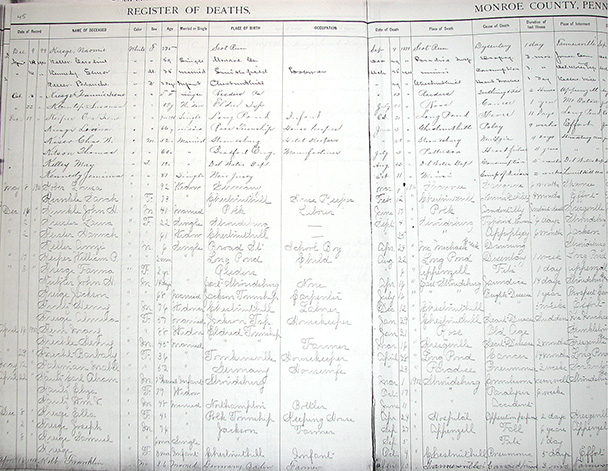
Before there was a death certificate for every individual, there was often a book. Clerks, registrars, churches, hospitals, and other institutions recorded deaths line by line in registers—sometimes preserving names, dates, family relationships, birthplaces, causes of death, and burial information. A Death Register may be the original surviving record of an ancestor’s death, not merely a list pointing somewhere else.
Introduction
A Death Register is a record book or ledger in which deaths were recorded chronologically or as they were reported to the responsible government office, church, institution, or other record keeper.
Unlike a death certificate, which generally creates a separate document for an individual death, a death register may contain dozens or hundreds of deaths recorded together in the same volume.
Death registers are especially important to genealogists because many were created before standardized individual death certificates became common.
In some places, the register may be the principal surviving official record of the death.
And there is an important distinction:
A Death Register is not necessarily a Death Index.
An index points you toward another record. A register may itself be the record.
What Might a Death Register Contain?
The amount of information varies enormously by place and time.
A register entry might contain only:
- Name of deceased
- Date of death
- Age
A more detailed register might include:
- Full name
- Date of death
- Place of death
- Residence
- Age at death
- Date of birth
- Birthplace
- Sex
- Race
- Marital status
- Occupation
- Cause of death
- Duration of illness
- Father’s name
- Father’s birthplace
- Mother’s name
- Mother’s maiden name
- Mother’s birthplace
- Spouse
- Name of informant
- Physician
- Undertaker
- Cemetery
- Burial date
- Registration date
- Certificate or record number
The columns themselves are important.
Always read the headings at the top of the register—not merely the information appearing beside your ancestor’s name.
Without the headings, it can be surprisingly easy to misunderstand what a date, place, or name represents.
Death Register vs. Death Certificate
A death register and death certificate may contain similar information, but they are different records.
A death certificate generally documents one person’s death on an individual form.
A death register records multiple deaths within a book, ledger, or similar recordkeeping system.
Depending upon the jurisdiction and period, information from an individual death certificate or return may have been copied into the register.
In other situations, the register itself may have been the primary record.
That distinction matters because the two records may not contain identical information.
If both survive, examine both.
The certificate might contain details omitted from the register—or the register may preserve information that is difficult to read or missing from the surviving certificate.
Death Register vs. Death Index
These are even easier to confuse.
A Death Index is primarily a finding aid. Its purpose is generally to help locate a death certificate, registration, register entry, or another underlying record.
A Death Register is generally a record of the deaths themselves.
A register may look like an index because the entries are arranged in rows and columns. It might even contain only a limited amount of information.
But appearance alone does not determine what the record is.
Ask:
Was this book created to record the deaths, or was it created later to help people find another death record?
That question can help distinguish a register from an index.
The Register May Predate Death Certificates
This can make death registers particularly valuable.
Standardized death certificates were not introduced everywhere at the same time.
Before individual certificates became routine, a local clerk might simply record reported deaths in a ledger.
If your ancestor died during that earlier period, searching only for a death certificate could lead you to conclude incorrectly that no official death record exists.
Instead, look for:
- Town death registers
- County death registers
- Municipal death registers
- State or provincial registers
- Church death registers
- Institutional death registers
The form of the record changed over time.
Don’t let the absence of a certificate convince you there was no death record.
Who Reported the Information?
Whenever possible, determine where the information in the register came from.
It may have been supplied by:
- Family member
- Physician
- Undertaker
- Hospital
- Institution
- Clergy member
- Local official
- Information copied from another record
This affects how you evaluate the information.
A physician may be an excellent source for the cause and date of death but know very little about the deceased person’s parents.
An adult child may know a parent’s birthplace but be uncertain about a grandparent’s maiden name.
And if a clerk copied information from another document, transcription errors could be introduced.
Officially recorded does not necessarily mean independently verified.
Pay Special Attention to Parents
When a death register names parents, it can provide the clue needed to move backward another generation.
But treat the information appropriately.
The deceased obviously did not provide the information after death.
Someone else did.
If a mother’s maiden name or father’s birthplace appears in the register, ask whether the informant was likely to know it accurately.
Then verify those details using:
- Birth records
- Baptismal records
- Marriage records
- Census records
- Probate files
- Siblings’ records
A parent’s name in a death register is valuable evidence—but it shouldn’t automatically become unquestioned fact.
Causes of Death Can Lead Somewhere Else
Older death registers frequently include a cause-of-death column.
Besides providing insight into an ancestor’s death, the entry may suggest other records.
An accidental, violent, sudden, or unexplained death might lead to:
- Coroner’s records
- Inquest files
- Newspaper reports
- Court records
- Hospital records
An infectious disease may help explain several deaths within a family or neighborhood during a short period.
An occupational accident might lead to newspaper coverage or employer records.
The cause of death isn’t merely medical information.
It can tell you where to search next.
Look at the Entries Around Your Ancestor
This is one of the advantages of a register over an individual certificate.
You can see the neighboring entries.
Don’t immediately zoom in, transcribe your ancestor’s line, and leave.
Look above and below it.
You might discover:
- Another family member
- A child with the same surname
- Several deaths at the same address
- Multiple deaths from the same disease
- Residents of the same institution
- People from the same neighborhood
Several members of one household might have died during an epidemic.
A mother and infant might appear within days of one another.
Two people at the same address may have different surnames but still belong to the same family.
The surrounding entries provide context that an isolated certificate cannot.
Residences Can Be Powerful Clues
If the register includes a street address or residence, use it.
Compare the address with:
- Census records
- City directories
- Newspapers
- Property records
- Maps
- Other family death records
An address can distinguish between two people with the same name.
It can also identify relatives living in the same household or nearby.
If several deaths are recorded at the same address, investigate everyone involved rather than assuming they were unrelated.
Don’t Confuse the Dates
A death register can contain several dates.
Depending upon the record, you may see:
- Date of death
- Date death was reported
- Date of registration
- Burial date
They are not interchangeable.
If your ancestor died on October 4, was registered on October 6, and buried on October 7, all three dates describe different events.
Read the column headings carefully before adding a date to your family tree.
Search for the Corresponding Certificate or Return
If the register contains a certificate number, registration number, volume number, or other reference, follow it.
The register may lead to an individual record containing additional information.
Look for:
- Death certificate
- Death return
- Medical certificate of death
- Burial permit
- Coroner’s record
Don’t assume that because the register contains substantial information there is nothing else to find.
It may be only one part of the death-recording process.
Search the Other Direction Too
Sometimes the certificate is found first.
If so, look for the register.
Why bother if you already have the death certificate?
Because the register can provide context.
It may clarify an illegible entry, contain a slightly different spelling, identify a registration number, or reveal related deaths occurring nearby in time or place.
More importantly, examining both records can help you understand how the death information traveled through the recordkeeping system.
Church and Institutional Death Registers
Not every death register was created by a civil government.
Churches, hospitals, poorhouses, asylums, prisons, military facilities, and other institutions also maintained registers of deaths.
These records may contain information unavailable in civil death records.
An institutional register might identify:
- Admission information
- Length of residence
- Ward or department
- Cause of death
- Person notified
- Burial arrangements
- Cemetery
A church register might provide:
- Religious affiliation
- Sacraments
- Burial date
- Cemetery
- Clergy
- Family relationships
If your ancestor died in an institution or had a strong religious affiliation, investigate whether a separate death register survives.
Watch for Original vs. Copied Registers
A register may not have been created at the exact time of death.
Some volumes were copied from earlier records.
Others were reconstructed or compiled later.
Look at:
- Title pages
- Introductory notes
- Column headings
- Handwriting
- Dates covered
- Repository descriptions
If hundreds of entries spanning many years appear in identical handwriting and ink, you may be looking at a later transcription rather than a contemporary register.
That doesn’t make the record useless.
It does affect how you evaluate it.
Whenever possible, determine whether an earlier underlying record survives.
Where Might You Find Death Registers?
Depending upon the location and period, death registers may be held by:
- State or provincial archives
- County governments
- City or town clerks
- Vital records offices
- Courthouses
- Public libraries
- Historical societies
- Genealogical societies
- Churches and religious archives
- Hospitals and institutional archives
- University manuscript collections
Many have been digitized, but others remain available only on microfilm or in the original volumes.
Search catalogs for terms such as:
- Death Register
- Register of Deaths
- Death Record Book
- Mortality Register
- Vital Register
- Register of Burials
- Death Returns
And always examine the collection description to determine exactly what kind of record you have found.
Key Takeaways
- A Death Register records multiple deaths in a book, ledger, or similar recordkeeping system.
- It may be the principal surviving death record, especially before standardized individual death certificates.
- A Death Register is not the same thing as a Death Index. An index generally points to another record; the register may itself be the record.
- A Death Register and Death Certificate may contain overlapping but not necessarily identical information.
- Read all column headings before interpreting an entry.
- Determine who supplied the information whenever possible.
- Parents’ names and birthplaces are valuable clues but should be verified with other sources.
- Cause of death may lead to coroner, inquest, hospital, court, or newspaper records.
- Examine the entries before and after your ancestor’s entry. Nearby deaths may reveal family or community connections.
- Residences can help distinguish people and identify other household members.
- Do not confuse death, registration, reporting, and burial dates.
- Follow certificate or registration numbers to any underlying documents.
- Civil, church, hospital, poorhouse, asylum, prison, and other institutional death registers may all exist.
- Determine whether the register is contemporary with the deaths or a later transcription.
- Don’t stop with the line containing your ancestor’s name. The surrounding register may be part of the story.
Examples