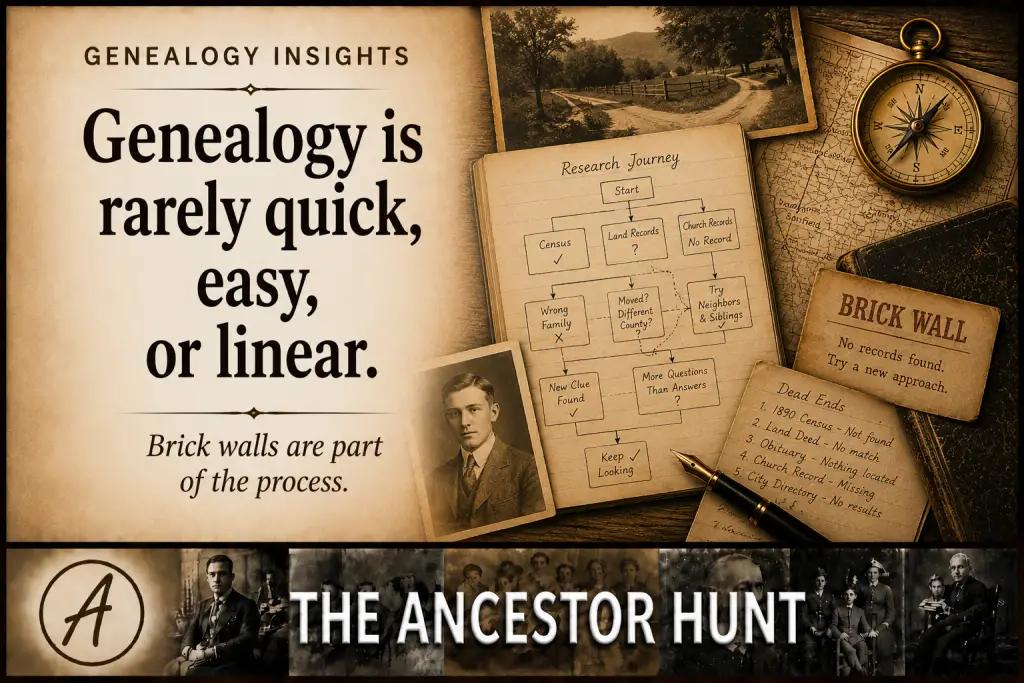
The most important discoveries often come after the straightforward path disappears.
The Insight
Many people begin genealogy expecting a simple progression from one generation to the next. Find a parent, then a grandparent, then a great-grandparent, and continue moving backward through time.
Reality is rarely that straightforward.
Records disappear. Names change. Ages vary from one census to another. Locations shift unexpectedly. Two documents may tell different versions of the same story. Some ancestors leave behind dozens of records, while others seem to vanish without a trace.
Research often moves in unexpected directions. A search for a birth record may lead to a land record. A newspaper article may solve a problem that census records could not. A sibling’s records may reveal information about an ancestor who left little evidence behind. Progress frequently comes in bursts separated by periods of uncertainty, frustration, and reassessment.
Experienced genealogists eventually learn that research is not a straight line. It is a process of asking questions, testing theories, reevaluating evidence, and following clues wherever they lead. The unexpected detours are often where the most valuable discoveries are found.
Why It Matters
- Brick walls are a normal part of genealogy research.
- Conflicting evidence often leads to deeper understanding.
- Difficult problems frequently require new approaches rather than more searching.
- Important discoveries are often found in unexpected record types.
- Patience is often more valuable than speed.
What To Look For
- Ancestors who disappear between records.
- Conflicting dates, ages, or places.
- Missing records that should exist but cannot be found.
- Family members whose records provide clues about another relative.
- Local events, migrations, or historical circumstances that may explain gaps in the record trail.
- Research paths that unexpectedly lead to new questions rather than immediate answers.
Research Action
When progress stalls, resist the urge to repeatedly search the same records in the same way. Instead, step back and reconsider the problem. Look for collateral relatives, study the local community, examine neighboring families, and revisit records you may have overlooked earlier.
Many brick walls are eventually solved not by finding a new record, but by seeing existing evidence from a different perspective.
Key Takeaway
Genealogy is not a race to collect names. It is a process of discovering and evaluating evidence. The path is often winding, frustrating, and unpredictable, but the most meaningful discoveries frequently occur after the easy answers run out.
The Genealogy Insights Field Guides
Discover all 30 Genealogy Insights in the Field Guides Collection