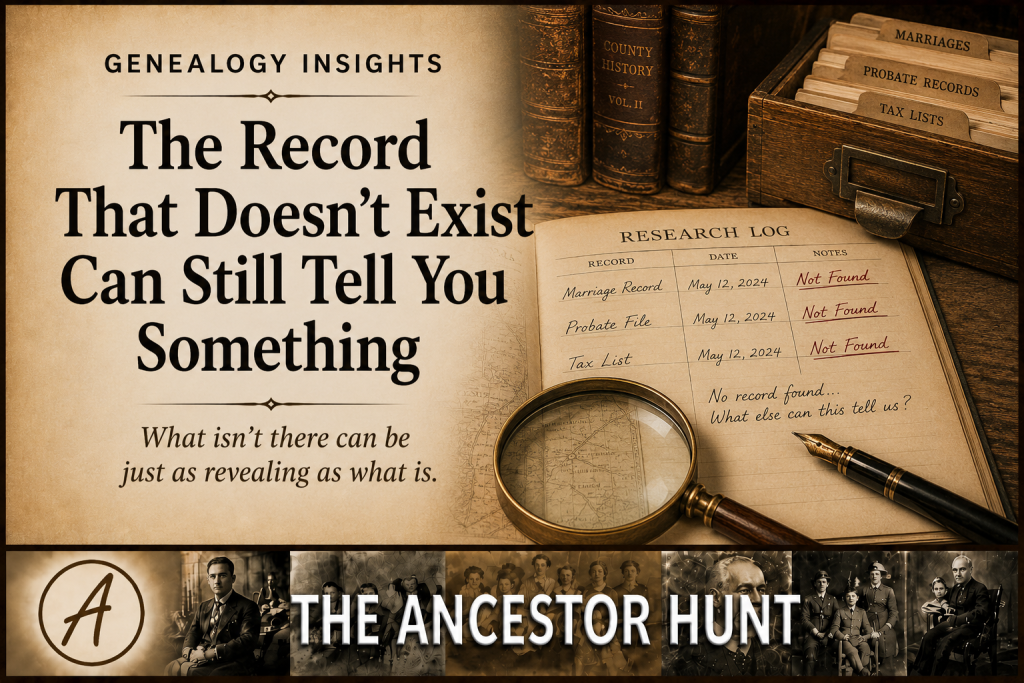
Sometimes the most important clue in your research is the record you expected to find—but didn’t.
The Insight
Missing records are not always dead ends. Often, they are clues that point your research in an entirely new direction.
Most genealogists focus on finding records. Experienced researchers also pay close attention to the records that should exist but don’t. Every unexpected gap raises an important question: Why is it missing?
The answer may reveal more than the record itself ever could.
Why it Matters
When an expected record cannot be found, many researchers assume they simply haven’t searched hard enough. Sometimes that’s true—but not always.
A missing marriage record might suggest the couple married in another county or state, belonged to a church that maintained its own records, or married before the county was established.
A missing probate file may indicate there was no estate to settle, that records were lost, or that probate occurred in another jurisdiction.
When an ancestor suddenly disappears from tax lists, city directories, newspapers, or census records, the absence may point to a move, military service, financial hardship, death, or another significant life event.
Missing records rarely answer questions by themselves, but they often point you toward the next question you should be asking.
What to Look For
As you research, pay attention to records that should exist but cannot be found.
Look for:
- Missing records that appear for other members of the same family.
- Gaps between otherwise consistent records.
- Counties, states, or jurisdictions that may have changed.
- Churches, courts, or neighboring counties that kept separate records.
- Historical events that may explain why records were never created or have been lost.
- Patterns of disappearance across several record types rather than relying on a single missing document.
Research Action
When an expected record cannot be found, resist the urge to simply repeat the same search over and over.
Instead:
- Identify why you expected the record to exist in the first place.
- Consider whether the event may have occurred in another county, state, or jurisdiction.
- Determine whether records for that time period were ever created or have survived.
- Look for alternate record types that may provide the same information.
- Compare the missing record with other evidence to identify new research questions.
Treat every missing record as a clue rather than a failure. Asking why the record is absent often leads to discoveries that another search never would.
Key Takeaway
A missing record is not always a failure—it is often evidence.
The Genealogy Insights Field Guides
Discover all 30 Genealogy Insights in the Field Guides Collection