The Ancestor Hunt regularly adds and updates new collection links, as well as searches for and fixes broken links.
(This page's most recent update is May 2026)
Practical solutions for real genealogy research problems. Explore the new Field Guides
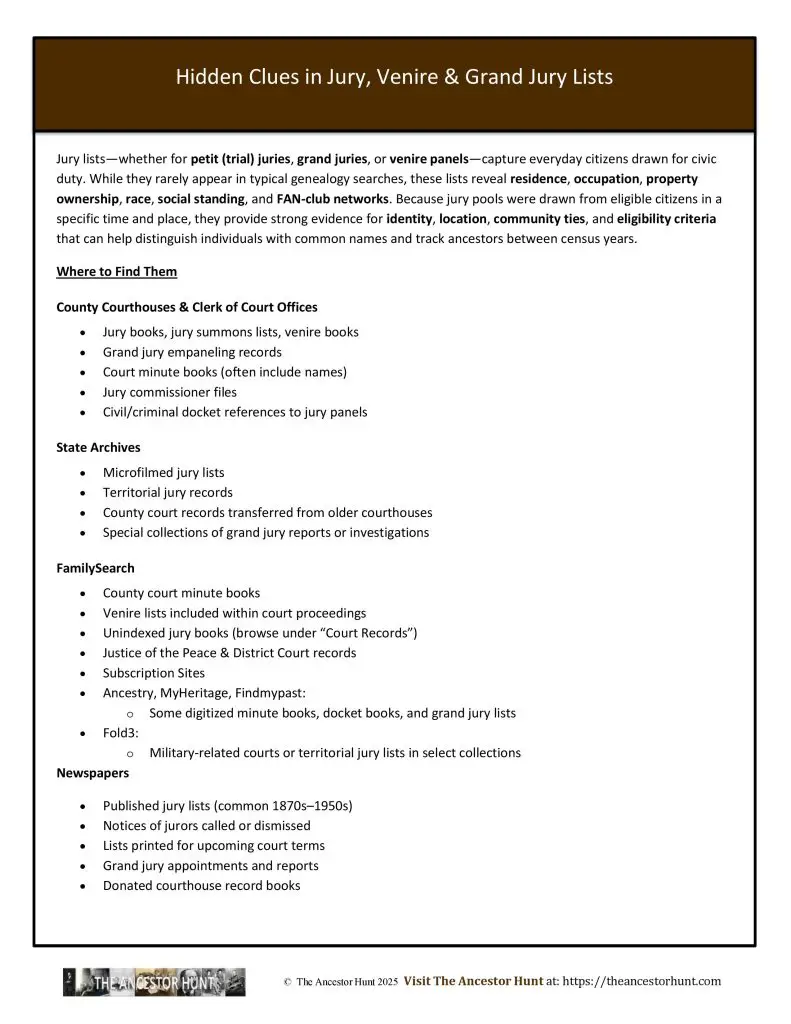
Jury lists—whether for petit (trial) juries, grand juries, or venire panels—capture everyday citizens drawn for civic duty. While they rarely appear in typical genealogy searches, these lists reveal residence, occupation, property ownership, race, social standing, and FAN-club networks. Because jury pools were drawn from eligible citizens in a specific time and place, they provide strong evidence for identity, location, community ties, and eligibility criteria that can help distinguish individuals with common names and track ancestors between census years.
Download the Quicksheet PDF
To obtain a four-page Quicksheet PDF of this information, download it by clicking on the Download button below:
For all the previously published Quick Reference Guides, click on QuickSheets.
If you use Quicksheets often, the Quicksheet Vault puts 450+ of them in one organized place — clean, printable, and easy to reuse whenever you need them. Whether you keep digital references handy or build your own genealogy binder, the Vault makes research simpler. Learn more about the Quicksheet Vault HERE
4 replies on “Hidden Clues in Jury, Venire & Grand Jury Lists”
Your examination of jury, venire, and grand jury lists as underused genealogy anchors is spot‑on, especially for untangling common surnames across census years. The same level of detail often appears in contemporary San Joaquin Records which capture arrest dates, property liens, and court appearances for individuals in those communities. Cross‑referencing modern filings with historic jury panels lets researchers confirm residence continuity and occupational shifts with far greater confidence. I recommend treating current court archives as a natural extension of these civic rosters for California genealogy.
Your analysis of petit, grand, and venire jury lists as a source of residence, occupation, and community ties adds a valuable layer to genealogy research. Combining those clues with Lake Court Records creates a cross‑checked timeline that often confirms a juror’s address or property status. Our searchable court database includes summonses, dockets, and judgments from the same counties, letting you verify civic duties against official filings. That kind of triangulation sharpens the evidentiary chain and saves countless hours chasing dead‑end leads.
Your analysis of petit, grand and venire jury lists as a hidden genealogical goldmine neatly shows how civic duty records reveal residence, occupation and social ties. For those needing parallel official documentation Clinton Court Records offer digitized dockets and judgments that often name the same individuals, creating a powerful cross‑reference point. Combining those court filings with the jury panels you highlighted can verify dates, property ownership and community status that census data alone may miss, underscoring the value of integrated archival research.
Your analysis of jury, venire, and grand jury lists shows how these civic rosters reveal residence, occupation, and community ties missed by genealogy. Integrating those insights with the Richmond Court Records we host lets researchers corroborate property deeds and probate details that anchor the clues in official documentation. Cross referencing juror names against our court filings untangles common name ambiguities and maps family migration between censuses with confidence. Your Quicksheet PDF is an ideal launchpad, and pairing it with systematic court searches will turn those hidden hints into a lineage.