The Ancestor Hunt regularly adds and updates new collection links, as well as searches for and fixes broken links.
(This page's most recent update is May 2026)
Practical solutions for real genealogy research problems. Explore the new Field Guides
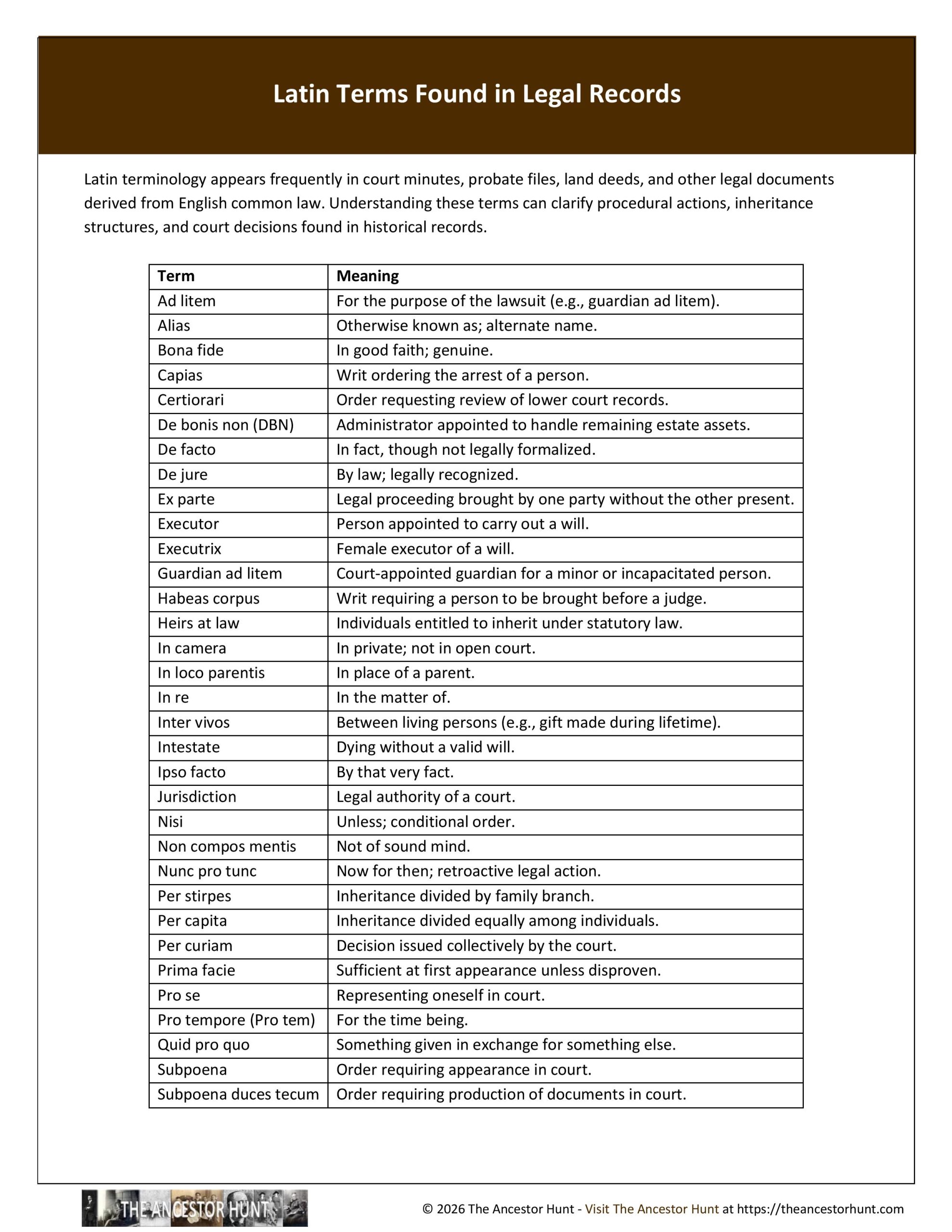
Latin terminology appears frequently in court minutes, probate files, land deeds, and other legal documents derived from English common law. Understanding these terms can clarify procedural actions, inheritance structures, and court decisions found in historical records.
| Term | Meaning |
| Ad litem | For the purpose of the lawsuit (e.g., guardian ad litem). |
| Alias | Otherwise known as; alternate name. |
| Bona fide | In good faith; genuine. |
| Capias | Writ ordering the arrest of a person. |
| Certiorari | Order requesting review of lower court records. |
| De bonis non (DBN) | Administrator appointed to handle remaining estate assets. |
| De facto | In fact, though not legally formalized. |
| De jure | By law; legally recognized. |
| Ex parte | Legal proceeding brought by one party without the other present. |
| Executor | Person appointed to carry out a will. |
| Executrix | Female executor of a will. |
| Guardian ad litem | Court-appointed guardian for a minor or incapacitated person. |
| Habeas corpus | Writ requiring a person to be brought before a judge. |
| Heirs at law | Individuals entitled to inherit under statutory law. |
| In camera | In private; not in open court. |
| In loco parentis | In place of a parent. |
| In re | In the matter of. |
| Inter vivos | Between living persons (e.g., gift made during lifetime). |
| Intestate | Dying without a valid will. |
| Ipso facto | By that very fact. |
| Jurisdiction | Legal authority of a court. |
| Nisi | Unless; conditional order. |
| Non compos mentis | Not of sound mind. |
| Nunc pro tunc | Now for then; retroactive legal action. |
| Per stirpes | Inheritance divided by family branch. |
| Per capita | Inheritance divided equally among individuals. |
| Per curiam | Decision issued collectively by the court. |
| Prima facie | Sufficient at first appearance unless disproven. |
| Pro se | Representing oneself in court. |
| Pro tempore (Pro tem) | For the time being. |
| Quid pro quo | Something given in exchange for something else. |
| Subpoena | Order requiring appearance in court. |
| Subpoena duces tecum | Order requiring production of documents in court. |
| Testator | Person who made a will. |
| Testatrix | Female person who made a will. |
| Ultra vires | Beyond legal authority. |
| Venue | Proper geographic location for trial. |
| Versus (v.) | Against (used in case names). |
| Videlicet (viz.) | Namely; that is to say. |
| Et al. | And others. |
| Et ux. | And wife. |
| Et vir. | And husband. |
Download the Quicksheet PDF
To obtain the Quicksheet PDF of this information, download it by clicking on the Download button below:
For all the previously published Quick Reference Guides, click on QuickSheets.
If you use Quicksheets often, the Quicksheet Vault puts 450+ of them in one organized place — clean, printable, and easy to reuse whenever you need them. Whether you keep digital references handy or build your own genealogy binder, the Vault makes research simpler. Learn more about the Quicksheet Vault HERE
4 replies on “Latin Terms Found in Legal Records”
Your concise guide to Latin terms such as ad litem and ex parte spotlights how these abbreviations frame probate and land‑deed narratives, a detail often missed by casual researchers. In Texas, the Tarrant Court Records system offers searchable docket PDFs that retain the exact language you describe, making it possible to cross‑reference guardianship appointments and estate inventories directly. Combining your linguistic insights with that database turns vague citations into solid evidence for building accurate family trees.
Latin terms in legal records can sometimes make documents difficult for readers who are unfamiliar with traditional legal language. Learning the meaning of these expressions can make legal research easier and more productive. Resources such as Pinellas Appraiser Records can also be useful when reviewing property-related public information. Clear explanations help readers make better sense of legal documents.
Your thorough breakdown of Latin phrases such as ex parte and de jure highlights how these shortcuts still shape probate and land deed language, often puzzling seasoned genealogists. For researchers confronting the same terminology in newer filings, the comprehensive Los Angles Court Documents database provides searchable transcripts that translate the legal shorthand into clear modern terms. Cross‑referencing historic glossaries with current case files lets you verify inheritance chains and court actions with far greater confidence.
The Ancestor Hunt’s list of Latin terms is a shortcut for anyone untangling probate files or old court minutes, because each phrase instantly signals the procedural nuance behind a family’s legal history. When researchers need sources, the depth of Bucks Court Records available through our portal lets you match those Latin phrases to docket entries, marriage licenses, and estate inventories from Pennsylvania. Cross‑referencing the glossary with our archives lets you confirm whether a “de bonis non” appointment truly altered an inheritance chain, turning translations into concrete evidence for genealogists.