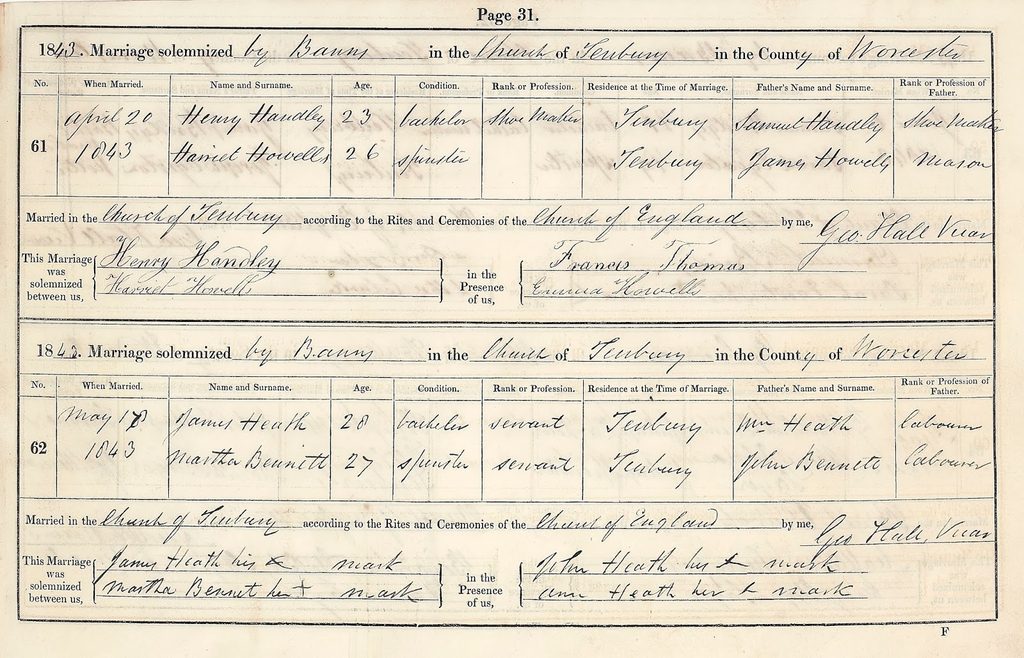
Your ancestors may have left more than one record of their marriage. Even when a civil marriage certificate survives, the church marriage register may contain additional information about the couple, their families, and the people who witnessed the ceremony. And for marriages that occurred before civil registration began, the church register may be the only surviving record of the event.
Introduction
A church marriage register is a record maintained by a church, parish, or congregation documenting marriages performed under its authority.
Churches have recorded marriages for centuries, often long before governments established standardized civil registration systems. Depending on the denomination, location, and historical period, these records may be among the earliest surviving sources of information about an ancestor’s marriage.
For genealogists, church marriage registers can provide valuable details about the bride and groom, their families, residences, witnesses, and the circumstances surrounding the ceremony.
Even when you have already located a civil marriage record, searching for the corresponding church marriage register entry may reveal information that does not appear in the government record.
What Might a Church Marriage Register Contain?
The information recorded in church marriage registers varies considerably by denomination, jurisdiction, and period.
Depending on the register, an entry may include:
- Names of the bride and groom
- Date and location of the marriage ceremony
- Ages or dates of birth
- Places of birth or residence
- Names of parents
- Marital status, such as bachelor, spinster, widow, or widower
- Occupations
- Names of witnesses
- Name of the officiating minister or priest
- Name of the church or parish
- Signatures or marks of the couple and witnesses
- Information concerning previous marriages or required religious permissions
Some early registers contain little more than the couple’s names and the marriage date. Later records may provide considerably more information.
The amount of detail often depends on the recordkeeping practices of the denomination and the requirements in effect when the marriage occurred.
Church Registers May Precede Civil Marriage Records
One of the most important reasons to search church marriage registers is that they may document marriages that occurred before civil registration was established in a particular jurisdiction.
In some communities, churches were responsible for recording marriages long before local or national governments maintained systematic marriage records.
For example, England and Wales began civil registration of marriages in 1837, but parish marriage registers survive from much earlier periods.
In other locations, churches continued to maintain their own marriage registers alongside government registration systems.
If your ancestor married before civil registration began in the relevant location, a church register may be your primary source for documenting the marriage.
However, the existence and completeness of surviving church records vary considerably. Not every congregation maintained registers, and not every register has survived.
The Church Record May Contain Different Information
Finding a civil marriage certificate does not necessarily mean you have located every record associated with the marriage.
A civil record and a church register entry may have been created for different administrative or religious purposes.
Consequently, they may contain different information.
For example, a civil certificate might identify the couple, their ages, and the date of marriage, while the church register could provide the names of witnesses, the officiating minister, or additional details concerning the couple’s religious affiliation.
The reverse is also possible. A civil marriage application may contain extensive family information, while the church register records only the couple’s names and marriage date.
When both records survive, compare them carefully.
Differences in names, ages, residences, or other details may provide clues that deserve further investigation.
Pay Attention to the Witnesses
Church marriage registers frequently identify individuals who witnessed the ceremony.
These names can be particularly valuable when researching families whose relationships are difficult to establish.
Witnesses might include siblings, parents, cousins, friends, neighbors, or other individuals associated with the bride and groom.
However, the presence of a witness does not automatically establish a family relationship.
Research the witnesses independently and look for their names in other records involving the couple.
A witness who appears repeatedly in church registers, census records, probate documents, or other family records may help establish connections that are not immediately apparent from the marriage entry alone.
In some cases, the witnesses may provide clues to the bride’s family before marriage, particularly when her parents are not identified in the register.
Look for Clues in the Surrounding Entries
A church marriage register should not always be examined as an isolated record.
The entries immediately before and after your ancestor’s marriage may provide useful clues about the family and community.
For example, you might discover another marriage involving someone with the same surname, a familiar witness appearing in several entries, or multiple members of an extended family marrying in the same congregation.
These associations may help identify siblings, relatives, neighbors, or other people connected with the couple.
Also investigate whether the church maintained baptismal and burial registers.
Finding an ancestor’s marriage in a particular church may lead you to baptismal records for their children, earlier records involving their parents, or burial entries for other family members.
A single marriage entry can therefore provide an entry point into an entire collection of family records.
Don’t Assume the Couple Lived Near the Church
A marriage recorded in a particular church does not necessarily mean that both individuals lived in that parish or community.
The ceremony might have taken place in the bride’s parish, a church associated with one of the families, or another location selected for personal, religious, or practical reasons.
Some registers identify the parish or residence of each party. Others provide only the location of the ceremony.
When a register identifies different residences for the bride and groom, investigate both locations.
The information may lead to additional church records, marriage banns, family members, or earlier residences.
Understand the Difference Between Original Registers and Transcriptions
Many church marriage records are available online through genealogy databases, historical societies, and archival collections.
However, not every searchable record represents an image of the original register.
Some collections consist of indexes or transcriptions prepared from church books. Others reproduce copies of registers created by church officials or government authorities.
A transcription may omit witnesses, occupations, residences, marginal notes, or other details that appear in the original entry.
It may also contain errors introduced when names or handwriting were interpreted.
Whenever possible, examine an image of the original register rather than relying exclusively on an index or transcription.
Pay particular attention to handwritten additions, corrections, signatures, and notes in the margins.
These details may not appear in the searchable database.
Where Might You Find Church Marriage Registers?
Church marriage registers may survive in the custody of individual congregations, diocesan or denominational archives, government archives, historical societies, libraries, and genealogy organizations.
Depending on the denomination and location, they may be cataloged under:
- Church Marriage Registers
- Parish Registers
- Church Records
- Sacramental Records
- Marriage Records
- Parish Marriage Books
- Ecclesiastical Records
- Denominational Archives
Some registers have been digitized and indexed, while others remain available only through the church or an archival repository.
If you know the denomination of your ancestor, investigate the recordkeeping practices and archives associated with that religious tradition.
If you do not know the denomination, examine local histories, city directories, census records, and other sources that may help identify the churches operating in the community at the time of the marriage.
Also consider that church boundaries, congregational affiliations, and the location of surviving records may have changed over time.
A congregation that no longer exists may have transferred its registers to another church or a denominational archive.
Key Takeaways
- Church marriage registers document marriages performed under the authority of a church, parish, or congregation.
- They may provide marriage information from periods before civil registration was established.
- Register entries can identify the couple, marriage date, residences, parents, witnesses, officiant, and other useful details.
- A church marriage register may contain information that does not appear in the corresponding civil marriage record.
- Research witnesses and other individuals named in the entry for possible family connections.
- Examine surrounding entries for additional marriages involving relatives or associates.
- Search the same church’s baptismal and burial registers for additional family records.
- Do not assume that both parties lived in the parish where the marriage occurred.
- Whenever possible, examine the original register rather than relying solely on an index or transcription.
- If the original church no longer exists, investigate whether its records were transferred to another congregation or archival repository.
Examples