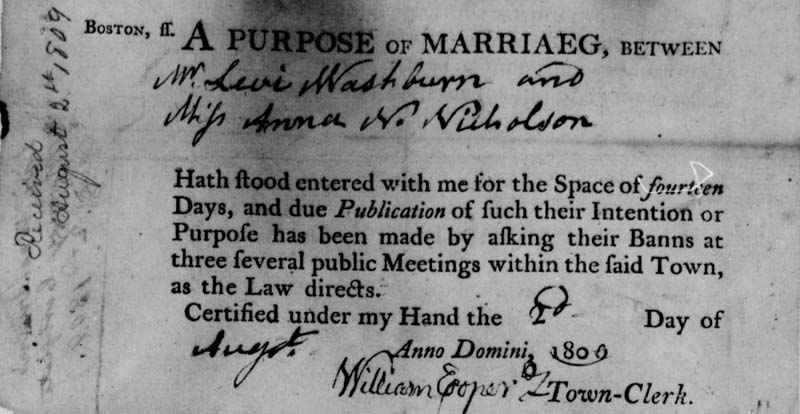
Before some of our ancestors married, they formally announced their intention to do so—and a local clerk wrote it down. Marriage intentions can identify the prospective bride and groom, their residences, and the date they declared their plans. But there is an important catch: an intention to marry is not proof that the wedding ever happened.
Introduction
A marriage intention is a formal record that two people declared their intention to marry.
These records are particularly associated with places and periods in which local governments required couples to notify a town or municipal official of their planned marriage before the ceremony could occur.
The clerk recorded the couple’s intention, creating a civil record of the proposed marriage.
For genealogists, marriage intentions can be especially valuable because they may survive when another record of the marriage cannot readily be found.
But their purpose must be understood correctly.
A marriage intention documents a plan to marry. It does not, by itself, prove that the marriage took place.
Marriage Intention vs. Marriage License
The two records are related, but they are not necessarily the same thing.
A marriage intention records the couple’s declaration that they planned to marry.
A marriage license is an authorization issued by the appropriate civil authority allowing a marriage to be performed.
Think of the distinction this way:
Intention: We plan to marry.
License: You are authorized to marry.
Marriage return, certificate, or register entry: The marriage took place.
The exact process varied by jurisdiction and historical period, and terminology was not always used consistently. Researchers should therefore determine what an intention represented under the laws and practices of the particular place being researched.
What Might a Marriage Intention Contain?
Early intentions can be quite brief, but depending on the jurisdiction and period, an entry might include:
- Name of the prospective groom
- Name of the prospective bride
- Date the intention was filed or recorded
- Residence of the groom
- Residence of the bride
- Marital status
- Occupation
- Ages
- Names of parents
- Previous married names
- Clerk or official recording the intention
- Notations concerning the subsequent marriage
The residences can be particularly valuable when the bride and groom came from different communities.
A marriage intention recorded in one town may identify the other party as a resident of another town, immediately giving the researcher another location to investigate.
The Date of Intention Is Not the Marriage Date
This is perhaps the easiest mistake to make.
If a marriage intention was recorded on April 10, 1815, that does not necessarily mean the couple married on April 10.
That date documents when their intention was recorded.
The marriage ceremony might have occurred days or weeks later.
Or it might never have occurred.
When entering the information into your family tree, identify it specifically as a marriage intention rather than automatically recording the date as the marriage date.
Then look for another document confirming the ceremony.
An Intention Does Not Prove That the Couple Married
People changed their minds.
Circumstances changed.
Illness, death, family objections, legal problems, or other events could prevent an intended marriage from occurring.
Consequently, finding two ancestors together in a marriage intention should not automatically establish them as husband and wife.
Look for evidence that the marriage was completed, such as a:
- Marriage certificate
- Marriage return
- Marriage register
- Church marriage entry
- Newspaper wedding announcement
- Later civil record identifying them as spouses
This distinction becomes particularly important when two people with familiar family names appear in an intention but cannot subsequently be found together.
Don’t force the marriage to happen simply because the paperwork says they intended it to happen.
Marriage Intentions Can Help When the Marriage Record Is Missing
Suppose you know from later records that a couple was married, but you cannot locate a marriage certificate or church record.
A marriage intention may provide an important piece of evidence.
It can establish that the couple was planning to marry at a particular time and place and may help narrow the period in which the actual marriage occurred.
That information can guide searches of:
- Church registers
- Town records
- County records
- Newspapers
- Family Bibles
- Published vital-record compilations
Even without the final marriage record, the intention can help establish the chronology of the relationship.
Different Residences Can Be an Excellent Clue
Pay close attention when the bride and groom are identified as residents of different towns.
That information can be especially useful when researching the bride.
Suppose the intention was recorded in the groom’s town but identifies the prospective bride as:
“Mary Brown of Concord.”
That simple phrase gives you another community in which to search for Mary’s family.
Look for her in census records, church registers, birth records, tax lists, probate files, and other local sources.
Her residence before marriage may help distinguish her from other women with the same name.
Look for Intentions in Both Communities
When the prospective bride and groom lived in different places, investigate the marriage-recording practices of both jurisdictions.
A related record may exist in each community.
One may contain information that the other does not.
This principle is similar to researching marriage banns: the administrative process surrounding an intended marriage can sometimes create more than one record.
Don’t assume that finding the intention in one town means there is nothing useful to search for in the other.
Marriage Intentions May Appear in Published Vital Records
Marriage intentions are sometimes encountered in published compilations of town or local vital records.
This can create another potential misunderstanding.
A researcher searching a collection labeled Marriages might encounter an entry that is actually an intention, not a record of the completed marriage.
Look carefully for abbreviations, headings, explanatory notes, or wording indicating that the entry represents an intention.
If the collection distinguishes between marriages and intentions, preserve that distinction in your own research.
The compiler knew there was a difference—and so should we.
Compare the Intention with the Eventual Marriage Record
When both records survive, compare them.
Look for differences in:
- Name spellings
- Residences
- Ages
- Marital status
- Parents
- Marriage date
- Location
A difference may simply reflect how information was recorded, but it can also provide a useful clue.
The intention might preserve the bride’s residence before marriage, for example, while the marriage register records only the location of the ceremony.
Together, the two documents may tell you more than either one does separately.
Where Might You Find Marriage Intentions?
Depending on the jurisdiction and period, marriage intentions may appear in:
- Town and municipal records
- Vital-record books
- Clerk’s registers
- Marriage intention books
- Marriage registers
- State or local archives
- Libraries and historical societies
- Published town vital records
- Digitized genealogy collections
Search catalogs using terms such as:
- Marriage Intentions
- Intentions of Marriage
- Marriage Notices
- Intentions and Marriages
- Town Marriage Records
- Vital Records
If an online database returns an entry, examine the collection description and, whenever possible, the original image.
Determine whether you are looking at an intention, an actual marriage record, or a transcription combining several types of marriage information.
Key Takeaways
- A marriage intention records a couple’s formal declaration that they planned to marry.
- A marriage intention and a marriage license are not necessarily the same document.
- The intention records the plan; the license generally authorizes the marriage.
- The date the intention was recorded should not automatically be treated as the wedding date.
- A marriage intention does not prove that the marriage actually occurred.
- Look for a marriage return, certificate, register entry, church record, or other evidence confirming the ceremony.
- Residences recorded for the bride and groom can provide valuable clues to their families and earlier lives.
- If the couple lived in different communities, investigate marriage records in both places.
- Published collections labeled Marriages may include marriage intentions, so read headings and collection descriptions carefully.
- When both an intention and completed marriage record survive, compare them for additional information.
Examples