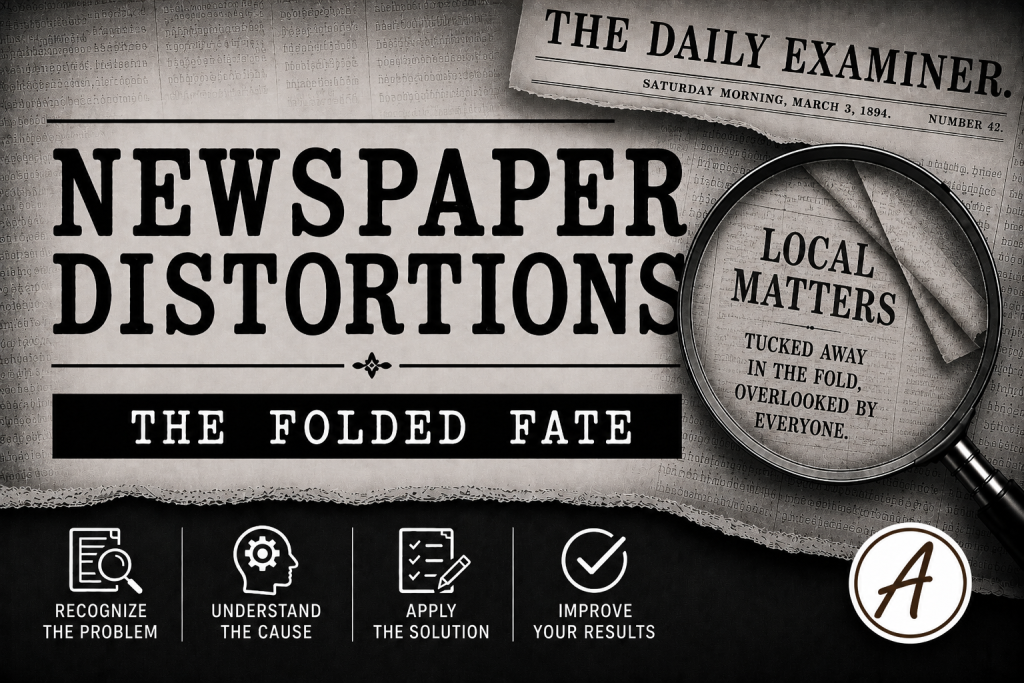
Long before newspapers were digitized, they endured decades of physical handling, storage, and preservation. Many were folded for delivery, stacked in attics, stored in boxes, or bound tightly into library volumes. Over time, fold lines, creases, tears, and worn edges damaged portions of the printed text. When these pages were later scanned, missing letters and obscured words became permanent parts of the digital image. A surname split by a fold or hidden in a binding crease may be impossible for OCR to interpret, leaving researchers with incomplete or misleading search results.
Distortion Type
Fold Lines, Creases, and Paper Wear
Why it Happens
Newspapers folded for storage or bound tightly in volumes.
Why it Matters
Creases erase letters or entire names, often along margins or bindings.
Search Strategies
- Zoom into crease zones when viewing digital scans.
- Compare the same issue in another archive.
- Search nearby names (“Mr.” “Mrs.”) to spot fragments.
Example
A researcher locates what appears to be an obituary for James Thornton, but the surname seems incomplete. A deep crease runs directly through the center of the page, obscuring several letters. OCR interprets the damaged name as Tho ton, making it impossible to locate through a standard surname search. In another issue, a wedding announcement printed near the binding edge loses part of the bride’s maiden name because the newspaper was tightly bound into a volume before being scanned. By zooming into the damaged area and comparing the issue with a copy from another archive, the researcher successfully reconstructs the missing information.
Key Takeaway
Sometimes the problem isn’t the newspaper or the OCR—it’s the passage of time. A single fold line can erase enough letters to hide an ancestor from modern searches.
The Newspaper Distortions Field Guides
Discover all 25 Newspaper Distortions, companion Field Notes, videos, and audio lessons in the Field Guides Collection