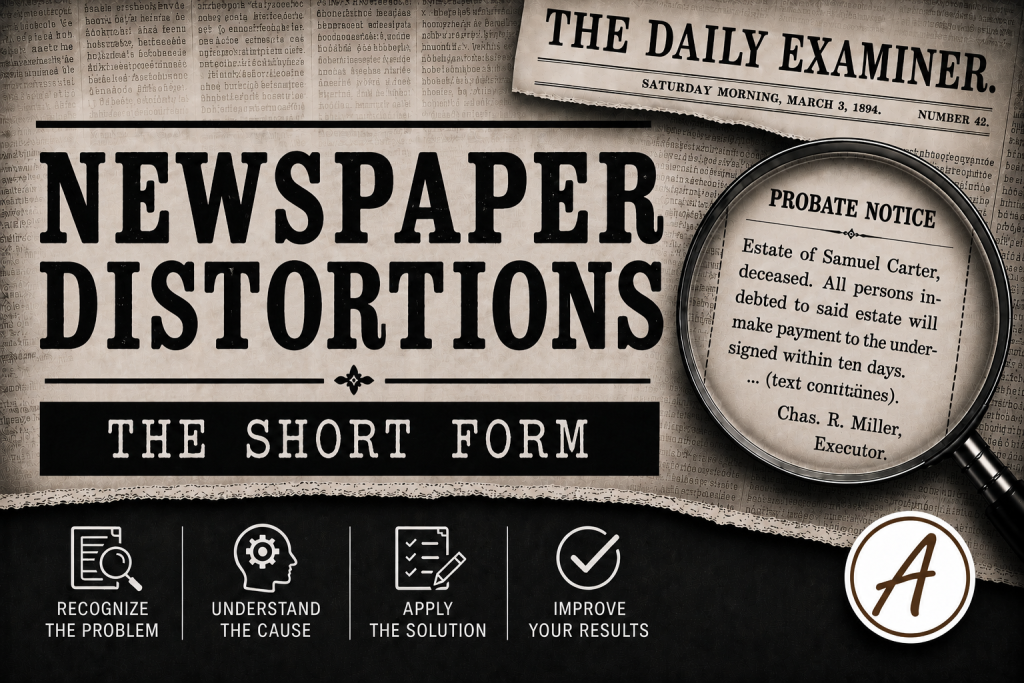
Newspapers were expensive to print, and every column inch mattered. To save space, editors, clerks, and typesetters routinely abbreviated common given names, titles, organizations, and locations. These shortened forms were widely understood by contemporary readers, but they can create unexpected obstacles for modern researchers who search only for complete names.
Distortion Type
Abbreviations and Initials
Why it Happens
Space limits in print; clerks abbreviated.
Why it Matters
“Chas.” for Charles, “Wm.” for William, “Thos.” for Thomas, “Col” for Colonel—legitimate variants, not errors. Yet most searches fail to include them.
Search Strategies
- Include abbreviated forms: (“Chas Smith” OR “Charles Smith”).
- Use period and no-period versions (“Wm”/“Wm.”).
- Build wildcard stems (Cha*, Tho*).
Example
A researcher searches for Charles Anderson in a newspaper database but finds no mention of him during the years he lived in town. A broader search eventually reveals that local newspapers consistently referred to him as Chas. Anderson. Similar references appear under Chas Anderson without the period. Once both abbreviated and full-name forms are searched, the researcher uncovers dozens of articles, including business notices, community events, and an obituary that had previously gone undiscovered.
Key Takeaway
Newspapers often shortened names to save space, not to create confusion. If you search only for complete names, you may miss the very records you’re trying to find.
The Newspaper Distortions Field Guides
Discover all 25 Newspaper Distortions, companion Field Notes, videos, and audio lessons in the Field Guides Collection