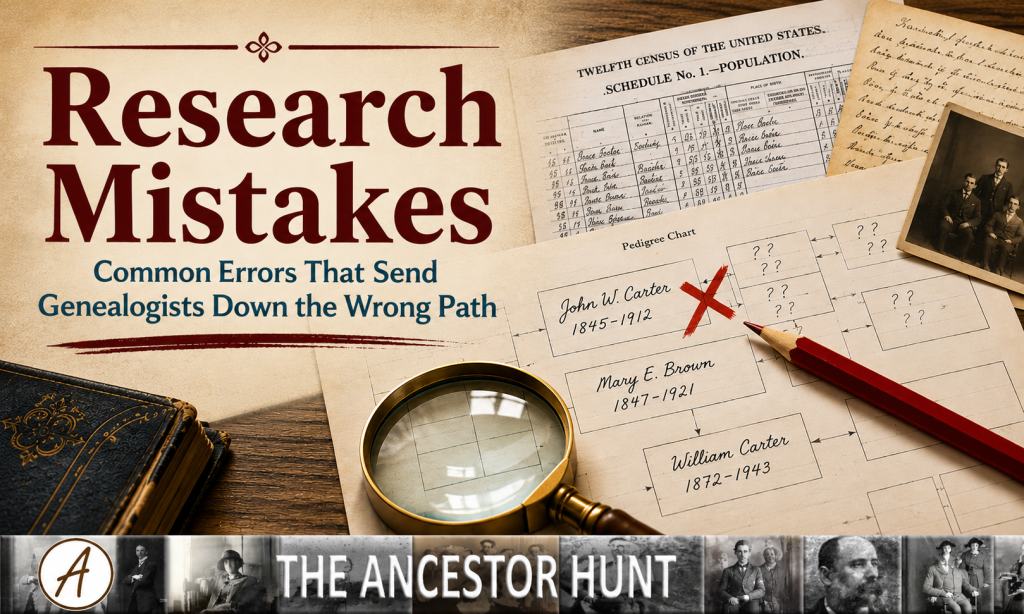
One incorrect family tree can send you and hundreds of other researchers down the wrong path.
Online family trees are among the most valuable genealogy resources available—but they are also one of the easiest places to inherit someone else’s mistakes. A tree should be treated as a research clue, not as evidence. Thousands of researchers can unknowingly copy the same incorrect information, making an error appear believable simply because it is repeated so often.
Why This Mistake Happens
Researchers often assume that if multiple trees show the same information, it must be correct.
Unfortunately, many online trees are copied from one another rather than independently researched. A single incorrect birth date, spouse, parent, or location can spread through hundreds of trees over time.
It is also tempting to accept information that fits what we already believe, especially when it saves hours of research.
Common Warning Signs
- No sources are attached.
- Sources are attached but do not actually support the conclusion.
- Every tree has exactly the same dates and relationships.
- Nobody explains where the information originated.
- The conclusion conflicts with known records.
- Parents appear too young or too old.
- Children are born in impossible locations or timeframes.
- A person seems to live in two places at once.
- Facts appear without supporting documents.
The Hidden Cost
Accepting incorrect information can lead to months—or years—of wasted research.
You may:
- Build an entire branch on the wrong parents.
- Search for records in the wrong county or state.
- Follow the wrong migration path.
- Merge two different people into one.
- Miss the correct family entirely.
Every incorrect assumption becomes harder to undo as additional research builds upon it.
A Better Way
Instead of asking:
“Is this tree correct?”
Ask:
“Can I prove every important conclusion?”
For every major fact, look for original or contemporary records whenever possible.
Examples include:
- Birth records
- Marriage records
- Death records
- Census records
- Probate files
- Land records
- Military records
- Newspaper articles
- Church records
If several independent records point to the same conclusion, your confidence increases dramatically.
Questions to Ask Yourself
- Where did this information originate?
- Can I identify the original source?
- Does the source actually support the conclusion?
- Are there conflicting records?
- Would I reach the same conclusion without seeing this online tree?
Key Takeaway
An online family tree is an excellent place to discover research leads—but it should never be the final authority. Use trees to generate ideas, then let original records determine whether those ideas are actually true.
Avoid More Costly Genealogy Research Mistakes
This article is one of a growing collection of practical genealogy Quicksheets designed to help you recognize costly mistakes, think more critically, and make better research decisions.
Learn more about the Quicksheet Vault HERE