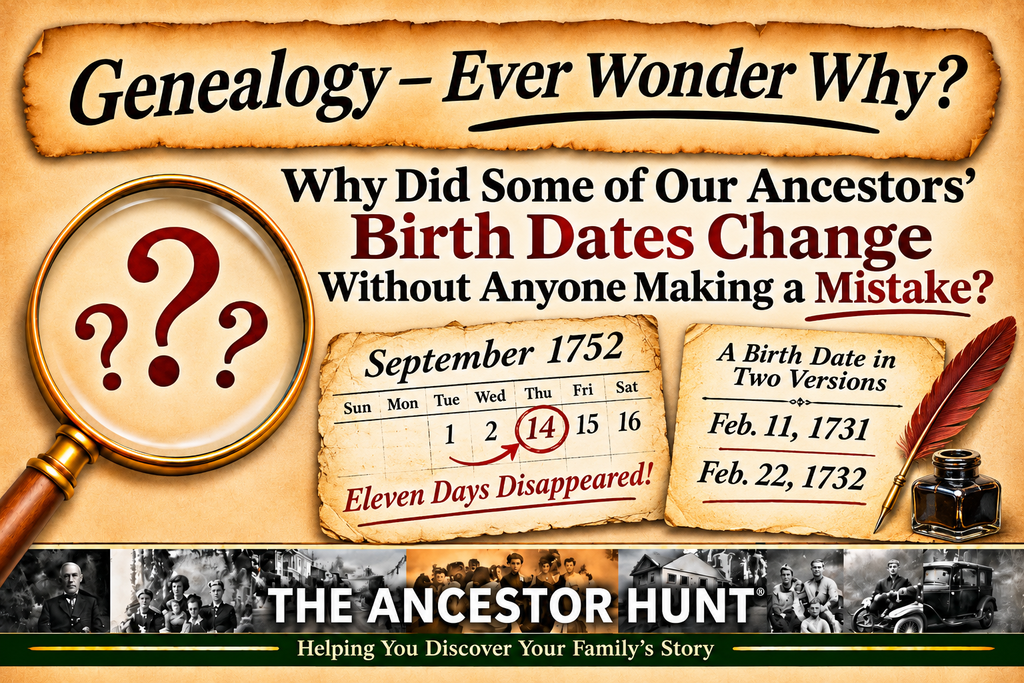
Imagine discovering two historical documents recording your ancestor’s birth date. One says February 11, 1731, and the other says February 22, 1732.
The day is different. The year is different.
Surely someone made a mistake.
But what if both dates were absolutely correct?
In fact, this is precisely what happened with George Washington’s birth date.
The explanation lies in one of the most extraordinary changes in the way our ancestors recorded time – a change that continues to create challenges for genealogists today.
Why Our Ancestors’ Calendar Needed to Be Changed
For centuries, much of Europe used the Julian calendar, introduced during the time of Julius Caesar.
Unfortunately, its method of calculating leap years resulted in a slight discrepancy between the calendar year and the actual solar year.
The difference was small, but over centuries it accumulated. Calendar dates gradually drifted away from their intended seasons.
In 1582, Pope Gregory XIII introduced a revised calendar, known as the Gregorian calendar, which corrected the accumulated discrepancy and modified the rules governing leap years.
However, not every country adopted the new calendar at the same time.
England and its American colonies continued using the Julian calendar for another 170 years.
Consequently, ancestors living in different countries could experience exactly the same day but record it using different dates.
Eleven Days Disappeared From Our Ancestors’ Calendars
By 1752, the British calendar was eleven days behind the Gregorian calendar.
To correct the discrepancy, Parliament authorized an extraordinary change.
Wednesday, September 2, 1752, was immediately followed by Thursday, September 14, 1752.
September 3 through September 13 simply did not exist on the official British calendar that year.
This applied to Great Britain and its American colonies, among other British territories.
Anyone who went to bed on September 2 and awoke the following morning found that the calendar date had advanced by twelve, although only one day had actually passed.
For genealogists, this creates an interesting situation.
If you discover an American colonial document recording a birth, marriage, or death between September 3 and September 13, 1752, it deserves further investigation.
The date might reflect continued use of the old calendar, a later calendar conversion, a different community’s calendar conventions, or an error in transcription.
Understanding the calendar change could help explain the apparent discrepancy.
The Year 1751 Had Only 282 Days
The disappearance of eleven days was not the only remarkable change.
Before 1752, the official legal year in England and its American colonies began on March 25 rather than January 1.
This meant that January, February, and the first 24 days of March belonged to the preceding legal year compared with our modern system.
Consider the following sequence:
- December 31, 1750
- January 1, 1750
- February 1, 1750
- March 24, 1750
- March 25, 1751
That sequence may look completely wrong to us today, but it was correct under the old legal dating system.
When the government established January 1 as the beginning of 1752, the preceding legal year was shortened.
The year 1751 began on March 25 and ended on December 31, lasting just 282 days.
For genealogists researching colonial ancestors, this change can be even more significant than the disappearance of eleven days in September 1752.
An ancestor’s recorded birth year might differ by an entire year without either record being incorrect.
Some Birth Records Contained Two Years Rather Than One
Because people were aware that different systems existed for determining the beginning of the year, some record keepers used a practice known as double dating.
You might encounter dates such as:
- January 15, 1740/41
- February 22, 1725/26
- March 10, 1698/99
These dates do not necessarily indicate uncertainty about when a person was born.
Quite the opposite.
The record keeper was attempting to eliminate confusion by identifying the year under both dating conventions.
For example, February 22, 1725/26 meant February 22, 1725, according to the old legal year, but February 22, 1726, when the year was reckoned from January 1.
An important distinction is that double dating the year did not necessarily convert the day and month from the Julian to the Gregorian calendar.
Those were separate adjustments.
Misunderstanding this distinction could cause genealogists to introduce errors while attempting to correct information that was already accurate.
George Washington’s Birth Date Changed by Eleven Days and One Year
One of the most famous examples of the calendar change involves George Washington.
Under the calendar conventions in effect in Virginia when he was born, his birth date was February 11, 1731.
Applying the two calendar adjustments produces the following results:
| Dating Convention | Birth Date |
|---|---|
| Original Old Style date | February 11, 1731 |
| Double-dated year | February 11, 1731/32 |
| January 1 year convention, Julian day retained | February 11, 1732 |
| Fully converted Gregorian date | February 22, 1732 |
These four presentations represent the same birth.
Washington was not born twice. No one needed to correct an inaccurate family recollection.
The system used to identify his birth date had changed.
Your own ancestors who lived during this period may have experienced exactly the same situation.
The Sixth Month Was Not Always June
Another fascinating complication involves records created by members of the Religious Society of Friends, commonly known as Quakers.
Quakers frequently identified months by number rather than name.
Before the 1752 calendar change, however, March was generally regarded as the first month and February as the twelfth month.
Consequently, a Quaker birth record stating that a child was born on the eighth day of the sixth month might refer to August 8 rather than June 8.
The following table illustrates the change in Quaker month numbering.
| Numbered Month | Before 1752 | Beginning in 1752 |
|---|---|---|
| First Month | March | January |
| Second Month | April | February |
| Third Month | May | March |
| Fourth Month | June | April |
| Fifth Month | July | May |
| Sixth Month | August | June |
| Seventh Month | September | July |
| Eighth Month | October | August |
| Ninth Month | November | September |
| Tenth Month | December | October |
| Eleventh Month | January | November |
| Twelfth Month | February | December |
The earlier English legal year began on March 25, which creates additional complications when interpreting dates during the first 24 days of that month. The dating conventions of the particular Quaker meeting should also be considered.
Simply translating the month number into its modern equivalent without considering the year of the record could introduce a two-month error into your family tree.
Our Ancestors Did Not All Change Calendars at the Same Time
The adoption of the Gregorian calendar took place over several centuries.
Many Roman Catholic countries adopted it beginning in 1582. Britain and its colonies made the transition in 1752. Other countries continued using the Julian calendar well into the twentieth century.
Consider the following examples:
| Country or Territory | Gregorian Calendar Adoption |
|---|---|
| Spain, Portugal, and much of Italy | 1582 |
| France | 1582 |
| Denmark and Norway | 1700 |
| Great Britain and its American colonies | 1752 |
| Sweden | 1753 |
| Russia | 1918 |
| Greece | 1923 |
These are commonly cited civil calendar adoption years. Regional exceptions, transitional arrangements, and the continued use of older calendars by religious communities mean that not every historical record necessarily followed these dates.
Even records created within what is now the United States could use different calendar conventions.
For example, Dutch colonial records from New Netherland generally used the Gregorian calendar long before the British colonies adopted it.
A genealogist researching seventeenth-century New York ancestors could therefore encounter records created under different calendar systems in the same geographical area.
The language of the document, the identity of its creator, and the jurisdiction governing the location could all be important clues.
Applying a British calendar conversion to a Dutch record that already used the Gregorian calendar would create an error where none had previously existed.
Adding Eleven Days Was Not Always the Correct Conversion
There is another complication that genealogists should be aware of.
The difference between the Julian and Gregorian calendars was not always eleven days.
Because the two calendars used different rules for determining leap years, the difference increased over the centuries.
| Century | Typical Days Added to Julian Dates |
|---|---|
| Late 1500s | 10 |
| 1600s | 10 |
| 1700s | 11 |
| 1800s | 12 |
| 1900s | 13 |
| 2000s | 13 |
These are general guidelines. The exact difference between the two calendars changed around the leap-year transitions of 1700, 1800, and 1900. Dates near those transitions require particular care when converting.
For example, a nineteenth-century Russian birth date recorded under the Julian calendar would generally require a twelve-day adjustment rather than eleven.
A twentieth-century Russian birth date recorded under the Julian calendar would generally require a thirteen-day adjustment.
The appropriate conversion depends on the date itself and the calendar used to record it.
Also, remember that converting a date from the Julian to the Gregorian calendar and adjusting a year recorded under the March 25 convention are two separate procedures.
Our Ancestors May Have Changed Their Own Recorded Birth Dates
One particularly interesting consequence of the calendar change is that some of our ancestors may have adjusted their birth dates during their lifetimes.
Someone born under the Julian calendar might subsequently use a birth date expressed according to the Gregorian calendar.
A church baptismal register could therefore contain one birth date, while a later family Bible, personal record, or gravestone contains another.
Both dates might accurately represent the same event.
However, not everyone necessarily converted their earlier dates. Some continued using the dates they had always known.
This makes it difficult to determine which calendar convention a later record keeper used without examining the surrounding evidence.
The calendar change is a possible explanation for conflicting historical dates, not automatic proof that two different dates represent the same event.
What Does This Mean for Your Genealogy Research?
When researching ancestors who lived during periods of calendar transition, consider the following:
- Determine which calendar was in use where and when the original record was created.
- Pay particular attention to English and American colonial dates between January 1 and March 24 before 1752.
- Recognize that double-dated years do not necessarily indicate uncertainty.
- Be cautious when interpreting numbered months in early Quaker records.
- Do not automatically add eleven days to every date recorded under the Julian calendar.
- Be careful not to convert dates that have already been converted by a transcriber or previous researcher.
- Preserve dates exactly as they appear in original documents.
- Record any converted dates separately and explain the calendar conventions used.
- Consider calendar differences when evaluating conflicting birth, marriage, and death dates.
The objective is not to replace historical dates with modern ones, but to understand what those historical dates actually represent.
A Clue Worth Remembering
Genealogists spend considerable time attempting to resolve conflicting dates.
We question the accuracy of documents, the reliability of informants, and the memories of our ancestors.
But sometimes the documents are correct, the informants were reliable, and our ancestors remembered their birth dates perfectly.
Sometimes the date changed because the calendar changed – not because anyone made a mistake.
Sources and Further Reading
- Connecticut State Library – 1752 Calendar Change
- St. Louis Genealogical Society – Calendars and Double Dating
- Brigham Young University Library – Quaker Research Outline
- New York Genealogical and Biographical Society – The Calendar and Colonial New York
- University of Nottingham – Dating Historical Documents
- Cambridge University Press – A Handbook of Dates
- Claus Tøndering – The Gregorian Calendar