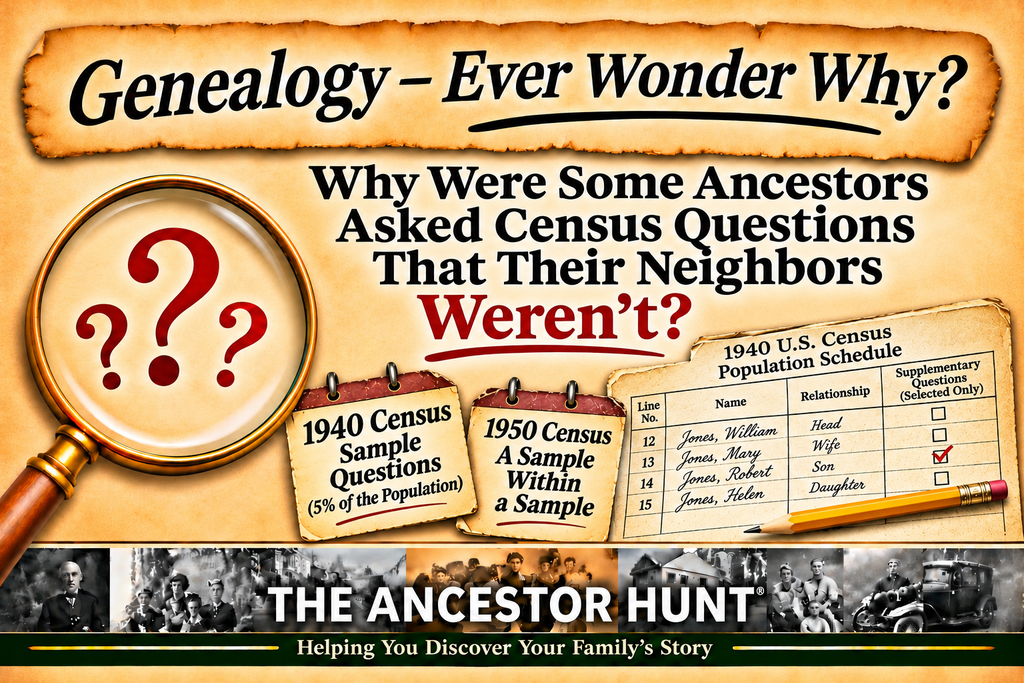
Imagine examining a census record and discovering that your ancestor’s next-door neighbor was asked about his parents’ birthplaces, military service, and usual occupation.
Yet none of that information was recorded for your ancestor.
They lived on the same street, were approximately the same age, and were enumerated by the same person.
Why were they asked different questions?
We tend to think of the federal census as a standardized questionnaire that everyone was required to answer. However, throughout much of American census history, the questions asked of one person could differ considerably from those asked of another.
Sometimes the differences depended on an individual’s personal circumstances.
At other times, they depended entirely on where the enumerator happened to write the person’s name.
Not Everyone Was Asked the Same Questions Before 1940
Long before statistical sampling was introduced into the federal population census, enumerators were instructed to ask certain questions only of individuals who met specific criteria.
Age, sex, marital status, birthplace, employment, military service, and other personal characteristics could determine which questions an individual was expected to answer.
Consider some examples:
| Census Year | Individuals Selected | Additional Information Requested |
|---|---|---|
| 1880 | Married, widowed, or divorced individuals | Marital status details |
| 1890 | Surviving Union veterans and their widows | Details of military service |
| 1900 | Women who were or had been married | Number of children born and number still living |
| 1910 | Foreign-born males aged 21 and older | Naturalization status |
| 1910 | Men old enough to have served in the Civil War | Union or Confederate military service |
| 1930 | Individuals meeting specified unemployment criteria | Additional unemployment information |
The absence of an answer in a particular census column does not necessarily mean the enumerator forgot to ask the question or that your ancestor refused to answer it.
The enumerator may have been specifically instructed not to ask it.
Some Ancestors Were Recorded on Additional Census Schedules
In certain census years, an individual’s circumstances could result in the creation of an entirely separate census record.
For example, the 1890 census included a special schedule intended to identify surviving Union veterans and their widows.
The information collected included military rank, company, regiment, enlistment and discharge dates, length of service, and service-related disabilities.
Consequently, two neighbors could both appear on the regular population schedule, while only one appeared on a separate schedule containing considerable additional personal information.
This is particularly significant because most of the 1890 population census was destroyed, but portions of the special veterans schedules survived.
The 1930 census also included a separate unemployment schedule intended to collect additional information about qualifying individuals who were out of work.
Unfortunately, those unemployment schedules are not known to have survived.
Special schedules were also used to collect additional information about Native Americans during certain census years.
The 1900 and 1910 special Indian population schedules, for example, contained questions concerning tribal affiliation and other characteristics that were not included on the regular population schedules.
The important lesson for genealogists is that the regular population census was not always the only census document created about an ancestor.
Census Enumerators Sometimes Became Too Accustomed to Skipping Questions
One particularly interesting problem arose during the 1910 census.
Enumerators were instructed to identify surviving veterans of the Civil War and distinguish between those who had served in the Union and Confederate forces.
However, by 1910, the war had ended 45 years earlier. Most individuals being enumerated were too young to have served.
An enumerator could therefore record dozens of people without needing to ask the military service question.
The Census Bureau subsequently acknowledged that the repetitive practice of skipping the question contributed to enumerators overlooking some individuals who should have been asked it.
The result was incomplete reporting of surviving Civil War veterans.
This has an important implication for genealogists.
If your ancestor was old enough to have served in the Civil War but the military service column in the 1910 census is blank, do not automatically conclude that he never served.
The question may never have been asked.
Military service records, pension files, veterans schedules, and other sources should still be investigated.
The 1940 Census Introduced an Entirely Different Reason for Asking Additional Questions
In 1940, the Census Bureau introduced statistical sampling into the federal population census.
The objective was to collect additional information about the American population without requiring every individual to answer every question.
Each side of the regular population census form contained space for 40 individuals.
Two predetermined lines were designated for supplementary questions.
The individuals whose names appeared on those lines were selected to provide additional information.
This represented approximately 5% of the population.
Unlike many of the selective questions in earlier censuses, selection did not initially depend on a person’s age, occupation, birthplace, marital status, or military service.
It depended on where that person’s name appeared on the census form.
Individual supplementary questions could still have age or other eligibility requirements.
Even an Infant Could Be Selected for Supplementary Questions
The 1940 census enumerator instructions did not permit enumerators to substitute a different household member simply because the selected individual was a child.
The person occupying the designated sample line was the person for whom supplementary information was to be collected.
That person might be:
- The head of the household.
- The head’s spouse.
- A child or infant.
- A boarder or lodger.
- A servant.
- Another household member.
Imagine a household containing a 65-year-old grandfather, a married couple, and their newborn child.
If the newborn child’s name happened to occupy a designated sample line, the infant would be selected rather than the grandfather.
Naturally, an adult informant would provide the applicable information about the child, and questions for which the child was ineligible would not be answered.
For genealogists, this could be particularly frustrating. The grandfather might have possessed a wealth of family history information, yet the census sampling procedure provided no opportunity to collect supplementary information about him.
A Former President Was Passed Over While His Servant Was Selected
An actual example documented by the National Archives illustrates just how impersonal the selection process could be.
Former President Herbert Hoover appeared on line 12 of a 1940 population census page.
Sam Wu, identified as a servant, appeared on line 14.
Line 14 was one of the designated supplementary question lines.
Consequently, supplementary information was collected about Sam Wu rather than Herbert Hoover.
The enumerator was not permitted to select the former president because of his prominence or historical significance.
For census sampling purposes, the individual’s position on the form mattered more than his position in society.
Some Information Previously Collected About Everyone Was Suddenly Collected About Very Few
From 1880 through 1930, the birthplaces of an individual’s father and mother were among the standard federal population census questions.
These columns have been extremely valuable to genealogists attempting to identify an ancestor’s origins and locate earlier generations.
In 1940, however, parental birthplaces became supplementary questions.
Consequently, this valuable information was collected for approximately 5% of the population rather than as a standard question for everyone.
Other supplementary questions in 1940 concerned:
- Mother tongue.
- Military service.
- Social Security participation.
- Usual occupation and industry.
- Whether a woman had been married more than once.
- A woman’s age at her first marriage.
- The number of children a woman had borne.
Not every selected individual was eligible to answer every supplementary question.
Nevertheless, a person selected for the sample could have considerably more genealogically useful information recorded than someone appearing immediately above or below them.
An Ancestor Could Have Two Different Occupations Correctly Recorded on the Same Census Page
Another interesting feature of the 1940 supplementary questions concerned employment.
The main population schedule collected information about employment circumstances during a specified week in March 1940, with additional rules for individuals who were unemployed or temporarily absent from work.
The supplementary questions asked about the selected individual’s usual occupation.
These were not necessarily the same.
Consider a hypothetical example involving a bank teller who lost his regular employment during the Great Depression and subsequently found temporary work as a grocery clerk.
His census information might include:
| Location on Census Form | Occupation Recorded |
|---|---|
| Main population schedule | Grocery clerk |
| Supplementary questions | Bank teller |
Both answers could be correct.
One described the work he was currently performing, while the other described his usual occupation.
For genealogists, this could provide a valuable clue about how the Great Depression affected an ancestor’s employment and economic circumstances.
An apparent inconsistency could actually reveal an important chapter in an ancestor’s life.
The 1950 Census Introduced a Sample Within a Sample
The Census Bureau expanded its use of statistical sampling in 1950.
The regular population census form contained space for 30 individuals.
Six individuals were selected for supplementary questions, representing approximately 20% of the population.
However, the sampling procedure did not end there.
The individual occupying the last designated sample line was selected for a further series of questions, subject to eligibility requirements.
In effect, the 1950 census contained a sample within a sample.
| Sampling Feature | 1940 Census | 1950 Census |
|---|---|---|
| Individuals per standard page | 40 | 30 |
| Individuals selected for supplementary questions | 2 | 6 |
| Percentage selected | 5% | 20% |
| Individuals selected for a further set of questions | None | 1 |
This meant that two individuals could both be selected for supplementary questions, yet one could have even more information recorded than the other.
The additional questions for the final sample person included, when applicable:
- Previous occupation and industry.
- Whether the individual had been married more than once.
- How many years had passed since the individual’s most recent marriage, widowhood, divorce, or separation.
- The number of children an eligible woman had borne, excluding stillbirths.
For genealogists, some of these questions could reveal previously unknown marriages, help establish approximate marriage or divorce dates, or identify children missing from the family tree.
Yet only approximately one person in 30 occupied the line designated for these further questions.
The 1950 Census Used Five Different Versions of the Population Form
There was another interesting feature of the 1950 census sampling procedure.
The Census Bureau used five versions of the standard population form, varying the positions of the designated sample lines.
This meant that the supplementary questions were not always associated with the same line numbers on every census page.
Genealogists should therefore examine the actual census image rather than assume that a particular line number always indicates selection for supplementary questions.
Look for the highlighted lines identifying the sample individuals.
Then examine the corresponding entries in the supplementary section at the bottom of the form.
Your ancestor might have additional information recorded that is not immediately apparent when examining the main population schedule.
Some Ancestors Could Answer Sensitive Questions Without Telling the Enumerator
Both the 1940 and 1950 censuses collected information concerning income.
However, not everyone was comfortable disclosing personal financial information to a census enumerator.
This was particularly understandable in smaller communities where the enumerator might have been a neighbor or acquaintance.
Individuals who preferred not to disclose their income directly to the enumerator could complete a separate form and mail the information to the Census Bureau.
In 1940, income questions applied to individuals aged 14 and older. In 1950, income questions were restricted to eligible individuals selected for supplementary questions.
Consequently, the absence of an income figure on a surviving population schedule does not necessarily mean the individual had no income or refused to provide the information.
The information may have been submitted separately.
Why Missing Census Information Is Not Always Missing Information
Genealogists frequently encounter blank census columns and wonder why information was not recorded.
There are several possible explanations.
| Reason for Missing Information | Possible Explanation |
|---|---|
| Individual did not qualify for the question | Age, sex, birthplace, or another characteristic excluded the individual. |
| Individual was not selected for sampling | The person’s name did not appear on a designated sample line. |
| Individual qualified for one sample but not another | Particularly relevant to the 1950 census. |
| Information was collected separately | A special schedule or confidential form was used. |
| Enumerator overlooked the question | The individual qualified, but the question was not asked. |
| Informant could not provide the answer | The requested information was unknown to the person responding. |
Understanding the reason for a blank entry can prevent genealogists from drawing incorrect conclusions.
It can also help determine whether additional research might uncover the missing information elsewhere.
What Does This Mean for Your Genealogy Research?
When examining federal census records, take time to understand the instructions governing the questions asked during that particular census year.
For the 1940 and 1950 censuses, always examine the supplementary sections at the bottom of the original census images.
Do not rely exclusively on indexed information or transcriptions, which may not include every supplementary answer.
If your ancestor was not selected for supplementary questions, consider examining the census records of siblings, parents, and other relatives.
A brother or sister selected for supplementary questions might provide the parental birthplace information missing from your direct ancestor’s census record.
Also, investigate whether an ancestor’s military service, employment circumstances, or other personal characteristics might have resulted in the creation of a separate census schedule.
The information you are seeking may have been collected somewhere other than the familiar population schedule.
A Clue Worth Remembering
We often assume that census enumerators asked everyone the same questions and that differences in recorded information reflect differences in the answers provided.
But sometimes our ancestors were never given the opportunity to provide those answers.
Their age, personal circumstances, or even the position of their name on a census sheet determined how much of their lives was recorded for future generations.
Sometimes the information missing from your ancestor’s census record was not forgotten, concealed, or lost. It was simply never requested.