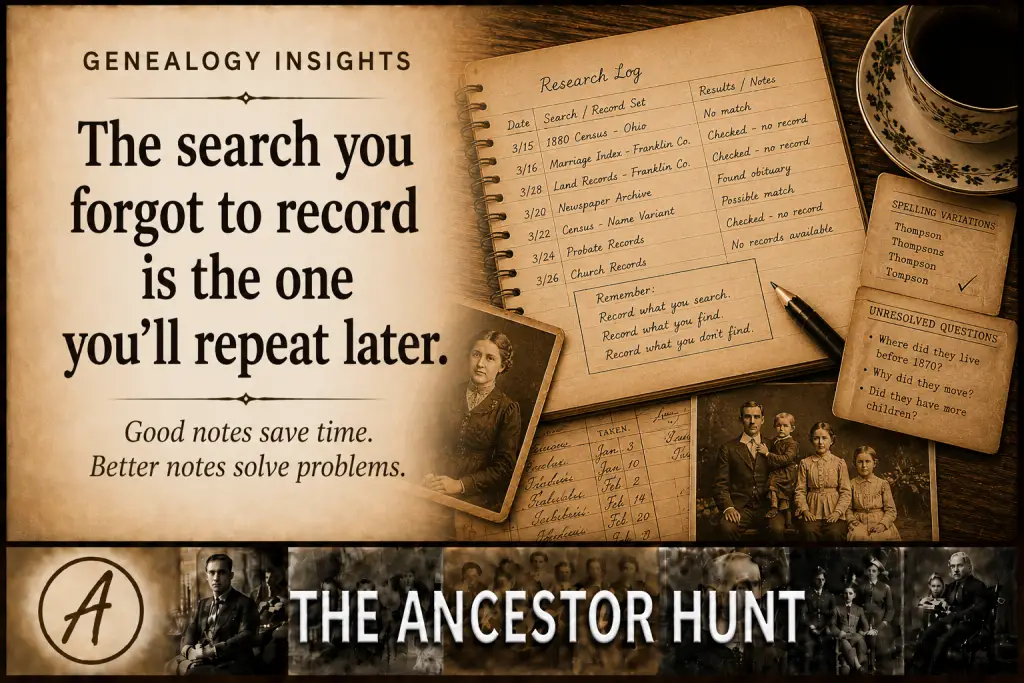
The time you spend documenting your research today can save hours of duplicated work tomorrow.
The Insight
One of the most common frustrations in genealogy occurs when a researcher discovers they have already searched for the same information months—or even years—earlier but cannot remember the result.
Many genealogists save records, screenshots, and downloaded documents but fail to record where they searched, what search terms they used, what repositories they checked, and what conclusions they reached. Without that information, it becomes easy to repeat the same unsuccessful searches, revisit the same dead ends, and lose track of unanswered questions.
Good research notes do more than organize information. They document the research process itself. A well-maintained research log captures both successes and failures, creating a record of your thinking as well as your findings.
Experienced researchers understand that genealogy is not simply the collection of records. It is the management of information. The more complex a family history becomes, the more valuable organized notes become.
Why It Matters
- Research notes prevent duplicated work.
- Negative searches are often as valuable as successful ones.
- Research logs help track unresolved questions.
- Organized notes make it easier to revisit old projects.
- Good documentation supports stronger conclusions and fewer mistakes.
What To Look For
- Repeated searches that produce the same results.
- Questions that remain unresolved.
- Record collections already examined.
- Spelling variations and alternate search strategies previously used.
- Repositories, archives, and databases already searched.
- Negative results that eliminate certain possibilities.
Research Action
Create a simple research log and use it consistently.
Record:
- What you searched.
- Where you searched.
- When you searched.
- What you found.
- What you did not find.
- Questions that remain unanswered.
The format matters far less than the habit. A simple log that is used regularly is more valuable than a sophisticated system that is never maintained.
Key Takeaway
Every genealogy search produces information, even when no records are found. Recording your searches, conclusions, and unanswered questions creates a roadmap for future research and prevents you from repeating work that has already been done.
The Genealogy Insights Field Guides
Discover all 30 Genealogy Insights in the Field Guides Collection