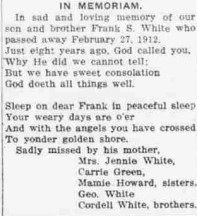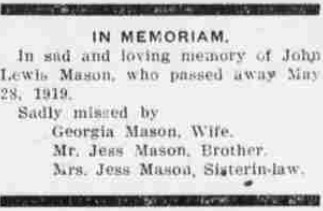
You found the obituary—but did you search the newspapers again on the anniversary of your ancestor’s death? Families sometimes published In Memoriam notices months or years later to remember someone they had lost. These easily overlooked notices can name relatives, preserve family relationships, provide personal details, and occasionally contain clues that never appeared in the original obituary.
Introduction
An In Memoriam notice is a newspaper notice published in remembrance of someone who has died.
Unlike an obituary or death notice, which usually appears shortly after the death, an In Memoriam notice may be published months or years later—often on the anniversary of the person’s death, birthday, a holiday, or another meaningful date.
Some are only a few lines long. Others include poems, personal messages, photographs, or the names of family members remembering the deceased.
For genealogists, their greatest value may be simple:
They give us another opportunity to find information about the deceased and the family—at a completely different point in time.
Yet they are easily missed because researchers commonly stop searching newspapers shortly after finding an obituary.
How Is an In Memoriam Notice Different from an Obituary?
An obituary generally reports and summarizes a death. It may include biographical information, surviving relatives, funeral arrangements, and details about the deceased’s life.
An In Memoriam notice serves a different purpose.
It remembers the person after the immediate events surrounding the death have passed.
A notice might begin with phrases such as:
- In Memoriam
- In Loving Memory
- In Memory Of
- In Remembrance
- Sacred to the Memory Of
- Remembering
- Gone But Not Forgotten
Some newspapers placed these notices in a dedicated In Memoriam or Memorial section rather than among current death notices and obituaries.
That distinction matters when searching historical newspapers.
What Might an In Memoriam Notice Contain?
The information varies considerably, but a notice may include:
- Full name of the deceased
- Maiden or previous surname
- Date of death
- Age at death
- Birth date
- Photograph
- Names of a spouse or children
- Names of parents or siblings
- Names of other relatives
- Family relationships
- Residence
- Military service
- Religious affiliation
- Personal memories
- Poems or verses
- Names or descriptions of the people who placed the notice
Even a very short notice can provide useful information.
For example:
“In loving memory of our dear mother, Mary Smith, who passed away five years ago today. Sadly missed by her daughters Helen and Margaret.”
That brief statement establishes relationships and gives the researcher an approximate death date to investigate.
Pay Attention to Who Placed the Notice
One of the most valuable parts of an In Memoriam notice can be the closing line.
A notice might be signed:
“Sadly missed by her husband and children.”
Or:
“Remembered always by daughter Margaret and family.”
Or it may list several people by name.
These are not merely sentimental closings. They can be genealogical clues.
The people placing the notice may identify themselves through relationships that were not stated in the original obituary.
And because the notice may have appeared years later, the names can show what happened to family members after the death.
A daughter who appeared under her maiden name in an earlier obituary, for example, might now appear under her married surname.
Always examine who placed the notice—not just who the notice commemorates.
Search the Anniversary of the Death
This is one of the most useful strategies for finding these notices.
Once you know an ancestor’s death date, search the same newspaper around the first anniversary of the death.
Then try subsequent anniversaries.
If the person died on March 12, 1925, search around March 12 in 1926, 1927, 1928, and later years.
Families sometimes published notices annually for many years.
Do not limit the search to the exact anniversary. Newspapers may not have published every day, and families could submit notices several days before or after the date.
Also search around:
- Birthdays
- Christmas and other holidays
- Mother’s Day or Father’s Day
- Wedding anniversaries
- Significant family occasions
The timing of the notice itself may tell you something about which dates remained important to the family.
Later Notices Can Reveal Changes in the Family
An obituary captures the family at approximately the time of death.
An In Memoriam notice published ten years later captures part of that family ten years later.
That difference can be valuable.
Suppose a woman’s obituary names three unmarried daughters.
Several years later, an In Memoriam notice names those daughters using married surnames.
You have just acquired three new research leads.
A later notice may also reveal that a spouse is still living, identify grandchildren who were not mentioned previously, or show that a family member has moved to another community.
This makes a series of In Memoriam notices particularly interesting.
Don’t assume that notices repeated year after year contain identical information. Compare them.
The Same Person May Be Remembered in Several Newspapers
An In Memoriam notice does not necessarily appear only in the newspaper where the original obituary was published.
Family members may have moved.
The deceased may have lived in several communities.
Children or siblings living elsewhere might place their own notice in a local newspaper.
Search newspapers associated with:
- The deceased’s final residence
- Earlier residences
- The spouse’s residence
- Children’s residences
- Parents or siblings
- The family’s hometown
A notice published far from the place of death may provide evidence of a family connection that deserves further investigation.
Photographs Can Be an Unexpected Reward
Some In Memoriam notices include photographs.
For a genealogist who has never seen an image of an ancestor, that alone can make the notice an extraordinary discovery.
The photograph may have been published with the original obituary, but not necessarily.
Families sometimes selected a favorite portrait for later memorial notices.
If you find a photograph, examine other anniversary notices for the same person. Different photographs may have been used over the years.
Even when newspaper reproduction quality is poor, the image may be the only surviving photograph of the person that you can locate.
Search Terms Can Be Tricky
In Memoriam notices can be difficult to locate through ordinary name searches.
Newspaper digitization relies heavily on Optical Character Recognition (OCR), and decorative borders, unusual typefaces, photographs, and damaged newspaper pages can interfere with searchable text.
Try combinations of the person’s name with phrases such as:
- “In Memoriam”
- “In Loving Memory”
- “In Memory”
- “In Remembrance”
- “Sadly Missed”
- “Gone But Not Forgotten”
- “Remembered By”
Search surname variations, initials, nicknames, and married names.
Most importantly, once you know the death date, browse newspaper pages around its anniversaries even when keyword searches produce nothing.
A notice can be sitting on the page even though the newspaper database cannot find it.
Don’t Confuse the Publication Date with the Death Date
Because an In Memoriam notice may be published years after a death, the newspaper’s publication date is obviously not the death date.
But another problem can occur.
A notice may say:
“In loving memory of John Brown, who passed away three years ago today.”
The researcher must calculate the approximate death date from the publication date.
Whenever possible, verify that calculated date with a death certificate, death index, obituary, cemetery record, or another source.
Likewise, wording such as “one year ago” or “five years ago today” should be treated carefully if the newspaper was published a day or two before or after the actual anniversary.
Use the notice as evidence and a research lead rather than forcing its wording into a precise date without corroboration.
Compare It with the Original Obituary
If you have both documents, place them side by side.
The obituary may provide:
- Biographical details
- Parents
- Surviving relatives
- Funeral arrangements
The In Memoriam notice may provide:
- Later surnames of relatives
- Additional family members
- Photographs
- Personal relationships
- Evidence that certain relatives remained connected
- A different perspective on the deceased
Neither necessarily replaces the other.
Together, they can provide a richer picture of the person and family.
And sometimes the In Memoriam notice supplies the clue that allows you to identify someone whose relationship in the obituary was unclear.
Don’t Stop After Finding One
If you find one In Memoriam notice, search subsequent years.
A family that published a memorial notice on the first anniversary may have done so repeatedly.
Create a simple timeline:
Year 1 — Who placed the notice?
Year 3 — Who is named?
Year 5 — Have surnames changed?
Year 10 — Are new generations mentioned?
A sequence of notices can quietly document changes in a family over time.
That is something a single obituary cannot do.
Key Takeaways
- An In Memoriam notice remembers someone after death and may appear months or years after the obituary.
- These notices are frequently overlooked because genealogists concentrate newspaper searches around the date of death.
- Search newspapers around anniversaries of the death, not just immediately after it.
- Notices may identify spouses, children, siblings, grandchildren, and other relatives.
- Pay particular attention to the people who placed or signed the notice.
- Later notices may reveal married surnames, new generations, or changes in residence.
- Search newspapers in communities where surviving family members lived.
- Photographs sometimes appear and may be unavailable elsewhere.
- OCR can miss memorial notices, so browsing anniversary issues can be worthwhile.
- Don’t confuse the publication date with the death date.
- Compare multiple memorial notices with one another and with the original obituary.
- Once you find one In Memoriam notice, search additional anniversaries—the family may have published them repeatedly.
Examples