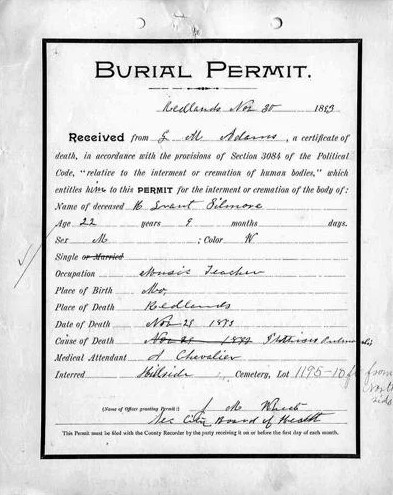
Before your ancestor could be buried, someone may have needed official permission to do it. A burial permit can connect the death to the funeral and burial, identifying where the person died, where the body was going, who handled the arrangements, and sometimes the cemetery where your ancestor was buried. It is an easily overlooked record that can help fill the gap between a death certificate and the final resting place.
Introduction
A burial permit is an official document authorizing the burial or other disposition of a deceased person.
Depending on the jurisdiction and time period, it may also be called a burial certificate, burial authorization, disposition permit, permit for burial, or burial-removal permit.
Burial permits became increasingly common as governments developed formal systems for registering deaths and regulating the disposition of human remains. Before burial could occur, a local official might require documentation that the death had been properly reported.
For genealogists, burial permits can provide another record of an ancestor’s death while also documenting something a death certificate may not fully explain:
What happened to the deceased after death?
What Might a Burial Permit Contain?
The information varies considerably by jurisdiction and period, but a burial permit may include:
- Name of the deceased
- Age or date of birth
- Sex
- Race
- Marital status
- Residence
- Date and place of death
- Cause of death
- Name of physician
- Date the permit was issued
- Date of burial
- Cemetery or place of burial
- Name of funeral director or undertaker
- Name of the person receiving or presenting the permit
- Permit or registration number
- Information concerning transportation or removal of the body
Some permits contain only a few pieces of information. Others closely resemble abbreviated death certificates.
The genealogical value often comes from combining the permit with the other records created during the death and burial process.
The Burial Permit Connects Two Events
A death and a burial are related events, but they are not the same event.
A death certificate primarily documents the death. A cemetery record primarily documents the burial.
A burial permit can provide the connection between them.
It may identify where the person died and where the body was authorized to be buried. That can be particularly useful when the death and burial occurred in different jurisdictions.
For example, an ancestor might have died in a hospital in one county but been buried in the family cemetery several counties away.
The burial permit may help explain how those two locations are connected.
The Cemetery Name Can Open Another Collection
If the burial permit identifies the cemetery, don’t stop with the permit.
Use the cemetery name to search for:
- Burial registers
- Interment cards
- Cemetery lot records
- Plot ownership records
- Grave-opening records
- Sexton’s records
- Gravestone inscriptions
- Cemetery maps
A cemetery record may provide a precise grave location or identify the owner of the family plot.
Then investigate the people buried nearby.
Other individuals in the same plot may be relatives whose connection to your ancestor was not previously known.
A single cemetery name on a burial permit can therefore lead to an entirely new group of records.
Look for the Undertaker or Funeral Home
Burial permits frequently identify the undertaker or funeral director responsible for handling the deceased.
That name is another research lead.
If the funeral home’s records survive, they may contain information about family members, funeral arrangements, cemetery location, church services, transportation, newspaper notices, and the person who paid for or arranged the funeral.
For older records, the named undertaker may no longer be in business. Use city directories, newspapers, local histories, and library catalogs to trace the business.
The original funeral home may have changed names, merged with another firm, or transferred its records to a successor business, library, archive, or historical society.
The undertaker’s name on the permit may be your doorway to a much more detailed funeral home record.
The Burial Date Is Not the Death Date
A burial permit may contain several dates.
These can include:
- Date of death
- Date the death was registered
- Date the permit was issued
- Date of burial
Do not assume they are interchangeable.
The burial could occur a day or several days after death. Transportation, weather, family arrangements, religious practices, or an official investigation could create a longer interval.
Read the headings carefully and record each date according to what it actually represents.
The interval itself can occasionally provide a clue. An unusually long delay between death and burial may justify looking for newspaper reports, a coroner’s investigation, transportation records, or other circumstances surrounding the death.
A Burial Permit May Help Solve a Cemetery Mystery
Sometimes you know when an ancestor died but cannot determine where that person was buried.
The death certificate may provide no cemetery, the obituary may be missing, and no gravestone may appear in an online cemetery database.
A burial permit can sometimes provide the missing information.
Even when it does not name a specific cemetery, it may identify the town or destination to which the body was sent.
That clue can narrow the search considerably.
If the cemetery named on the permit no longer exists or cannot be found under that name, investigate whether it was renamed, absorbed into another cemetery, abandoned, relocated, or known by several different names.
Burial Permits Can Reveal Transportation of the Body
A person did not necessarily remain in the community where they died.
Families frequently returned deceased relatives to hometowns or family burial grounds. Someone who died while traveling might be transported hundreds of miles for burial.
Moving a body from one jurisdiction to another could require additional authorization.
Depending on the location and period, you may encounter a burial-removal permit, transit permit, or another document authorizing transportation and final disposition.
If a burial permit identifies a destination far from the place of death, ask:
Why was the deceased taken there?
The answer may lead to an earlier residence, spouse, parents, extended family, religious congregation, or established family burial plot.
Burial Permits and Death Certificates May Share Information
Much of the information appearing on a burial permit may also appear on the death certificate.
That does not necessarily make the burial permit redundant.
First, the permit may provide burial or funeral information missing from the death certificate.
Second, one record may survive when the other does not.
But use caution when comparing the two.
Information on the permit may have been copied directly from the death certificate or another document. If so, matching information does not represent two independent sources confirming the same facts.
Conversely, discrepancies can be useful clues.
If the death certificate and burial permit identify different burial locations, dates, or other information, investigate why.
Don’t Confuse a Burial Permit with a Burial Record
A burial permit authorizes burial or disposition.
A cemetery burial or interment record documents the cemetery’s handling of the burial.
Those are different records created for different purposes.
Finding a burial permit does not necessarily mean that the burial occurred exactly as authorized. Plans could change, and errors could occur.
Whenever possible, follow the permit to the cemetery records and verify that the deceased was actually interred there.
The cemetery record may also provide details that the permit does not, including grave location, plot owner, and other people buried in the same lot.
Where Might You Find Burial Permits?
Because burial permits were often part of the local death-registration process, they may be found in:
- County or municipal government records
- Vital records collections
- Health department records
- County courthouse collections
- State or provincial archives
- Libraries and historical societies
- Funeral home collections
- Cemetery records
- Digitized genealogy collections
They may be cataloged under several different names, so search beyond the exact phrase burial permit.
Try terms such as:
- Burial Permits
- Permits for Burial
- Burial Certificates
- Burial and Removal Permits
- Disposition Permits
- Transit Permits
- Death and Burial Records
Some collections have been indexed or digitized, while others remain in local repositories.
Follow the Trail Created by the Permit
A burial permit is particularly useful because several pieces of information can point directly toward additional records.
Cemetery named? Search its interment and plot records.
Undertaker named? Look for surviving funeral home records.
Body transported elsewhere? Research the destination and possible family connections there.
Unusual delay before burial? Investigate newspapers and possible coroner’s records.
Permit or death registration number provided? Determine whether it leads to another government record.
The permit may be a modest document, but its research value can extend well beyond the information printed on the page.
Key Takeaways
- A burial permit authorizes the burial or other disposition of a deceased person.
- It may identify the deceased, death date, burial date, cemetery, undertaker, and other useful information.
- A burial permit can connect the place of death with the place of burial.
- A named cemetery can lead to interment registers, plot records, and additional family members.
- A named undertaker may lead to surviving funeral home records.
- Distinguish the death date, permit date, and burial date.
- Transportation to another community may reveal an earlier residence or family burial location.
- Burial permits and death certificates may share information derived from the same source.
- A burial permit is not the same as a cemetery burial record.
- Follow every cemetery, funeral home, destination, and reference number appearing on the permit to see what additional records survive.
Examples