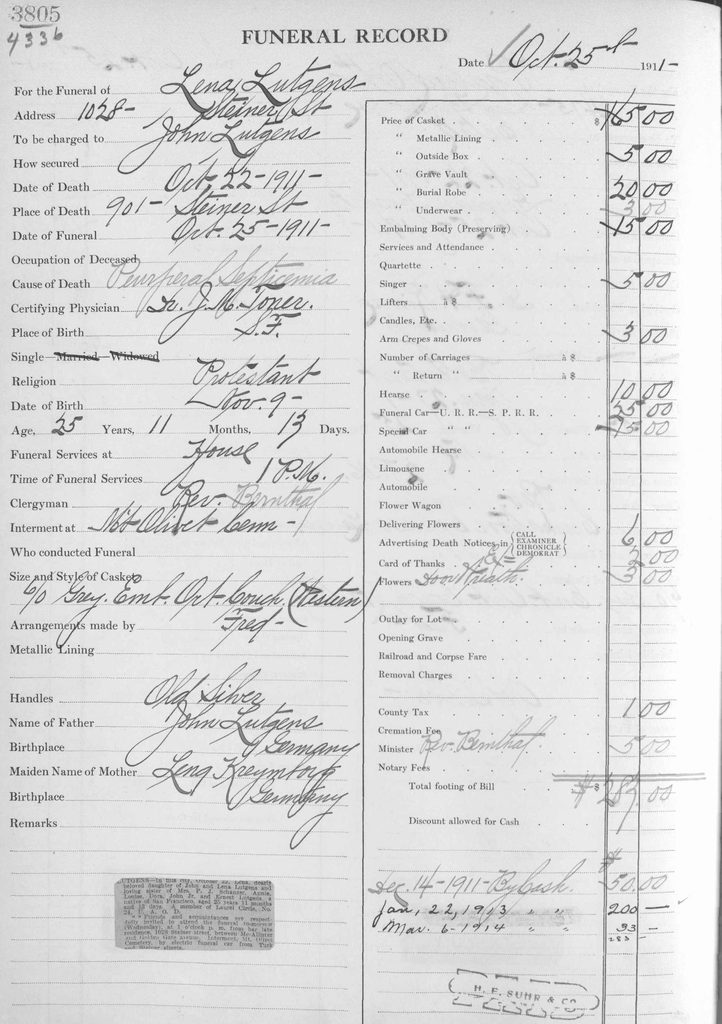
A death certificate tells you that your ancestor died. A funeral home record may tell you what happened next—and sometimes much more. Funeral homes collected information from families while arranging transportation, preparation of the body, funeral services, and burial. Their records may identify relatives, residences, cemeteries, churches, and other details that can lead your research in several new directions.
Introduction
Funeral home records are documents created by undertakers, morticians, and funeral homes while arranging services for the deceased and their family.
Depending on the time period and funeral home, these records might be called funeral home records, undertaker records, mortuary records, funeral registers, case files, or funeral director records.
They were created primarily for business and administrative purposes rather than genealogy. The funeral home needed information to prepare the deceased, arrange services and transportation, coordinate burial or cremation, and bill the responsible parties.
In doing so, funeral directors sometimes recorded a surprising amount of information about the deceased and their family.
A funeral home record can contain details that do not appear on the death certificate—and can point directly to several other records worth finding.
What Might a Funeral Home Record Contain?
The contents vary greatly according to the funeral home, period, and type of record.
A record may include:
- Full name of the deceased
- Date and place of death
- Age or date of birth
- Birthplace
- Residence
- Occupation
- Marital status
- Name of spouse
- Names of parents
- Parents’ birthplaces
- Name of the person providing the information
- Name of the person responsible for funeral arrangements
- Funeral date and location
- Name of the church or clergy member
- Cemetery and burial location
- Date of burial
- Details concerning transportation of the body
- Name of physician
- Cause of death
- Names of pallbearers
- Newspaper used for an obituary or death notice
- Financial charges for funeral services
Some funeral home records contain only basic information and an accounting of expenses. Others resemble detailed biographical summaries.
The Informant Can Be an Important Clue
Pay attention to the person who supplied the information or made the funeral arrangements.
That person might have been a spouse, child, sibling, parent, other relative, friend, neighbor, or another associate of the deceased.
The relationship may be explicitly stated—or it may not be.
Even when no relationship is given, the informant’s name can provide an important research lead.
For example, an unfamiliar person who arranged the funeral might turn out to be a married daughter whose surname you had not previously discovered.
As always, do not assume a relationship simply because someone appears in the record. Investigate the person and determine how they were connected to the deceased.
Funeral Home Records Can Lead You to the Cemetery
One of the most useful pieces of information in a funeral home record is often the place of burial.
The record may identify:
- Cemetery name
- Burial date
- Section or lot
- Transportation arrangements
- Cemetery charges
Once you know the cemetery, another group of records becomes available for investigation.
Look for cemetery burial registers, interment cards, plot ownership records, grave-opening records, and gravestone information.
A family cemetery plot may contain additional relatives whose connection to the deceased was not previously known.
The funeral home record may therefore be the bridge between the death record and an entire group of cemetery records.
Look for the Church and Clergy
A funeral record may identify the church where services were held or the clergy member who conducted them.
That information can provide evidence of a religious affiliation that was previously unknown.
Once a congregation is identified, investigate whether its records survive.
They may include baptism, marriage, membership, confirmation, burial, or other records involving the deceased and members of the family.
Even the name of the officiating minister can be useful. Researching where that person served at the time may help identify the church when the funeral home record does not name it.
Funeral Records May Point to an Obituary
Funeral homes frequently assisted families with newspaper death notices and obituaries.
A funeral record might identify the newspaper in which a notice was placed, record the cost of the announcement, or include a clipping or copy of the submitted text.
If a newspaper is named, search its issues around the date of death and funeral.
This can be especially valuable when the obituary is difficult to locate through a name search because the newspaper has not been indexed or the digitized text was poorly recognized.
The funeral home record may have just given you the newspaper and the narrow date range you need.
Transportation Records Can Reveal Another Location
Not everyone was buried where they died.
A person might die while traveling, in a hospital away from home, or after moving far from the community where the family maintained a burial plot.
Funeral homes sometimes arranged transportation of the deceased by railroad, hearse, ship, or other means.
A record might therefore identify another city, county, state, or even country where the body was sent for burial.
This information can help explain why you cannot find a burial near the place of death.
It may also reveal an important connection to an earlier family residence.
If the body was transported elsewhere for burial, investigate why that particular destination was chosen.
Parents, grandparents, a spouse, or other relatives may already have been buried there.
The Financial Details May Be Genealogically Useful
A funeral bill may initially look like nothing more than a list of expenses.
Don’t dismiss it too quickly.
The person billed for the funeral may have been a relative or other person closely associated with the deceased. Charges may identify the cemetery, newspaper, clergy member, transportation company, or other organizations involved in the funeral.
Payment information might also connect the funeral with an estate, insurance policy, fraternal organization, veterans’ organization, employer, or government benefit.
The dollars and cents themselves may not matter to your research.
The names and organizations attached to those expenses might.
Funeral Home Records and Death Certificates May Overlap
Funeral directors often participated in the process of completing and filing death certificates.
As a result, information in a funeral home record and a death certificate may be very similar.
That does not necessarily mean the two records independently confirm one another.
The same person may have supplied the family information for both records, or information may have been copied from one document to another.
On the other hand, differences between the two can be useful.
A funeral home record might provide a mother’s maiden name omitted from the death certificate, identify a cemetery more precisely, or name the person responsible for the arrangements.
When both records survive, compare them carefully rather than assuming they contain identical information.
Funeral Home Records Can Survive When the Funeral Home Does Not
One of the biggest challenges with funeral home records is determining where old records went.
A funeral home that served your ancestor’s family 80 or 100 years ago may no longer exist.
But its records may have survived.
When funeral homes close, merge, or are purchased, their older records sometimes pass to:
- A successor funeral home
- A local library
- A historical or genealogical society
- A university or special collections library
- A local or state archive
Old funeral homes also frequently changed names as ownership changed.
A business operating as the Smith Funeral Home in 1925 might later have become Smith & Jones Funeral Home and eventually been acquired by another company entirely.
Researching the history of the funeral home itself can therefore be necessary to locate its records today.
How Do You Identify the Funeral Home?
Sometimes you already know which funeral home handled the arrangements.
If you don’t, several other sources may identify it.
Check:
- Death certificates
- Obituaries and death notices
- Funeral announcements
- Cemetery records
- Burial permits
- Church records
- City directories
- Newspaper advertisements
Newspaper obituaries often state that the deceased was “at” a particular funeral home or that services would be conducted from its chapel.
City directories can then help establish the funeral home’s address and trace changes in its name or ownership.
Where Might You Find Funeral Home Records?
Funeral home records are more scattered than government vital records because they were created by private businesses.
Possible repositories include:
- The funeral home that created them
- A successor funeral home
- Local libraries
- County and regional archives
- Historical societies
- Genealogical societies
- University manuscript collections
- State archives
- Digitized genealogy collections
Some funeral home registers have been indexed or digitized. Many others have not.
If you cannot find the records online, search library and archival catalogs using the funeral home’s name as well as terms such as funeral home records, undertaker records, mortuary records, and funeral registers.
Local genealogical and historical societies can be particularly useful because they may know what happened to the records of funeral homes that disappeared decades ago.
Don’t Stop with the Funeral Home Record
A good funeral home record is a research roadmap.
One entry might send you to several additional sources:
Cemetery named? Look for burial and plot records.
Church or clergy named? Search the congregation’s records.
Newspaper named? Look for the obituary and funeral announcements.
Body transported elsewhere? Research the destination and family connections there.
Previously unknown relative named? Research that person.
Funeral paid by an estate or organization? Investigate the associated probate, insurance, military, fraternal, or other records.
That is what makes funeral home records particularly useful.
They don’t merely document what happened after a death. They can tell you where to look next.
Key Takeaways
- Funeral home records were created as part of arranging funerals, burials, cremations, and related services.
- They may contain information about the deceased, spouse, parents, relatives, residence, occupation, and birthplace.
- The person who supplied information or arranged the funeral may provide an important family clue.
- Cemetery information can lead to burial registers, interment cards, plot records, and additional relatives.
- Church and clergy information may lead to religious records involving the family.
- A named newspaper can help locate an obituary or death notice.
- Transportation information may reveal that the deceased was returned to another community for burial.
- Even financial entries can identify relatives, organizations, and additional records.
- Information shared by a funeral home record and death certificate may have originated from the same source, so the two should not automatically be treated as independent evidence.
- If an old funeral home no longer exists, investigate successor businesses, libraries, archives, and local historical or genealogical societies for surviving records.
Examples